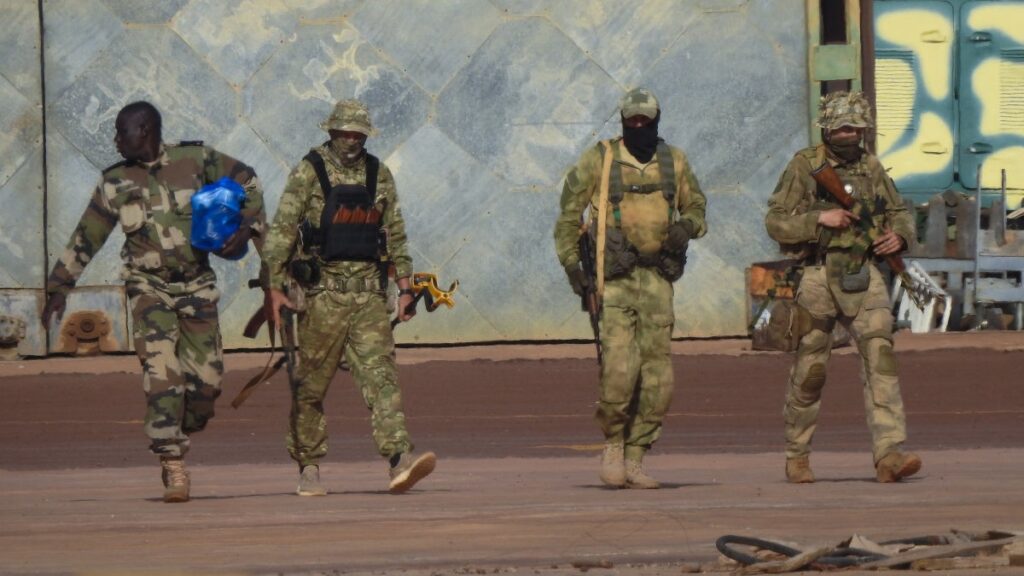
- Since early 2025, the Malian military and the Russian-backed Wagner Group have been responsible for numerous summary executions and forced disappearances targeting Peul men.
- Security forces and Wagner mercenaries frequently accuse the Peul community of collaborating with Islamist militants fighting for territorial control.
- The African Union is being called upon to intensify its intervention in Mali to safeguard civilians and advocate for transparent investigations into these atrocities.
The Malian armed forces and their Russian allies, the Wagner Group, have carried out dozens of extrajudicial killings and disappearances of Peul civilians since January 2025, according to a recent report by Human Rights Watch.
These joint operations, aimed at suppressing Al-Qaeda-linked groups like the GSIM (Jama’at Nusrat al-Islam wa al-Muslimeen), have reportedly resulted in at least 12 summary executions and the disappearance of 81 Peul men. Witnesses state that the victims are often targeted solely based on their ethnicity and perceived ties to insurgent groups.
“The Malian military junta holds ultimate responsibility for the grave abuses committed by its soldiers and the allied Wagner Group,” stated Ilaria Allegrozzi, senior Sahel researcher at Human Rights Watch. “The authorities must immediately cease these violations, account for the missing, and ensure those responsible face justice.”
Human Rights Watch is urging the African Union (UA) to pressure the Malian government to investigate these allegations, provide reparations to affected families, and conduct fair trials for the perpetrators.
Field research conducted between February and May 2025 involved interviews with 29 individuals, including survivors and community leaders. Despite formal inquiries sent to the Malian Ministries of Justice and Defense in June, no official response has been provided.
Widespread atrocities across Malian regions
In the Kayes region, reports corroborated by the United Nations indicate that 65 Peul cattle traders from Sebabougou were executed in April after being detained by the military and Wagner fighters. This pattern of violence stems from a long-standing and dangerous conflation of the Peul community with Islamist combatants by successive Malian governments.
On March 30, in the Segou region, at least six Peul civilians were killed in the village of Belidanédji while attempting to hide from a military sweep. One witness recounted seeing his friend shot in the chest at close range. Similarly, on March 19 in Kourma, 12 men were violently detained and loaded into trucks; their families have received no information regarding their whereabouts since.
The transition from Wagner to Africa Corps
Human Rights Watch has been documenting systemic abuses by Malian and Russian forces since 2021. While the Wagner Group recently announced its withdrawal from Mali, they are being replaced by Africa Corps, a paramilitary organization under the direct oversight of the Russian government. This shift comes amid a surge in attacks by Tuareg separatists and Islamist groups, resulting in significant casualties for both Malian and Russian personnel.
The protection of civilians is increasingly precarious following Mali’s exit from the ECOWAS regional bloc and the departure of United Nations peacekeepers in 2023. These exits have stripped victims of vital legal recourse and international monitoring.
Legal implications and war crimes
Under international humanitarian law, specifically Common Article 3 of the 1949 Geneva Conventions, the torture and murder of detainees are strictly prohibited. These acts, alongside the documented enforced disappearances, may constitute war crimes. As a party to the Rome Statute, Mali remains under the jurisdiction of the International Criminal Court, which has been investigating crimes in the country since 2012.
“Commanders in Mali and Russia must realize they can be held accountable for the actions of their troops,” Allegrozzi warned. “Whether through the African Union or the International Criminal Court, justice will eventually catch up with those linked to these atrocities.”
Detailed findings of military operations
The conflict in Mali and Russian involvement
Since 2012, Mali has been embroiled in a conflict with groups like the GSIM and the Islamic State, leading to thousands of deaths and the displacement of 350,000 people. The junta that seized power in 2021 has increasingly relied on Russian mercenaries for counter-insurgency, despite official denials regarding the presence of the Wagner Group.
Abuses in the Douentza region
On January 23, Malian forces entered the village of Kobou. During the raid, three Peul men were executed, and at least 30 homes were burned. Satellite imagery confirms widespread destruction in the village. One survivor described finding his elderly father’s body with his hands tied and a blindfold made from his turban.
Violence in the Timbuktu and Kayes regions
In Farana on March 26, four men were abducted by soldiers near a riverbank. Witnesses discovered bloodstains and human remains at the site, though the bodies were removed by the military. In Sebabougou on April 12, a mass arrest of approximately 100 Peul men took place. While 25 were eventually released from a Bamako prison, the remains of dozens of others were found in decomposing piles near the Kwala military camp.
Raids in the Segou region
On May 14, in the village of Sikere, Malian troops and Wagner fighters, supported by Dozo militiamen, executed four Peul men after accusing them of training as jihadists. In Belidanédji on March 30, six civilians were killed during a sweep, and others were reportedly tortured in shipping containers at the Molodo military base.