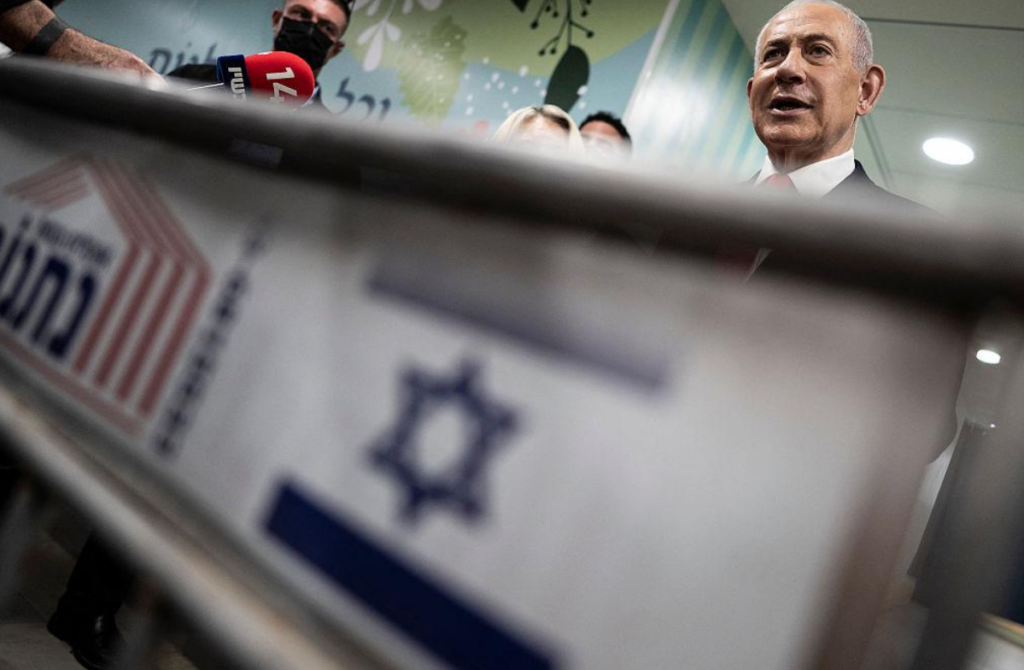
As Israel grapples with the aftermath of its 2026 legislative elections, Prime Minister Benjamin Netanyahu finds himself in an unfamiliar position: leading without a viable parliamentary majority. With just 53 seats in a 120-seat Knesset, his long-standing dominance has been challenged by an opposition bloc holding 48 seats and Arab-majority parties securing a record 19 seats. The outcome has not only reshaped domestic politics but also triggered ripple effects across the Middle East, from Gaza to Iran, Lebanon, and beyond.
An electoral success that fails to secure power
Benjamin Netanyahu’s Likud party remains the largest faction in the Knesset with 27 seats, yet this alone does not grant him the 61-seat majority needed to govern. The opposition, led by former military chief Gadi Eisenkot, holds 48 seats, while Arab parties such as the Joint List and Ra’am have strengthened their position to an unprecedented 19 seats. The fragmented parliament reflects deep societal divisions over governance, security, and national identity.
This electoral outcome marks a clear erosion of Netanyahu’s political influence, as his bloc has shrunk from 68 to 53 seats compared to the previous Knesset. The results underscore a broader realignment in Israeli politics, shaped by years of internal strife, ongoing conflicts, and widespread public discontent with government policies.
Arab parties hold the balance of power
The increased presence of Arab lawmakers introduces a critical variable into coalition negotiations. While their support could theoretically help form a majority, ideological and political barriers complicate potential alliances. Some Zionist parties remain reluctant to collaborate with Arab factions, leaving the path to governance uncertain. Possible scenarios include a national unity government, a minority coalition, or—if talks collapse—another round of elections.
Gaza: the next government’s immediate challenge
The humanitarian and security crisis in Gaza remains one of the most pressing issues facing Israel. Reconstruction efforts, border security, and the future of Palestinian governance will demand urgent attention from the next administration, regardless of its composition.
If Netanyahu manages to retain power, continuity in Israel’s hardline security policies toward Hamas and Palestinian territories is likely. His coalition partners, including nationalist and religious factions, advocate for firm stances on territorial disputes and military deterrence. However, any power shift could signal adjustments in diplomacy, potentially altering Israel’s relationships with international partners.
For Palestinians, the election results offer no immediate relief. The trajectory of policies on Gaza and the West Bank will depend on the alliances formed in the Knesset, leaving their future uncertain in the near term.
The Iran and Hezbollah factor: regional security in the balance
Beyond domestic politics, the election outcome has significant implications for Israel’s strategic posture in the region. Tehran’s nuclear ambitions, ballistic missile capabilities, and support for armed groups remain top priorities for Israeli security officials. A weakened government may struggle to maintain a cohesive stance on these threats, though national security concerns typically enjoy broad consensus in Israeli politics.
Lebanon’s Hezbollah poses another critical challenge. Any escalation in cross-border tensions could have severe humanitarian and economic repercussions, further destabilizing an already fragile regional environment. Meanwhile, developments in Syria continue to be closely monitored, as shifts in power dynamics along Israel’s northern borders could alter the security calculus.
The view from Washington and Arab capitals
The Biden administration will be closely watching Israel’s government formation process. While the U.S.-Israel alliance remains strong, disagreements over Gaza policy, military operations, and regional de-escalation efforts could strain relations. The election’s outcome may force Washington to recalibrate its approach to diplomacy in the Levant.
Arab governments, including Saudi Arabia, Egypt, Jordan, and the UAE, are also evaluating the situation with caution. For Riyadh, normalization with Israel remains a priority, but it is contingent on progress in Palestinian statehood and regional stability. A divided Israeli government may slow diplomatic momentum, while a coalition open to negotiations could present new opportunities for dialogue—though substantial progress remains unlikely without broader concessions.
A fragmented parliament and the future of the Middle East
The 2026 elections have laid bare Israel’s deep political fractures, exposing divisions over security, governance, and national identity. The rise of Arab representation, the erosion of Netanyahu’s majority, and the absence of a clear path to governance have set the stage for a precarious political period.
Three potential outcomes loom: Netanyahu retains power through new alliances, an alternative government is formed, or another round of elections is held if negotiations fail. Each scenario carries significant implications for the Middle East’s geopolitical landscape, influencing everything from Gaza’s future to Israel’s stance on Iran and its relationships with Arab neighbors.
In the end, Netanyahu has secured a narrow lead—but not the mandate to govern unilaterally. In a region where Israel’s decisions reverberate globally, this fragile victory may herald a new era of uncertainty, with consequences that extend far beyond its borders.