
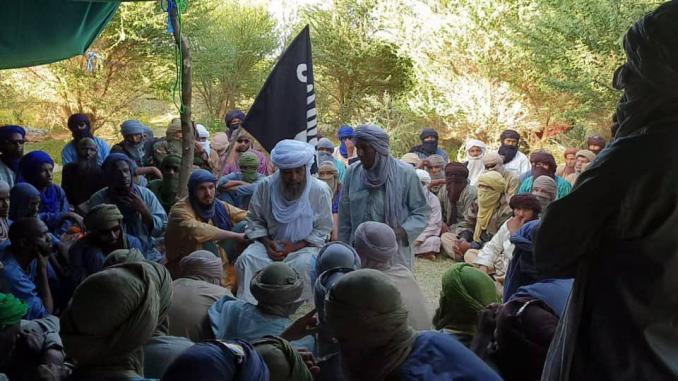
JNIM’s growing grip on Mali raises regional alarm
Attacks claimed by the Support Group for Islam and Muslims (JNIM), an Al-Qaeda affiliate, continue to escalate across Mali despite intensified military operations by national forces and international allies. Ambushes targeting government troops, raids on military outposts, and systematic blockades on key transport routes reveal the group’s expanding operational reach across multiple regions.
 Iyad Ag Ghali, JNIM leader
Anchoring strategy, not just conquest
Recent developments paint a concerning picture. On May 21, 2026, JNIM militants launched coordinated attacks on five villages in the Bandiagara region of central Mali, leaving authorities scrambling for answers. While Bamako’s military leadership increasingly focuses on urban security, the group exploits governance vacuums in rural areas by establishing parallel systems of control.
Rather than operating purely as a clandestine force, JNIM has developed a sophisticated implantation strategy. The organization deliberately leverages local conflicts, tribal divisions, and the absence of state services to build influence networks. In some areas, it imposes its own legal structures, taxation systems, and even dispute resolution mechanisms—essentially functioning as a shadow government where the state has failed.
This approach explains why military solutions alone prove insufficient. Operations may temporarily reclaim territory, but without restoring administrative, judicial, or economic functions, stability remains elusive.
Mali’s security turning point
The transitional government has pivoted toward military sovereignty since the withdrawal of French forces and the deepening partnership with Russia. While officials frame this as a break from Western security dependence, ground realities tell another story. Violence persists, armed groups maintain mobility, and reports continue to surface regarding alleged human rights violations involving both national troops and allied mercenaries.
Bamako consistently denies these accusations, dismissing them as foreign smear campaigns. Yet this polarization further narrows political mediation opportunities.
Sahel crisis fuels geopolitical rivalries
The Malian crisis is no longer isolated—it has become a chessboard for global powers. Russia, Turkey, Gulf states, Western nations, and regional actors all vie for influence, while jihadist groups exploit the fragmentation of regional cooperation and collapsing border security.
The gravest risk? Normalization of chronic insecurity. Vast territories now exist in a precarious limbo—neither fully controlled by the state nor by armed factions. A critical question looms: How far will this instability spread? With Bamako’s reliance on the Africa Corps mercenary group potentially wavering, the country faces an uncertain security horizon.
Key takeaways
- JNIM’s territorial implantation strategy outpaces military containment efforts
- Bamako’s shift toward Russian military partnerships hasn’t translated to improved security
- Geopolitical competition in the Sahel exacerbates existing fragilities
- Without comprehensive governance restoration, Mali risks permanent fragmentation



More Stories
Niger: Tiani faces fallout from special forces anger after Russian intervention
Crisis in Niger, IMF agreement in Sénégal, and Moroccan elections: Five essential stories
RDC-Israël : un rapprochement aux enjeux multiples