
On November 25, 1998, the French football landscape witnessed a historic moment. RC Lens, led by coach Daniel Leclercq, etched its name into the annals of the sport by securing a landmark 1-0 victory over Arsenal at Wembley Stadium. This triumph marked the first time a French club had claimed a win on English soil, a feat that resonated deeply within the football community.
Guillaume Warmuz, the former goalkeeper of Les Sang et Or, vividly remembers the evening that unfolded in the iconic London venue. Now 55, Warmuz reflects on the emotional and tactical journey that defined this unforgettable night.
From arrival to mindset: embracing the moment
Upon arriving in London, the Lens players immediately immersed themselves in the atmosphere of the English capital. Warmuz recalls the team’s mindset: “We wanted to savor every second of this unique opportunity. Playing at Wembley, especially against a team like Arsenal—England’s reigning champions—was a privilege we refused to waste.”
The squad viewed the match as the ultimate reward for their hard-earned French league title. The pressure was immense, but so was their determination to leave their mark. Leclercq, known affectionately as “Le Druide,” urged his players to approach the game with confidence and aggression, reminding them: “You’ve earned this. Now go out there and play without hesitation.”
The night before the match, the team trained with a singular focus. Warmuz describes the palpable excitement: “We didn’t want to leave the pitch. The energy was electric, and we all felt something special was about to happen.” As their bus approached Wembley, the players sensed they were stepping into footballing lore.
Tactical innovation: a bold defensive shift
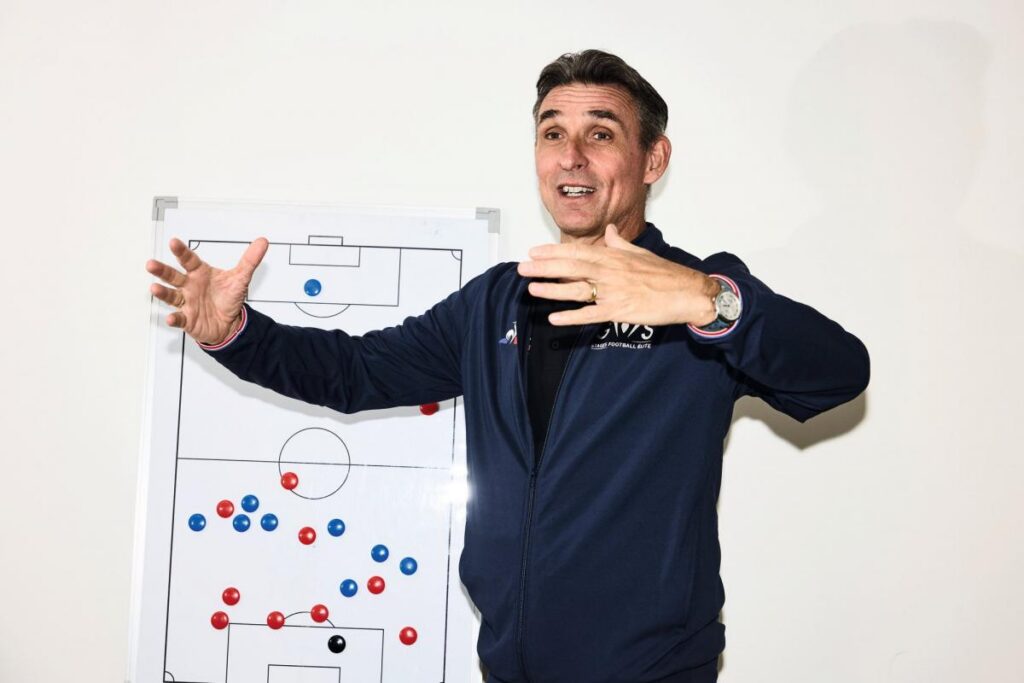
The Lens defensive strategy was nothing short of revolutionary. Traditionally a back-three formation, the team transitioned to a four-man defense, enabling them to play higher up the pitch. This tactical adjustment was designed to disrupt Arsenal’s rhythm and apply relentless pressure.
Frédéric Déhu, the team’s captain and defensive anchor, took on a more expansive role. Warmuz explains: “Déhu’s role was pivotal. He covered almost the entire width of the pitch, using his anticipation and positioning to neutralize threats. Cyrille Magnier focused on the right flank, while Déhu dominated the left.”
The midfield trio of Alex Nyarko, Cyril Rool, and Mickaël Debève operated with distinct roles. Nyarko maintained a central position, while Rool and Debève pushed forward aggressively. This tactical split—five players in the defensive block and five in the offensive—created a dynamic 4-3-1-2 formation. Up front, Vladimir Smicer was positioned just behind the strikers, Tony Vairelles and Pascal Nouma, who played with remarkable freedom.
First-half drama: a match of high stakes
The opening minutes set the tone for a fiercely contested encounter. Warmuz recalls: “Within three minutes, we faced our first real threat. A cross reached Christopher Wreh at the edge of the box, but he miscontrolled the ball, missing a golden opportunity.”
Warmuz’s own performance was stellar. He made a crucial intervention against Marc Overmars in the 6th minute, advancing high to intercept the Dutch winger’s cross. The match’s defining moment came in the 31st minute when Nicolas Anelka broke free in the Lens defensive line. Warmuz sprinted to close him down: “I knew I had to anticipate his move. If I played the ball, I’d be exposed. I executed a perfectly timed tackle, taking the ball from his feet just in time.”
The first half ended 0-0, but the intensity never waned. Arsenal’s players, visibly frustrated, were given a stern talking-to by Arsène Wenger during halftime. Warmuz remembers: “We left the pitch calm and composed, but determined to turn the screw. The adjustments we made were minor—just enough to tighten our shape and reduce gaps.”
Second-half dominance: seizing the moment
The second half saw Lens ramp up the pressure. Their relentless pressing forced Arsenal into mistakes, but the best chance fell to Pascal Nouma in the 52nd minute. Warmuz reflects: “A Smicer cross reached Nouma inside the box, but he sent it over the bar. It was the best chance of the match, and we all felt the sting of missing it.”
Substitute Wagneau Éloi injected fresh energy into the attack, maintaining pressure on Arsenal’s aging backline. Warmuz recalls: “The physical toll on our opponents was evident. They were exhausted, and their aggression was a sign of desperation.”
The defining moment arrived in the 73rd minute. A quick counterattack saw Vairelles dispossess an Arsenal player, and Éloi’s cross found Smicer. The Czech midfielder’s cross-trap was met by Debève, who capitalized at the back post. Warmuz describes the scene: “The goal was a result of our tactical flexibility. Smicer initiated the play, Vairelles made a darting run, and Debève arrived unmarked to finish it off.”The final 25 minutes were a testament to Lens’s resilience. Arsenal launched long balls into the box, but Warmuz remained composed. In the 89th minute, Overmars broke free, only for Warmuz to advance and force the Dutchman into a rushed lob, which he cleared.
The final whistle confirmed what no French club had achieved before: a victory at Wembley. Warmuz reflects: “We controlled the game from start to finish. I made no technical errors, stayed focused, and kept a clean sheet. That night, we wrote our names into history.”
A moment frozen in time: the aftermath
As the players left the pitch, a wave of euphoria swept over them. Warmuz recalls the post-match atmosphere: “No one seemed tired. The adrenaline kept us going, even as we prepared to face the media.”
He describes the quiet moment of reflection that followed: “I took my time in the shower, savoring the victory. When I stepped back onto the pitch alone, the stadium lights dimmed one by one. I stood there in the near-darkness, surrounded by the echoes of our chants and the weight of what we’d achieved.”
With tears in his eyes, Warmuz whispered: “Not only did I win at Wembley, but I was the first to do it. For a kid from Blanzy, this was beyond anything I could have imagined.” The victory against Arsenal in 1998 remains a defining chapter in French football history. It was a night when ambition, tactical brilliance, and sheer willpower combined to create an unforgettable legacy.


More Stories
Niger: Tiani faces fallout from special forces anger after Russian intervention
Crisis in Niger, IMF agreement in Sénégal, and Moroccan elections: Five essential stories
RDC-Israël : un rapprochement aux enjeux multiples