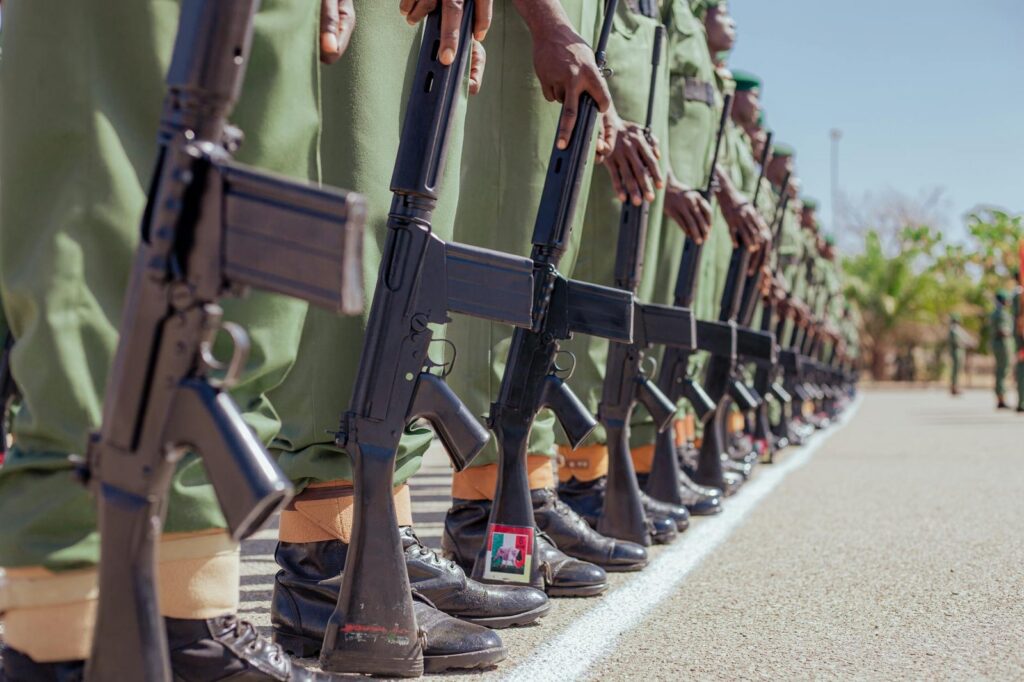
Bamako is tightening its grip on national territory. Mali’s transitional authorities have officially banned civilian access to thirty-nine military interest zones spread across the country. The measure, presented as a way to protect ongoing operations, comes as the Malian Armed Forces (FAMa) ramp up deployments against terrorist armed groups active in the centre and north. It fits into a strategy of securing sites considered critical for conducting asymmetric warfare.
A military map being redrawn
The designation of thirty-nine military interest zones is a far-reaching administrative act. Beyond classic installations such as barracks, military airports or logistics depots, the perimeter likely includes operational corridors, forward bases and sites where recently acquired air and ground assets are deployed. Mali has indeed strengthened its arsenal since 2022, notably with aircraft and drones aimed at regaining tactical initiative. Protecting these sensitive assets has become a priority for the general staff.
The measure also reflects a desire to compartmentalise information. In a conflict where human intelligence and observation of military movements are strategic resources for adversary groups, restricting movement around key sites responds to a counter-intelligence logic. The authorities seek to limit information leaks that could fuel complex attacks on military installations, such as those that have hit several garrisons in recent years.
A political signal to the population and partners
The announcement comes amid a context where the military-led transition is consolidating its control over the security apparatus. Since the withdrawal of the United Nations Multidimensional Integrated Stabilization Mission in Mali (MINUSMA) completed at the end of 2023 and the break with the French Barkhane force, Bamako claims full operational sovereignty. The country now relies on its own capabilities, bolstered by cooperation with Russian partners and through the Alliance of Sahel States (AES) framework, which brings together Mali, Burkina Faso and Niger.
For civilians, the measure will have concrete consequences. Restricted access to certain zones can disrupt trade circuits, pastoral movements and agricultural activities, especially in regions where military installations border inhabited areas. Humanitarian organisations, already facing a degraded security environment, will have to operate within an even more constrained framework. The question of prior information to affected communities and precise delimitation of perimeters arises sharply.
A Sahel under prolonged tension
Bamako’s move is part of a regional dynamic. Burkina Faso and Niger, partners within the AES, have also taken steps to protect their military infrastructure and regulate movement in sensitive areas. The convergence of security doctrines among the three states reflects a shared understanding of the threat and a desire to harmonise operational responses. This coordination is gradually extending to pooling resources and projecting a joint force announced by the bloc’s heads of state.
Nevertheless, the sanctuary strategy raises medium-term questions. When military interest zones multiply, they can freeze parts of the territory into exceptional status, complicating the return of civilian administration and the resumption of economic activities. The balance between security imperatives and continuity of national life becomes a delicate exercise, particularly in a country where nearly two-thirds of the territory has been affected to varying degrees by insecurity since 2012.
The evolution of this system will be monitored by chancelleries in the sub-region and by international donors, who are attentive to humanitarian access conditions and respect for populations’ rights. The concrete management of these thirty-nine zones, their exact perimeter and the penalties for violations will shape perception of the measure, both domestically and continentally.