
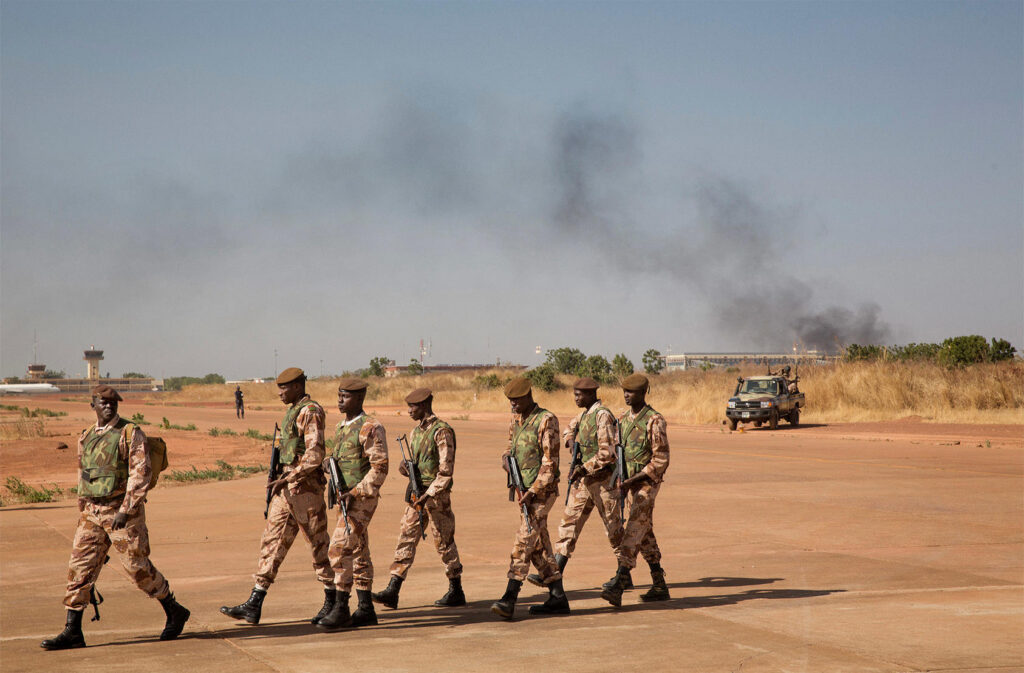
Mali has descended back into intense armed conflict following a period of extreme instability and consecutive coups in 2020 and 2021. On Saturday, April 25, a massive and synchronized operation was launched by the Front de libération de l’Azawad (FLA) in conjunction with the Al-Qaeda-affiliated Groupe de soutien à l’islam et aux musulmans (JNIM). The offensive targeted seven strategic locations: the capital Bamako and its neighboring town of Kati; the central towns of Konna, Mopti, and Sévaré; and the northern hubs of Gao and Kidal. Notably, Kidal has reportedly fallen entirely under the control of the insurgents.
The attackers employed a sophisticated array of tactics, including suicide vehicle-borne explosives, kamikaze drones, and direct ground assaults. Reports indicate the strikes began early Saturday morning, with the JNIM and FLA claiming responsibility for hitting high-profile targets such as the presidential residence, the Ministry of Defense, and the Modibo Keita International Airport in Bamako, alongside various military installations in the north and center of the country.
The transitional government characterized the events as a “complex and coordinated” assault. While officials initially reported 16 injuries and claimed the situation was under control, a 72-hour curfew was imposed on Bamako, and the international airport remained shut. General Oumar Diarra, the Chief of General Staff, described the violence as part of a wider “destabilization plan” orchestrated by both internal and external actors. He stated that the Malian Armed Forces (FAMA) had neutralized over 200 militants during their response. Regarding the loss of Kidal, Diarra explained that the military was executing a “redeployment” to Anefis to maintain operational flexibility while staying active within the region.

The Russian Africa Corps, a paramilitary unit under the Russian Ministry of Defense that replaced Wagner Group operations, confirmed its withdrawal from Kidal alongside Malian troops. They described this as a joint decision with Bamako’s leadership. The Russian force claimed to have played a vital role in repelling the weekend’s attacks, stating they prevented a major coup attempt allegedly supported by Western intelligence and European mercenaries. According to their reports, between 10,000 and 12,000 fighters were involved in the multi-city offensive. The Africa Corps stated they secured the presidential palace and other strategic points, though they acknowledged casualties and the need for medical evacuations.
The conflict has resulted in significant leadership losses for the junta. Defense Minister Sadio Camara was killed during a suicide attack on his home in Kati. The blast also killed one of his wives, two children, and several civilians. Camara was a central figure in the military transition and a key architect of Mali’s shift toward Moscow. His death marks a major blow to the current administration. Furthermore, Modibo Koné, the head of the National State Security Agency, was wounded by gunfire, while President Assimi Goïta was successfully evacuated from the Kati military base to a secure location.
This massive offensive highlights a growing alliance between Touareg separatists and jihadist groups. The FLA, recently formed from several movements under the leadership of Alghabass Ag Intalla, has formally abandoned the 2015 Algiers peace accords. While the Touaregs seek autonomy for the Azawad region and the JNIM aims for an Islamic state, they have found common ground against the Malian military and Russian paramilitaries. This tactical cooperation intensified following the withdrawal of UN peacekeepers (MINUSMA) in late 2023.
Geopolitical tensions are also rising, with allegations that the rebels are using modern warfare techniques, including FPV drones, purportedly learned from Ukrainian intelligence. While Ukraine denies providing direct support to groups classified as terrorists, analysts suggest Kiev may be seeking to pressure Russian interests in Africa. This has already led to a formal diplomatic break between Mali and Ukraine. The current situation suggests a highly coordinated effort that has significantly stretched the defensive capabilities of the Malian state and its Russian allies.


More Stories
Niger: Tiani faces fallout from special forces anger after Russian intervention
Crisis in Niger, IMF agreement in Sénégal, and Moroccan elections: Five essential stories
RDC-Israël : un rapprochement aux enjeux multiples