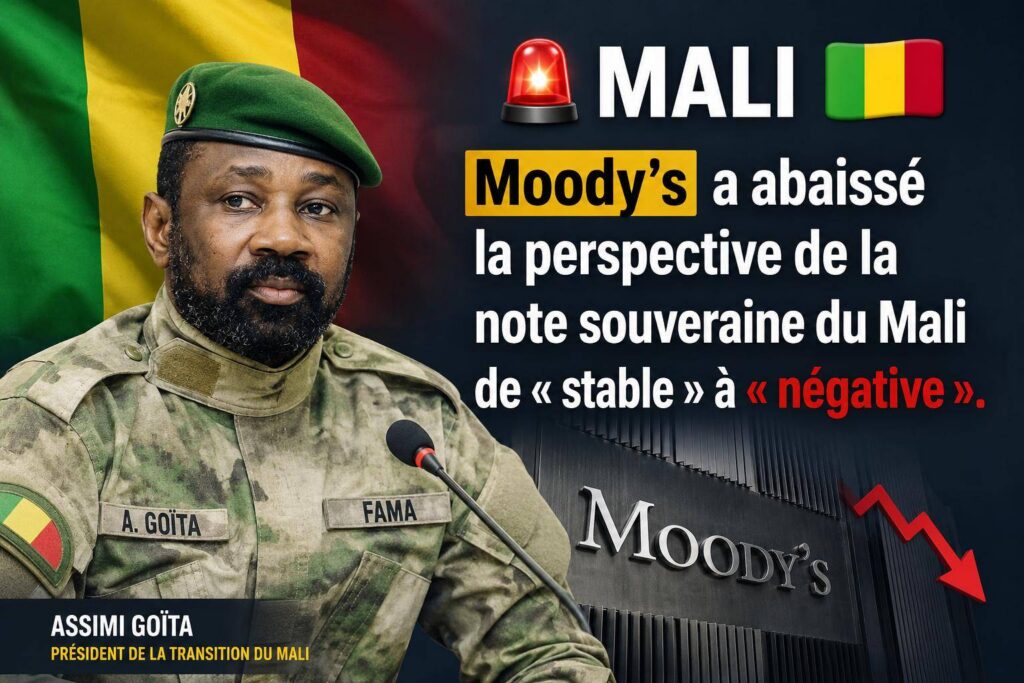
In a significant financial setback, Moody’s has downgraded Mali’s sovereign credit outlook from stable to negative, while retaining its Caa2 rating. This move underscores the growing concerns around the country’s economic stability, driven by escalating security threats, tightening financing conditions in the regional market, and lingering political uncertainties. For Mali, where development hinges on foreign and domestic investment, this shift sends a stark signal to global and regional investors, complicating efforts to secure essential capital.
Why Moody’s Warning Matters for Mali’s Economy
The revised outlook from Moody’s acts as a barometer for investor sentiment. By shifting the outlook to negative, the ratings agency signals a heightened risk of further downgrades in the near to medium term. The Caa2 rating itself places Mali’s sovereign debt in the speculative, high-risk category, making borrowing more costly and less attractive to international lenders.
A security crisis that stifles growth
The primary concern cited by Moody’s is Mali’s deteriorating security situation. Despite ongoing military restructuring and counterterrorism operations, persistent violence and instability continue to cripple economic activity. Attacks disrupt supply chains, undermine agriculture, and weaken state revenue collection in key regions, leaving local economies vulnerable and public finances strained.
The squeeze on regional financing
Beyond security, Mali’s financial challenges have intensified. With traditional external funding sources restricted due to diplomatic and institutional ruptures, the government has increasingly relied on the West African Economic and Monetary Union (UEMOA) bond market. However, this regional market has grown less accommodating. The West African Central Bank (BCEAO) has raised interest rates to curb inflation, pushing up borrowing costs for member states—including Mali. Recent sovereign bond issuances have seen lukewarm investor demand, reflecting growing caution among regional banks and financial institutions wary of Mali’s credit risk. This tightening of credit conditions limits the government’s ability to fund critical infrastructure and social programs.
Political uncertainty clouds investor confidence
Moody’s assessment also highlights deep-seated political instability. Mali remains in a prolonged transition period, with repeated delays in elections and uncertainty over the restoration of constitutional order. Such delays have eroded trust among multilateral partners and development financiers, further constraining external support.
The recent withdrawal of Mali from the Economic Community of West African States (ECOWAS), formalized through the Alliance of Sahel States (AES) alongside Niger and Burkina Faso, has reshaped regional dynamics. While authorities frame this as a step toward greater sovereignty and new strategic alliances, global financial markets view it as a source of legal and commercial unpredictability. Investors fear potential future trade barriers or restrictions on capital flows within the subregion, adding another layer of risk to Mali’s economic outlook.
Real-world consequences for Mali’s citizens
The implications of Moody’s downgrade extend far beyond financial markets. Higher borrowing costs for the state mean reduced public spending on essential services such as healthcare, education, and food subsidies. For businesses, the ripple effects are immediate and severe. Local banks, heavily exposed to government debt, have become more hesitant to extend credit to private enterprises. Small and medium-sized businesses—driving the national economy—face tighter lending conditions, which slows investment, job creation, and economic diversification.
Can Mali recover its economic footing?
Despite these challenges, Mali’s economy has shown remarkable resilience, particularly in the mining and cotton sectors. Yet, in today’s interconnected global financial system, resilience alone cannot shield the country from rating agencies’ scrutiny. To stabilize its economic outlook and restore market confidence, Mali must navigate a delicate balancing act: restoring security across its territory, clarifying its political transition roadmap, and demonstrating rigorous fiscal discipline. Only then can it begin to rebuild trust with regional investors and lay the groundwork for sustainable growth.