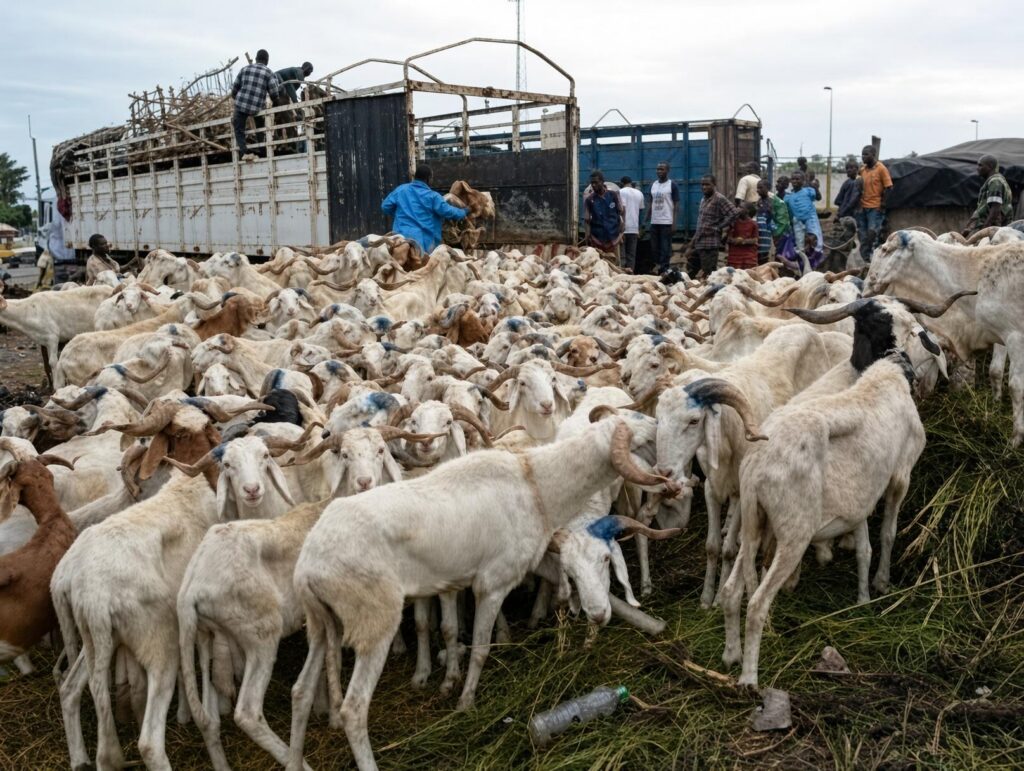
Government’s rigid policies turn livestock crisis into a national economic strain
With rising meat prices fueling public anger and no clear plan to stabilize the economy, Mali’s government is shifting blame onto private entrepreneurs. In response to soaring local meat prices, the Ministry of Industry and Commerce is preparing to implement a six-month ban on livestock exports—renewable indefinitely. Promoted as a measure to protect household purchasing power, this heavy-handed policy strikes at the heart of business freedom and regional trade dynamics.
Private sector suffocates as state tightens control
Cattle farming contributes over 15% to Mali’s GDP and is the country’s third-largest export earner, generating more than $150 million annually. Instead of supporting the farmers, traders, and transporters who sustain this vital sector, Bamako is imposing archaic protectionist measures by banning cattle sales across borders to Senegal, Côte d’Ivoire, and Guinea.
The abrupt closure of export routes doesn’t just disrupt trade—it leads to artificial stockpiling, collapses profit margins for livestock keepers, and risks bankrupting thousands of small and medium-sized businesses already struggling with rising feed costs and fuel hikes. This top-down intervention undermines market forces and risks creating scarcity rather than solving it.
Real problems ignored in favor of coercive solutions
The government’s decision ignores the root causes of rising meat prices: shifting livestock market locations due to administrative decisions, soaring animal feed costs, rampant insecurity on major transport routes, and systematic extortion along supply chains. While private operators call for administrative and security reforms to restore normalcy, officials respond with bans and centralized control—measures that have repeatedly failed in the past.
The export ban sends a chilling signal to regional partners and investors: Mali cannot guarantee predictability in trade or respect for contractual freedom. Why would a farmer invest in modernizing herds or infrastructure if tomorrow the state could simply halt access to more lucrative regional markets?
From short-term fix to long-term damage: the cost of regulatory volatility
The state’s repeated resort to export bans and price controls has not stabilized prices—it has eroded investor confidence and disrupted supply chains that rely on cross-border trade. A staggering 99% of Mali’s cattle sales are directed to neighboring countries; severing this lifeline threatens to collapse the sector entirely.
What Mali truly needs is not more control, but a stable and enabling business environment: secure transport routes, reduced administrative burdens, and a commitment to free enterprise. Only then can local production expand sustainably and prices return to reasonable levels without sacrificing economic freedom or regional trade relations.