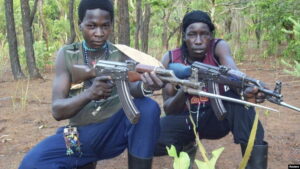
Haut-Mbomou: Russian mercenaries and government forces accused of arming LRA militants against Azandé resistance
In a disturbing escalation of violence in the Haut-Mbomou region of the Central African Republic, reports indicate that Russian-backed mercenaries and government troops have systematically armed and deployed members of the notorious Lord’s Resistance Army (LRA) to undermine the indigenous Azandé resistance movement. This dangerous alliance has unleashed a wave of intimidation, sabotage, and targeted attacks on local communities, raising serious concerns about the humanitarian and security fallout in one of the country’s most volatile zones.
Strategic deployment fuels instability in eastern Central African Republic
The sudden surge in LRA activity in Haut-Mbomou, bordering the Democratic Republic of the Congo, follows a coordinated strategy by foreign security actors and national forces. Observers on the ground report that LRA units, historically weakened by military operations and defections, have been re-equipped and redeployed with modern weaponry, allegedly under the supervision of Russian-speaking military advisors. These forces are now operating in close coordination with government-aligned militias, creating a dangerous synergy aimed at crushing local resistance.
Collusion raises alarm among civil society and regional observers
Civil society leaders and community elders in Haut-Mbomou have expressed outrage at what they describe as a deliberate campaign to destabilize their region. “The government and its foreign backers are using the LRA as a proxy force to terrorize our people,” said a local spokesperson. “They want to break our spirit and prevent us from organizing for our own protection.” Testimonies from displaced persons indicate that LRA units, often disguised as government patrols, have carried out raids, looted property, and abducted civilians—tactics reminiscent of the group’s darkest years.
Humanitarian crisis deepens amid coordinated violence
The renewed aggression has forced thousands of Azandé families to flee their homes, overwhelming already strained humanitarian resources in the region. Aid workers report severe access restrictions, with roads blocked and villages isolated by armed groups. The United Nations and international NGOs have warned that the situation could spiral into a full-blown humanitarian emergency, with food insecurity, lack of medical care, and protection risks escalating daily.
International implications grow as foreign actors gain influence
The involvement of Russian mercenaries—widely believed to be affiliated with the Wagner Group—has drawn international attention to the Central African Republic. While the government denies any formal link, multiple sources confirm the presence of foreign fighters in uniform, operating alongside national troops. Analysts suggest this strategy is part of a broader effort to consolidate control over resource-rich regions and suppress dissent under the guise of counter-insurgency.
What’s next for Haut-Mbomou?
As the security vacuum widens, the Azandé community faces a critical choice: escalate resistance with limited means or seek refuge in neighboring countries. Local leaders are calling for urgent international intervention, including the deployment of peacekeeping forces and a commitment to disarm all irregular groups. “We are not asking for war, but for protection,” pleaded a village chief. “Without it, our people will vanish.”
With no clear resolution in sight, the people of Haut-Mbomou remain trapped between armed factions, foreign interests, and a government that appears willing to sacrifice stability for control.