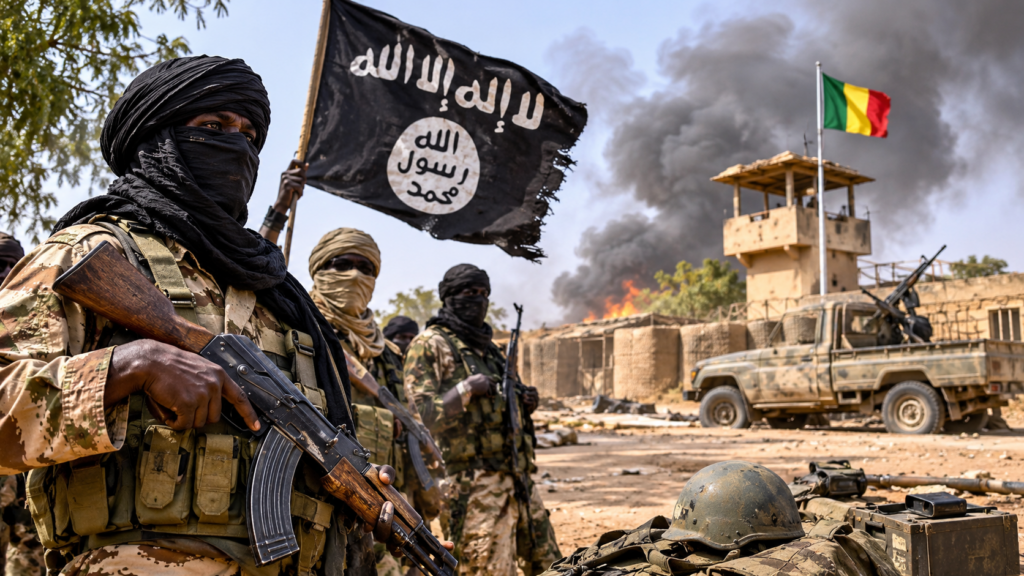
In a stark reminder of the deepening instability gripping Mali, a brazen weekend assault on a pro-government militia position in the town of Bayman has left authorities scrambling to assess the damage. Claims by the Group for the Support of Islam and Muslims (JNIM) of capturing the strategic site have sent shockwaves through the region, underscoring the precarious state of the country’s security apparatus.
The attack, which unfolded on the morning of October 31, 2026, targeted a position occupied by the so-called “Russafricains” militia fighters widely perceived as proxies of Mali’s military junta, often linked to Russian security contractors operating in the country. While the exact toll remains unverified, the JNIM’s assertion of neutralizing several fighters has raised urgent questions about the vulnerability of even fortified outposts to well-coordinated strikes.
Human cost and unanswered questions
The absence of an independently verified casualty list has left observers dependent on conflicting claims. The JNIM’s statement, while asserting the neutralization of enemy combatants, offers no concrete numbers, leaving the true human cost a mix of fatalities, injuries, and possible captives shrouded in uncertainty. This lack of clarity is not uncommon in the fog of Mali’s prolonged conflict, but it further complicates efforts to gauge the scale of the setback.
The attack in Bayman follows a pattern of increasingly bold offensives by jihadist groups. Just weeks prior, on September 10, an assault on Dioura claimed the lives of at least 100 Malian soldiers and five Russian paramilitaries, with dozens more soldiers reported missing or captured. These losses have laid bare the limitations of Mali’s military partnerships, despite public assurances of progress in counterterrorism efforts.
The myth of secured positions and the reality of attrition
Authorities have repeatedly touted military achievements, citing figures such as 4,800 alleged terrorists neutralized and 850 airstrikes conducted since May 2026. However, these claims stand in stark contrast to the relentless pace of attacks on military installations. The persistent incursions, including the latest in Bayman, suggest that territorial control remains tenuous and that defensive strategies are failing to deter determined adversaries.
At the heart of the problem is the question of whether Mali’s alliances particularly with Russia are translating into tangible improvements on the ground. While joint operations and aerial bombardments have been heralded as turning points, their effectiveness appears limited when measured against the continued resilience and adaptability of jihadist factions like the JNIM.
Mopti’s broader crisis: a test of resilience
The fallout from the Bayman attack extends beyond the immediate military setback. The region of Mopti, already a hotspot for intercommunal violence and insurgency, now faces heightened risks of further destabilization. With militia positions under threat and civilian populations caught in the crossfire, the episode underscores a critical dilemma: how long can Mali’s embattled authorities sustain a narrative of control amid deteriorating conditions?
The JNIM’s latest claim of victory is not merely a tactical blow but a symbolic one. It challenges the credibility of the country’s security narrative and exposes a gaping chasm between official pronouncements and ground realities. For the residents of Bayman and neighboring areas, the message is clear: the state’s ability to safeguard them remains dangerously compromised.
What comes next for Mali’s security strategy?
As Mali grapples with the aftermath of the Bayman assault, the path forward is fraught with uncertainty. The recurring pattern of attacks and counterclaims suggests that the junta’s military partnerships, while politically expedient, may not be delivering the security dividends they promise. For civilians and local forces alike, the immediate priority is securing the immediate area and preventing further gains by jihadist groups. Yet, with resources stretched thin and trust in state institutions eroding, the road to stabilization appears longer and more arduous than ever.
By Emmanuel Mbarga — Journalist