
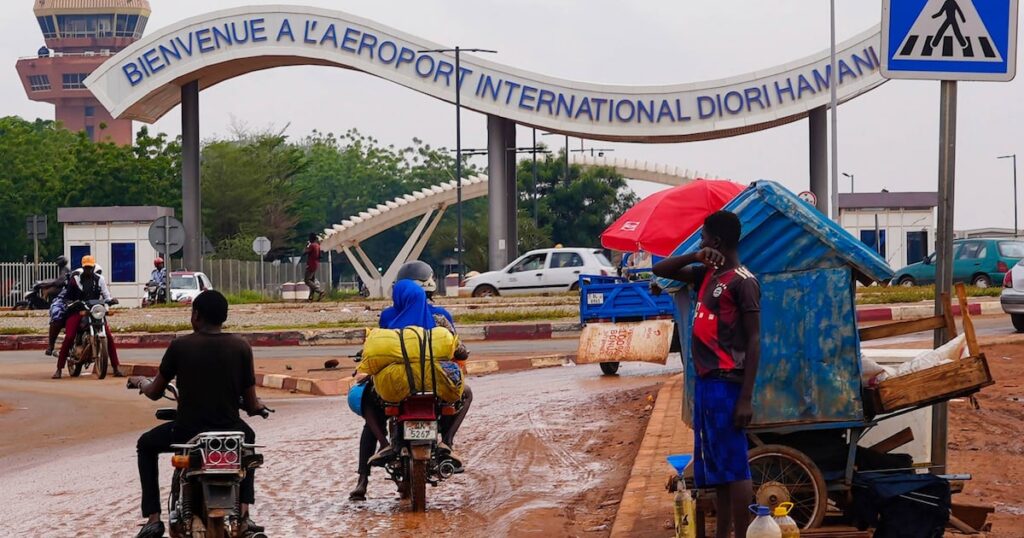
In the early hours of January 29, gunfire and explosions shattered the calm of Niamey’s Diori Hamani International Airport. This rare direct assault on Niger’s capital was later claimed by the Islamic State in the Sahel (IS-Sahel) through its AMAQ propaganda arm.
The attack, which lasted about an hour, was repelled by a joint aeroterrestrial response, according to Nigerien authorities. Official figures—though unverifiable by independent sources—cite 20 assailants killed, 11 captured, and four soldiers wounded. The Russian Foreign Ministry confirmed on February 2 that units from the Africa Corps, a Russian Defense Ministry-affiliated force, had assisted Nigerien troops in securing the site.
General Abdourahamane Tiani, Niger’s junta leader, praised the Russian partners for their professionalism in safeguarding the airport’s perimeter, which includes the strategic Air Base 101—a critical hub for the country’s military operations.
a propaganda victory for the islamic state
The IS-Sahel escalated its campaign on February 2 by releasing a video purportedly filmed during the attack. The footage, branded with the AMAQ logo, shows armed militants moving through the airport’s military zone on motorcycles, opening fire, and setting fires. Damaged aircraft—two small planes and a helicopter—were visible, along with scorched areas near the runway confirmed by satellite imagery.
The attack footage also shifted to the civilian side of the airport, where militants filmed commercial planes from Asky Airlines and Air Côte d’Ivoire parked on the tarmac. While Nigerien authorities acknowledged damage to three civilian aircraft, the Defense Ministry reported “equipment destroyed, including a stockpile of ammunition that caught fire.”
Niamey: a new jihadist battleground
Niger has faced a decade of violence from Al-Qaeda-affiliated JNIM and IS-Sahel in its western and southeastern regions. However, direct strikes on the capital remain uncommon. Just days before the airport assault, the JNIM claimed responsibility for destroying a military vehicle east of Niamey, signaling growing pressure on the central government.
This escalation coincides with a major shift in Niger’s security alliances. Since the July 2023 coup, the military regime has pivoted toward Moscow while distancing itself from Western partners. France’s forced departure in late 2023 was followed by the U.S. withdrawal of most military personnel in 2024, though diplomatic channels remain open.
diplomatic fallout and competing narratives
General Tiani accused France, Benin, and Côte d’Ivoire of “sponsoring” the attack, a claim swiftly condemned by Abidjan and Cotonou. Côte d’Ivoire summoned Niger’s ambassador, calling the remarks “serious” and warning they could harm bilateral ties.
Meanwhile, nearly 300 Italian troops stationed in Niger as part of the Italian Support Mission in Niger (MISIN) denied any involvement in the fighting. Defense Minister Guido Crosetto emphasized their “primary focus on security.”
a strategic target with far-reaching implications
The airport is more than a symbol—it’s a nerve center for Niger’s defense. It houses the joint headquarters of the G5 Sahel forces (Niger, Mali, Burkina Faso) and stores a significant uranium concentrate stockpile. Disputes over this resource, previously managed by French firm Orano, have intensified as Niamey explores alternatives, including potential deals with Russia.
Commercial flights resumed the day after the attack, and life in nearby neighborhoods quickly returned to normal. Yet the incident marks a turning point: by striking the capital’s logistical and military core, IS-Sahel exposed its growing capabilities. Meanwhile, Russia’s involvement underscores Niger’s pivot toward Moscow, risking deeper regional tensions.


More Stories
Niger: Tiani faces fallout from special forces anger after Russian intervention
Crisis in Niger, IMF agreement in Sénégal, and Moroccan elections: Five essential stories
RDC-Israël : un rapprochement aux enjeux multiples