
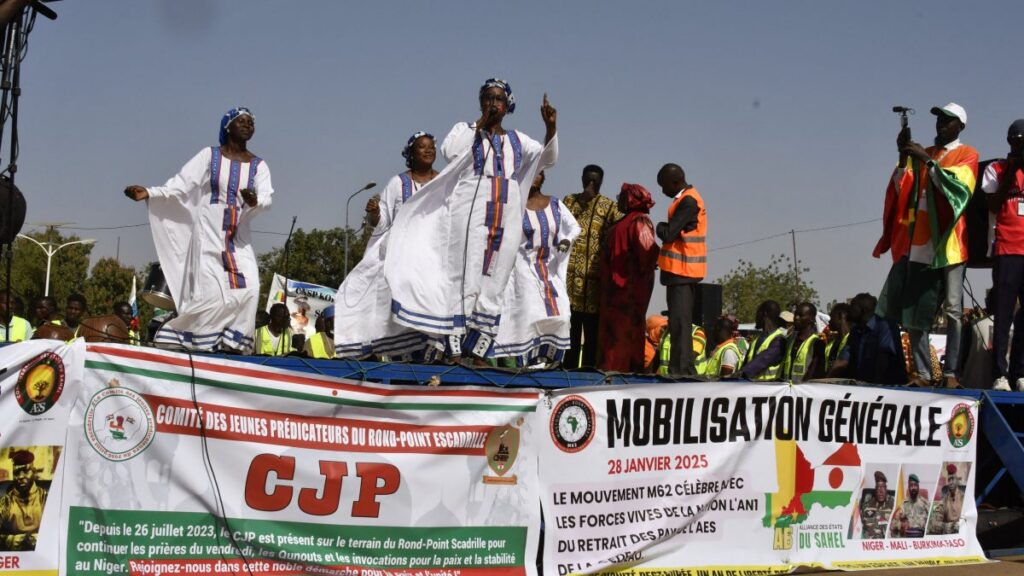
Since the military coup in July 2023, Niger has experienced a sharp decline in human rights, with the ruling junta intensifying repression against political opponents, activists, and journalists. The former president, Mohamed Bazoum, and his wife remain arbitrarily detained at the presidential palace in Niamey, denied communication with family or legal counsel. The junta also continues to hold former government officials, journalists, and human rights advocates without fair trial guarantees.
Niger faces persistent threats from armed Islamist groups, including the Islamic State in the Sahel (EIS), the Support Group for Islam and Muslims (GSIM/JNIM), linked to Al-Qaeda, as well as Boko Haram and the Islamic State in West Africa Province (ISWAP). These groups operate primarily in western and southeastern regions, with clashes intensifying near the borders with Mali and Burkina Faso, placing civilians in grave danger.
In August 2025, the junta launched « Garkuwar Kassa » (Hausa for « Shields of the Homeland »), a civilian militia initiative aimed at supporting the military. While intended to bolster security, critics warn this move could lead to unchecked abuses by untrained forces, raising concerns about potential human rights violations.
In March 2025, junta leader Abdourahamane Tiani was sworn in as transitional president for a five-year term without holding elections, further entrenching military control. The same month, Tiani signed a decree abolishing multiparty democracy nationwide, effectively suppressing political pluralism and democratic processes.
In January 2025, Niger withdrew from the Economic Community of West African States (ECOWAS), following the lead of Mali and Burkina Faso. This decision limited citizens’ access to justice through the ECOWAS Court of Justice. In September, the three nations announced plans to leave the International Criminal Court (ICC), jeopardizing accountability for atrocities committed against civilians.
escalating violence by islamist armed groups
Over a decade of Islamist insurgency, originating in northern Mali in 2012 and spreading to Niger and Burkina Faso by 2015, has left a trail of widespread abuses. In 2025, the Islamic State in the Sahel (EIS) escalated attacks in Niger’s Tillabéri region, bordering Mali and Burkina Faso. Civilians faced summary executions, arson, and looting, with hundreds killed and entire villages destroyed.
On March 21, EIS fighters attacked a mosque in the village of Fambita during afternoon prayers, killing at least 46 worshippers, including three children. They also looted livestock and homes, burning over 20 houses and several market stalls. On May 13, fighters attacked Dani Fari, a hamlet in Tillabéri, killing five men and two boys while burning at least 12 homes. On June 21, another mosque attack in Manda left over 70 dead, including five children, with at least 10 homes set ablaze.
On June 20, EIS militants entered Abarkaize, executing the village chief, aged 67. Three days later, they abducted five men, whose mutilated bodies were found on the outskirts of the village. On June 23, six civilians were killed in Ezzak, with homes looted. Survivors reported that the military had failed to act on advance warnings, leaving villages defenseless against these horrific assaults.
Before each attack, EIS fighters issued threats, accusing locals of collaborating with the Nigerien army or failing to comply with demands such as paying zakat (Islamic tax). The military’s inaction left communities vulnerable, with survivors alleging inadequate protection measures.
suppression of political dissent and human rights activism
Since the 2023 coup, the junta has systematically targeted opposition figures. Mohamed Bazoum and his wife remain detained without legal recourse, and their immunity was revoked in 2024 through a flawed process. In February 2025, the UN Working Group on Arbitrary Detention condemned Bazoum’s detention as unlawful, demanding his immediate release. Despite this, Bazoum remains incarcerated, and his trial remains pending.
The junta has also arrested dozens of former officials, including ministers, presidential advisors, and Bazoum’s associates, without due process. While some detainees were released in April 2025, many remain imprisoned for political reasons, including prominent human rights activist Moussa Tiangari. Tiangari was arrested in December 2024 and held incommunicado for two days before being transferred to the Central Service for Combating Terrorism and Transnational Organized Crime. In January 2025, he was charged with « conspiring with terrorist groups » and « plotting against state authority in collusion with foreign powers, » offenses that carry the death penalty if proven. Tiangari remains in pretrial detention without a court appearance, and his legal team’s appeals have been rejected on spurious grounds.
crackdown on freedom of expression and civil society
Since the coup, press freedom in Niger has been severely restricted. Journalists face harassment, arbitrary arrests, and self-censorship out of fear of reprisals. In January 2025, the government suspended the private television channel Canal 3 TV for 30 days after its editor criticized government ministers. The editor’s press card was also revoked, though the suspension was later lifted.
In February 2025, military authorities ordered the International Committee of the Red Cross (ICRC) to leave Niger without explanation, disrupting critical humanitarian aid to vulnerable communities.
On May 8, security forces arrested three journalists from Sahara FM in Agadez for reporting on alleged shifts in Niger’s security cooperation with Russia and Turkey. Though a judge ordered their release the next day, they were re-arrested and remain in detention. These actions underscore the junta’s tightening grip on media freedom and public discourse.
In August 2025, the Interior Minister dissolved four judicial unions, citing vague claims of « deviating from their roles » and prioritizing « personal interests. » The Niger Workers’ Union condemned the move as a grave violation of workers’ rights, while the Niger Bar Association demanded the unions’ reinstatement and organized a two-day strike in protest. These actions further erode judicial independence and the right to association.

More Stories
Ousmane Sonko’s firm stance on Senegal’s FMI agreement demands full transparency
Senegal’s institutional crossroads: the unfolding dynamic between Ousmane Sonko and Bassirou Diomaye Faye
Minister abdourahmane diouf reignites feud with ousmane sonko over special credits reform