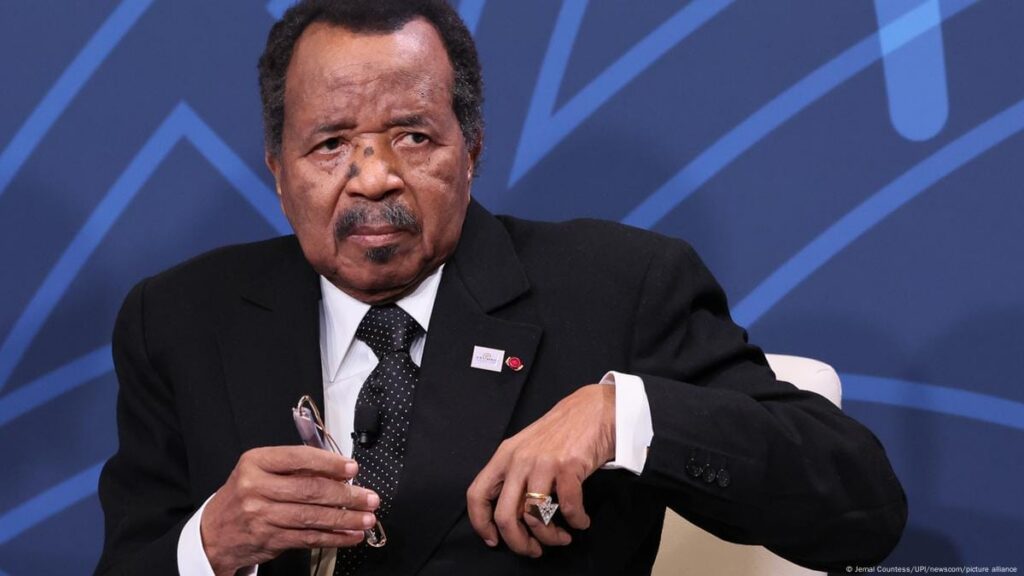
Cameroun: Paul Biya’s prolonged absence fuels power vacuum concerns
The extended absence of Cameroon’s President Paul Biya has reignited public debates about governance in the country. Departing on June 7, 2026, for what was officially described as a private European trip with his wife, the 93-year-old head of state has yet to return after 44 days abroad.
This prolonged silence has sparked widespread speculation regarding his health status, with rumors circulating across media outlets and social platforms.
Government scrambles to calm fears
In response to mounting concerns, the ruling Cameroon People’s Democratic Movement (CPDM) has attempted to reassure the public. An editorial published July 15 in L’Action, the party’s official newspaper, featured statements from Christophe Mien Zok, the party’s propaganda director, affirming that state institutions remain fully operational.
« The reins of power are not slipping from our grasp. The Lion has not left the fold, » he declared, dismissing claims of a country governed remotely or drifting without clear leadership.
Meanwhile, official presidential channels have continued to release greetings from President Biya to foreign leaders, including French President Emmanuel Macron on Bastille Day and the President of Montenegro. Yet no public appearances or detailed updates about his activities have been shared.
Opposition challenges the silence
The opposition has seized on the situation to demand answers. Deputy Jean-Michel Nintcheu has formally petitioned the Constitutional Council to assess whether the president’s absence constitutes a power vacuum.
The Democratic Union of Cameroon (UDC) has emphasized that while a prolonged absence abroad does not automatically trigger a presidential vacancy, it raises critical questions about state continuity and the effective exercise of presidential powers, particularly regarding mechanisms for temporary impediments.
Constitutional gaps exposed
Legal experts highlight that if the president’s absence exceeds 45 days, the Constitutional Council could be compelled to examine the situation. However, Cameroonian law currently lacks a clear maximum duration for presidential absences abroad.
The UDC has also pointed out that no vice president has been appointed since the April constitutional revision, underscoring what the party describes as an urgent need for institutional reform. It advocates for precise legal frameworks governing prolonged presidential absences to ensure state continuity and prevent institutional uncertainty.
As President Biya’s absence continues to stretch, the debate intensifies between authorities—who insist institutions remain fully functional—and critics demanding greater transparency and a clearer legal framework to address such extraordinary circumstances.