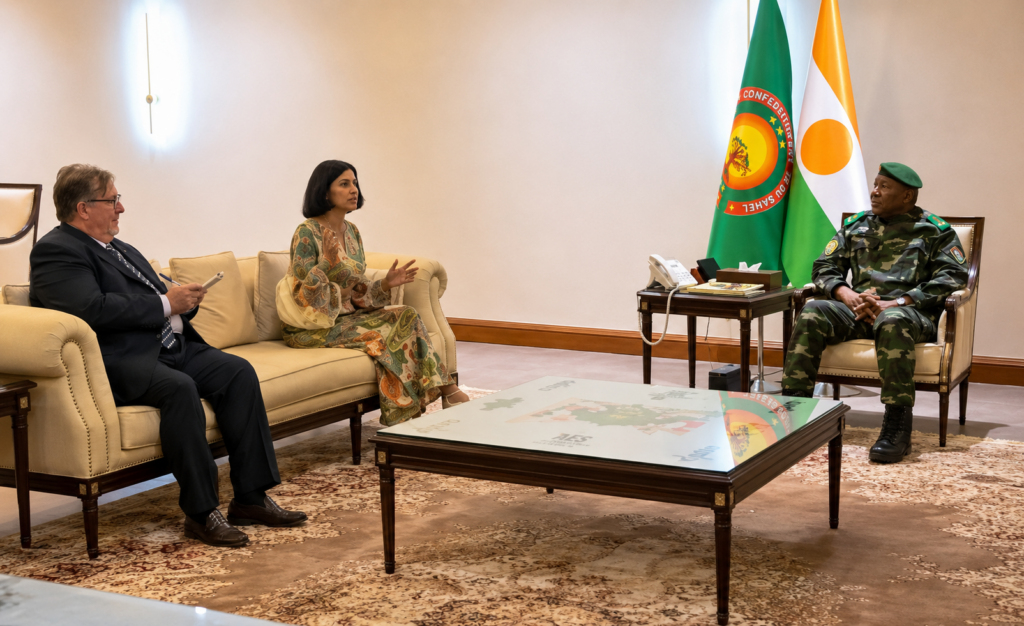
Niamey’s calculated diplomatic display
The presidential palace in Niamey orchestrated a display of customary ceremonial grandeur on Tuesday. General Abdourahmane Tiani, Chairman of the National Council for the Safeguarding of the Homeland (CNSP), welcomed Spain’s Ambassador to Niger, Gloria Minguez Ropiñon. While the official statement from Niamey’s leadership strives to project an image of robust and forward-looking bilateral cooperation, the carefully staged encounter does little to conceal the regime’s underlying motives amid mounting scrutiny over its handling of official passport issuance.
Diplomatic rhetoric conceals internal turmoil
Upon concluding the meeting, Ambassador Minguez Ropiñon reiterated Spain’s commitment to the “continuity” and “sustainability” of Nigerien-Spanish relations, dismissing any notion of replacing traditional partners. She highlighted key areas of collaboration for 2026 and 2027, including food security initiatives, women’s empowerment programs, educational exchanges, and the promotion of the Spanish language. Yet seasoned observers of Sahelian politics interpret this diplomatic flurry as a deliberate strategy to secure international legitimacy through low-cost image management.
The CNSP’s intensified communication campaign—particularly on consensual issues like youth employability—appears designed to deflect attention from domestic scandals. By amplifying Madrid’s endorsement of its initiatives, the military regime seeks to project an aura of stability and responsibility, despite persistent allegations of administrative malpractice.
The passport scandal: A calculated distraction
The timing of this diplomatic engagement is far from coincidental. Niamey’s leadership faces severe accusations regarding the opaque and potentially corrupt distribution of official passports, including diplomatic and service variants. By orchestrating a high-profile audience featuring Foreign Minister Bakary Yaou Sangaré and senior strategic advisors, the regime attempts to project an image of administrative rigor and sovereignty, even as allegations of favoritism and illicit trafficking persist.
The paradox is striking: while official discourse touts the benefits of Spanish language education for Nigerien youth, the mechanisms governing the issuance of travel documents remain shrouded in secrecy, fueling suspicions of systemic clientelism.
A performative diplomacy at odds with reality
The carefully curated audience included prominent figures such as Dr. Soumana Boubacar, Director of the Cabinet and Spokesperson, and Ambassador Illo Adani. This gathering was nothing short of a meticulously planned public relations exercise aimed at domestic consumption. Questioning this narrative uncovers the CNSP’s true objective: to justify its rule through perception rather than substance. By showcasing engagement from major European nations, Niamey hopes to dilute criticism of its governance and normalize practices that would otherwise invite condemnation.
The nation’s youth—central to rhetoric on education and future prospects—remain the most immediate casualties of this passport crisis. Without access to legitimate identification documents, their prospects for international mobility and opportunity are severely compromised, despite the promises embedded in Spain’s diplomatic overtures.
Crisis communication through diversion
The official statement from Niamey’s presidency exemplifies a textbook case of crisis management through distraction. Faced with allegations of administrative misconduct and potential passport trafficking, General Tiani opts for a strategy of diplomatic respectability. Whether this veneer of legitimacy will suffice to reassure international partners and citizens alike remains an open question—one that hinges not on ceremonial displays, but on tangible reforms and transparency.