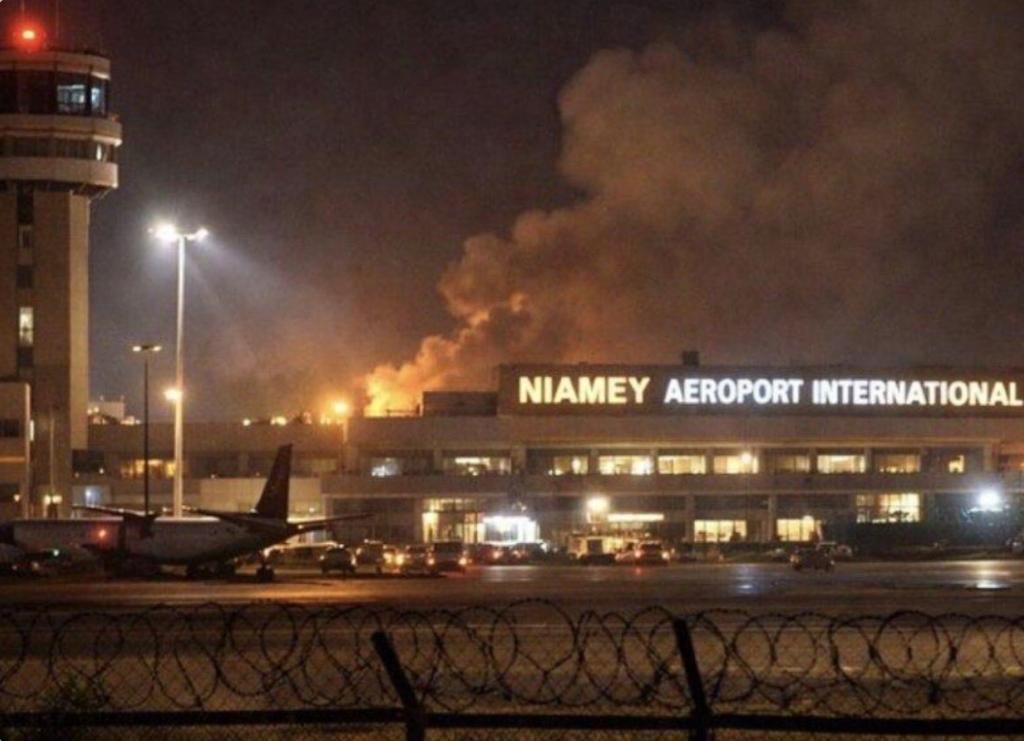
In the early hours of August 29, 2026, Niamey became the epicenter of a tense and unpredictable crisis. Widespread gunfire, explosions, and military vehicle movements echoed through critical areas of the capital, including the vicinity of Air Base 101 near Diori-Hamani International Airport, the presidential palace zone, and government administrative buildings. By dawn, no official statement had clarified the origin of the clashes or identified the combatants involved.
Unanswered Questions Fuel Speculation
With silence from authorities, speculation has spiraled. Was this another jihadist assault on a high-value target? An infiltration attempt? Or, far more alarmingly, an internal power struggle within the armed forces—or even a coup within a coup?
At this point, no verified information confirms a bid to remove General Abdourahamane Tiani from power. Yet the pattern of gunfire and military mobilization across multiple districts—including the activation of maximum alert status in several barracks—has fueled concerns over possible internal fractures.
Witnesses described convoys of armored vehicles, exchanges of fire in residential areas, and heightened military readiness, raising immediate questions about the stability of the current regime.
Security Promises Collide with Harsh Reality
The unrest coincides with a deeply fragile political and security landscape. Since the July 2023 ousting of President Mohamed Bazoum, the Tiani-led regime has positioned itself as the defender of national sovereignty and the guardian against terrorism. This narrative has justified the progressive exclusion of Western partners and a pivot toward Moscow and the Alliance of Sahel States, alongside Mali and Burkina Faso.
Yet despite the withdrawal of French and American forces—framed as a step toward reclaiming security autonomy—the reality has been far from reassuring. Jihadist violence persists, and armed groups have repeatedly demonstrated their ability to strike deep into the heart of the state’s security apparatus. The deterioration in safety has been palpable since the coup, compounded by shrinking political and media freedoms.
Perhaps most damaging of all is the paradox now impossible to ignore: a leadership that promised a « return to security » has failed to prevent dramatic attacks from unfolding inside the capital.
Diori-Hamani Airport: A Glaring Symbol of Vulnerability
The Diori-Hamani International Airport and its adjacent Air Base 101 have become emblematic of the regime’s mounting security failures.
In late January 2026, the complex faced an unprecedented assault—its first major attack in decades. Then, on June 18, another strike targeted the airport entrance and nearby military installations. The second attack was claimed by the Group for the Support of Islam and Muslims (JNIM), an Al-Qaeda affiliate. Official tolls reported 11 soldiers and two civilians dead, with 22 assailants neutralized.
The recurrence of such high-profile strikes within months raises a stark question: How can armed groups repeatedly penetrate one of the most fortified sites in the country?
After the January attack, authorities reinforced perimeter security, extending fences and installing hundreds of surveillance cameras. Eviction operations were also launched to clear nearby informal settlements. Despite these measures, the June assault proved that the problem was not merely one of physical barriers or proximity to civilian areas.
Such operations require precise intelligence—knowledge of patrols, security schedules, weak points, and patrol routes. The repeated success of such attacks suggests systemic failures in intelligence gathering and early warning capabilities.
The Russian Partnership Under Scrutiny
The regime’s pivot toward Russian military support has been presented as a panacea for security woes. Moscow’s Africa Corps and other Russian entities have taken on roles once filled by Wagner-linked forces, offering training, logistics, and advisory support to Niamey.
Yet the January airport attack prompted General Tiani to praise Nigerien and Russian forces—while publicly accusing France, Benin, and Côte d’Ivoire of orchestrating the assault, despite no public evidence.
This recurring tendency—to blame external actors rather than acknowledge internal shortcomings—highlights a troubling pattern. If Russian military support was meant to fill the void left by Western forces, why has the airport been struck twice in six months? And why do armed groups continue to exert such pressure so close to the seat of power?
Populist Rhetoric Meets Harsh Accountability
Since 2023, the Tiani regime has built much of its legitimacy on a nationalist and anti-interference platform. Slogans of sovereignty, denunciations of foreign meddling, and the embrace of new alliances have resonated with segments of the population.
But rhetoric alone cannot ensure safety. Security is measured not in speeches or flags, but in the protection of cities, infrastructure, soldiers, and citizens.
The events of this week may prove politically devastating. If the overnight clashes were jihadist in nature, they will underscore the continued ability of armed groups to penetrate the capital’s defenses. If, however, they stem from internal military conflict, they expose a far deeper crisis: a regime that rose to power promising stability and security, only to now face fractures within its own coercive apparatus.
Is a Power Struggle Underway?
For now, declaring a coup would be premature. Available information does not substantiate such a claim. Yet dismissing the possibility entirely would be equally reckless.
The simultaneous combat and military movements around key sites—airport, military installations, and presidential zone—demand close scrutiny. In an army deeply politicized since the 2023 coup, a factional clash would not be a minor incident. Tiani’s authority rests on a delicate balance between military and security factions. A fracture here could rapidly escalate into a national crisis.
One thing is certain: Niamey has endured another night of fear. And this follows two major attacks on its airport in less than six months.
The regime may continue to point fingers at external enemies, foreign powers, or terrorist groups. But one question now looms larger than any slogan: if, after three years of military rule and shifting security alliances, armed groups can still strike at the heart of the capital, where exactly does the failure lie?
The answer could prove more consequential for Niger’s future than any speech on sovereignty ever was.