
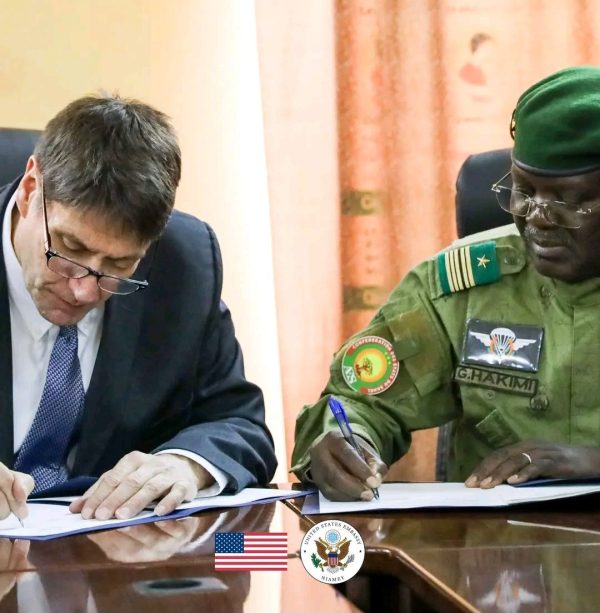
Is the Niger–United States health partnership a life-saving investment or a compromise on digital sovereignty? Since the signing of a health cooperation protocol in Niamey on 26 February 2026, this question has sparked intense debate across diplomatic and civil society circles.
The agreement, valued at $178 million (approximately 99.6 billion West African CFA francs), aligns with Washington’s America First global health strategy. The stated goals—combating malaria, monitoring infectious diseases, preventing polio, and improving maternal and child health—are widely supported. Yet beneath these objectives lie deeper concerns about data governance, long-term fiscal impact, and the potential erosion of national autonomy.
Massive funding amid fiscal strain
Under the deal, the United States commits up to $107 million over five years, while Niamey pledges to raise domestic health spending by more than $71 million. This dual commitment raises immediate questions: Can the Nigerien government sustain such increased investment without diverting funds from critical security or social programs?
With persistent budgetary pressures and escalating security challenges, every dollar reallocated to health comes with an opportunity cost. Will education, infrastructure, or defense budgets bear the brunt? And if so, what are the long-term consequences for national stability?
Health cooperation or strategic data exchange?
While framed as a technical collaboration to strengthen Niger’s healthcare system, the agreement goes further. It incorporates Niger into a bilateral health data exchange framework with the United States—an inclusion that has drawn scrutiny.
In an era where health data fuels research, policy, and economic competitiveness, its control has become a geopolitical battleground. Does this protocol grant Washington access to sensitive medical records of Nigerien citizens? If so, under what legal safeguards? The lack of transparency in public communications has fueled speculation and distrust.
Lessons from Africa: cautionary tales
Niger is not alone in navigating such partnerships. Across the continent, similar agreements have faced fierce resistance. Zimbabwe declined outright. In Kenya, a comparable data-sharing initiative was suspended by the courts in 2025. Zambia rejected a billion-dollar offer, citing national security risks tied to data clauses.
These precedents raise a critical question: Did Niger negotiate stronger protections, or did it prioritize immediate health gains over long-term legal safeguards? The answer could define the country’s digital sovereignty for decades.
Can this deal transform Niger’s health sector?
The challenges are undeniable: endemic malaria, frequent epidemics, under-resourced rural clinics, and persistently high maternal mortality. A well-executed injection of $178 million could modernize surveillance systems, expand vaccination coverage, and revitalize community health centers.
But history shows that external funding alone rarely drives sustainable change. Without systemic reforms—such as improved governance, local capacity-building, and transparent procurement—foreign aid risks becoming a bandage rather than a cure.
Balancing sovereignty and survival
The Niamey protocol reflects a familiar dilemma for African nations: how to attract essential external funding without ceding control over national assets. In a shifting geopolitical landscape, Niger appears to be taking a pragmatic stance—one that prioritizes urgent health needs over potential future risks.
The ultimate measure of success won’t be the dollar value of the agreement, but whether it strengthens Niger’s health sovereignty—or leaves the door open to unintended dependencies.




More Stories
Niger: Tiani faces fallout from special forces anger after Russian intervention
Mali : 17 morts dans les rangs des dozos, le JNIM accentue sa pression
Sahel : le pari des juntes tourne-t-il à l’échec sécuritaire ?