The ECOWAS dilemma: when democratic principles clash with political realities
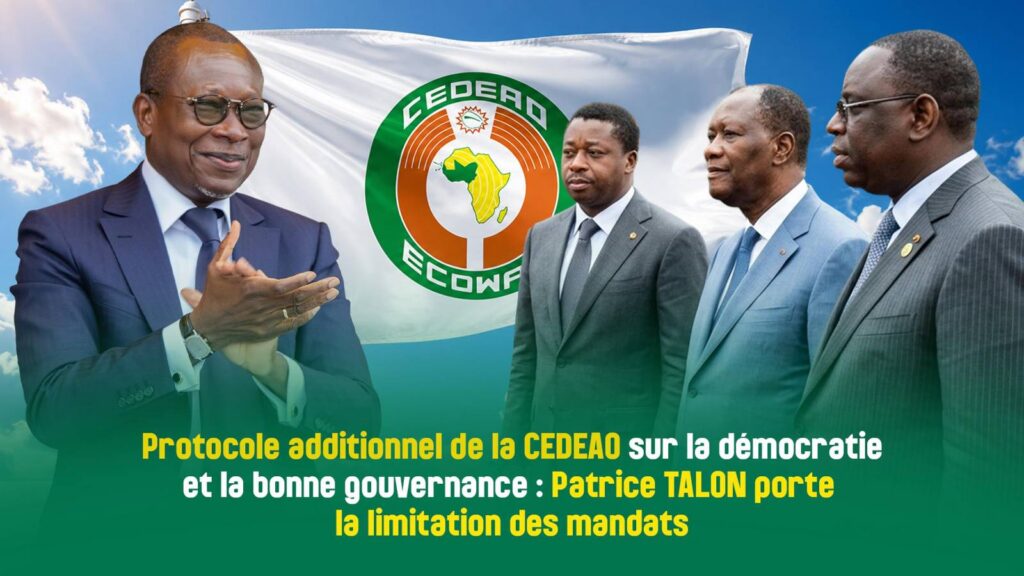
West Africa is navigating turbulent democratic waters, with a wave of military coups reshaping the regional landscape. At the heart of the ECOWAS bloc’s internal tensions lies a fierce debate over presidential term limits—a principle championed by Benin’s President Patrice Talon but fiercely opposed by a coalition of long-standing leaders including Togo’s Faure Gnassingbé, Côte d’Ivoire’s Alassane Ouattara, and Senegal’s former president Macky Sall. This ideological standoff is redefining Benin’s role in the subregion, as Cotonou takes a bold stand while others resist change.
Benin’s unwavering push for constitutional limits
Patrice Talon has never shied away from bold positions, especially when they align with his vision for governance. Since assuming office in 2016, the Beninese leader has made presidential term limits a cornerstone of his diplomatic doctrine. In his view, the chronic instability plaguing ECOWAS—evidenced by coups in Mali, Burkina Faso, and Niger—stems directly from leaders clinging to power beyond constitutional bounds.
During negotiations over revisions to ECOWAS’s Additional Protocol on Democracy and Good Governance, Talon proposed a sweeping reform: a strict ban on more than two presidential terms across all member states, with no loopholes for constitutional tinkering. For Cotonou, this is the only path to restoring the bloc’s credibility and preventing violent constitutional ruptures that undermine regional cohesion.
A united front against Benin’s reform agenda
Yet Talon’s crusade for democratic rigor has collided with a wall of resistance. Three influential leaders have publicly rejected his initiative. In Lomé, Faure Gnassingbé frames the proposal as an affront to national sovereignty, particularly after Togo transitioned to a parliamentary system that extends executive longevity. Meanwhile, in Abidjan, Alassane Ouattara—still in office after a controversial third term in 2020—insists term limits are a domestic matter. And in Dakar, under Macky Sall’s presidency, the stance remained firmly opposed to supranational constraints, despite Senegal’s own recent turbulence over the issue.
For these leaders, ECOWAS’s priorities should focus on combating terrorism and deepening economic integration—not policing presidential mandates. Their resistance highlights a deeper divide: should the bloc enforce democratic standards uniformly, or tolerate exceptions for political convenience?
The cost of conviction: Benin’s strategic absence
The deadlock has led to a noticeable shift in Benin’s regional engagement. True to his reputation for uncompromising principles, Patrice Talon has skipped key ECOWAS summits, framing his absence as a protest against double standards. Cotonou argues that the bloc punishes military coups while turning a blind eye to civilian-led constitutional overreach—a hypocrisy it refuses to endorse.
While critics label Benin’s withdrawal as isolationist, Porto-Novo frames it as a principled stance. The message is clear: principles matter more than protocol, and consistency in governance is non-negotiable.
A reformer in a region of skeptics
Despite opposition from regional heavyweights, Talon’s position is gaining traction among West African civil societies. By committing to step down in 2026—a rarity in the region—he positions Benin as a model of democratic transition, contrasting sharply with neighbors clinging to power. His argument is compelling: without a binding, universal rule on term limits, ECOWAS risks remaining a club of vulnerable leaders out of touch with a youthful population demanding renewal.
Talon’s gamble is bold. He wagers that true stability can only emerge from rules respected by all, without legal loopholes or backroom deals. Whether history vindicates him remains uncertain, but his stance has undeniably forced a reckoning within the bloc.
The broader stakes: democracy vs. political survival
This isn’t just a legal dispute—it’s a defining moment for West Africa. By challenging allies like Ouattara and Gnassingbé, Patrice Talon has elevated ethical governance above diplomatic niceties. While the opposition may have won a technical battle, his model of strict alternation remains a beacon for those fighting against instability.
Will reason prevail over the preservation of power? The answer may well determine the future of ECOWAS—and West Africa’s democratic trajectory.