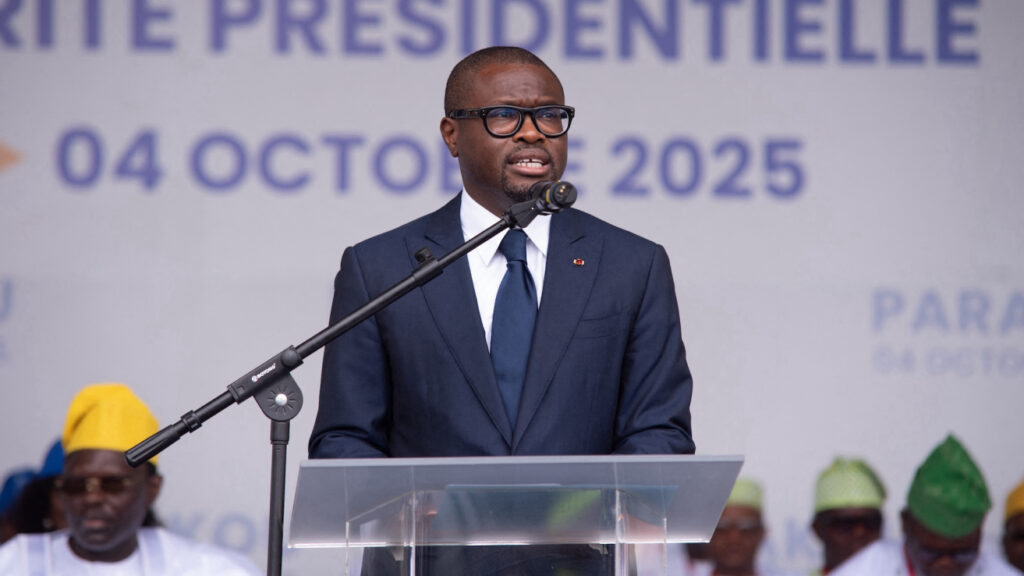
Bénin’s new leader faces a pivotal moment in the country’s democratic journey
Romuald Wadagni has secured a commanding victory in Bénin’s presidential election, winning 94.27% of the vote against his sole challenger, Paul Hounkpè. The latter acknowledged defeat and urged national unity, while the Constitutional Court validated a 63.57% turnout—the highest since the 2021 polls, which recorded just 50.17%. This marks the fifth peaceful democratic transition in Bénin since the landmark 1990 National Conference.
In a region where leaders often cling to power beyond constitutional limits, President Patrice Talon’s adherence to the two-term rule stands out as a rare example of stability in West Africa. Yet, the election was not without controversy. A few isolated incidents—including allegations of ballot-stuffing—were reported, prompting investigations. While these irregularities did not undermine the election’s credibility, the Constitutional Court nullified over 34,000 votes nationwide due to procedural flaws.
A mandate built on economic success—and persistent challenges
Wadagni, a former Finance Minister with a decade-long tenure under Talon, inherits an economy transformed under his leadership. Annual GDP growth surged from 1.8% in 2015 to nearly 8% by 2025, driven by structural reforms and sectoral diversification. Yet, the gains have not trickled down evenly: over 40% of Béninois still live below the poverty line, a stark reminder that growth alone is not enough.
His 2026–2033 agenda prioritizes inclusive growth, focusing on three pillars: universal social welfare, a competitive and diversified economy, and national cohesion. But translating economic progress into tangible poverty reduction will require targeted policies, particularly in rural and peri-urban areas where deprivation remains acute.
Political pluralism and regional stability at the forefront
The election unfolded against a backdrop of heightened political tensions. A failed coup attempt on December 7 underscored the fragility of the country’s democratic gains, while sweeping constitutional reforms since 2016 have reshaped the political landscape. Notably, the 15% sponsorship requirement for presidential candidates—introduced in the 2024 electoral code revision—has effectively sidelined major opposition parties, including Les Démocrates, which boycotted the vote after failing to meet the threshold.
With opposition representation in parliament now limited to pro-government legislators, the path to electoral inclusion appears blocked until at least 2040—unless the sponsorship rules are revisited. The 2025 Constitution introduced a pacte de responsabilité républicaine, a framework for government-opposition collaboration, but its implementation risks becoming a tool to stifle dissent rather than foster dialogue. A broader national dialogue could help address contested reforms, rebuild trust, and ensure policies reflect popular aspirations.
Security and diplomacy: navigating a fractured regional landscape
Bénin’s security challenges are compounded by strained relations with its neighbors. While cooperation with Nigeria has improved following its support against the coup attempt, ties with Burkina Faso and Niger remain fragile. Terrorist groups exploit these divisions, using transborder zones—particularly the W-Arly-Pendjari complex—as safe havens to launch attacks. Without renewed regional collaboration, the security vacuum will only embolden insurgents, threatening stability across all three countries.
Wadagni has signaled a conciliatory approach toward his counterparts, framing his presidency as an opportunity to reset diplomatic ties. However, the restoration of partnerships will depend as much on Bénin’s outreach as on the willingness of Ouagadougou and Niamey to engage. Restoring trust will require concrete steps, such as joint security operations and cross-border economic initiatives, to demonstrate that cooperation is mutually beneficial.
The new administration must also address institutional risks. The creation of a powerful Senate in late 2025—tasked with reviewing and potentially vetoing legislation—could create tensions with the executive branch. If former President Talon is appointed to lead the Senate, the risk of a bicephalous executive (dual-headed leadership) looms large, potentially paralyzing policymaking.
A seven-year roadmap for transformation
Wadagni’s presidency begins at a crossroads. The economic model that delivered rapid growth must now deliver prosperity for all, while political reforms risk deepening divisions if not balanced with inclusive governance. His ability to navigate these dual challenges—poverty reduction and democratic resilience—will define Bénin’s trajectory in the coming decade.
Success hinges on three priorities:
- Reinvigorating regional security cooperation to dismantle terrorist networks and restore cross-border stability;
- Revitalizing political pluralism through dialogue and potential reforms to sponsorship rules;
- Institutionalizing accountability via citizen participation platforms and public accountability tours to rebuild public trust.