
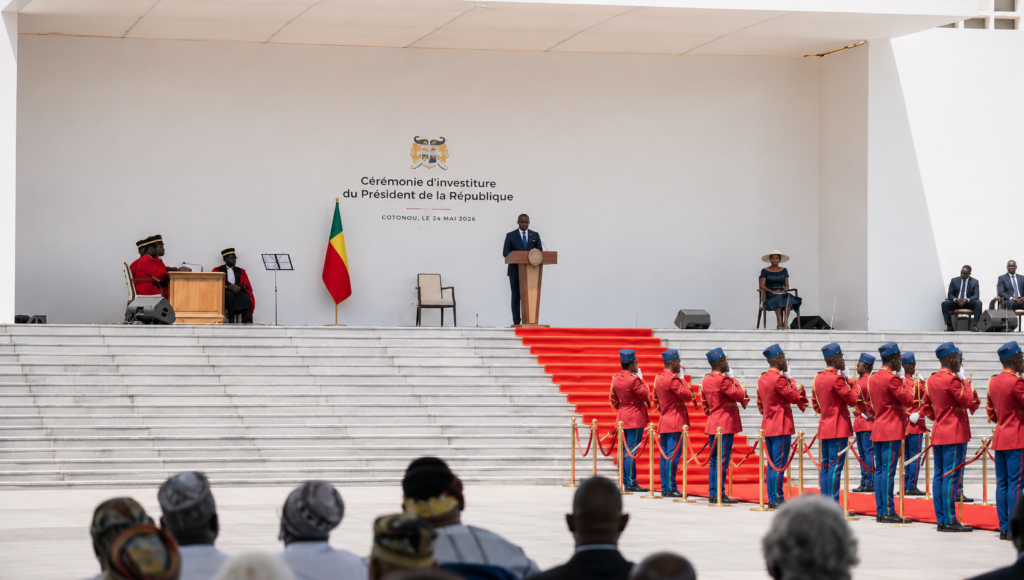
Benin’s Romuald Wadagni inaugurated as president with sweeping mandate amid opposition exclusion
Romuald Wadagni was sworn in on Sunday, May 24, in Cotonou, marking the start of a seven-year term. The former Finance Minister inherits a tightly controlled political landscape and promises economic continuity while signaling a cautious shift in regional diplomacy.

With 94% of the vote in an election where the main opposition party was barred from running, Romuald Wadagni’s inauguration sets a new tone for Benin’s political trajectory. The ceremony, held at the Palais des Congrès in Cotonou, was a carefully orchestrated affair, attended by over 6,000 guests, including former presidents and regional leaders.
At 49 years old, Wadagni takes the helm of a nation that has maintained steady economic growth under outgoing President Patrice Talon. His rise to power is rooted in decades of service, including 17 years at Deloitte before joining the government in 2016. As Finance Minister, he oversaw key financial strategies, including multiple sovereign bond issuances that preserved Benin’s international credit rating.
Economic continuity meets institutional change
The 2026 presidential election was a landslide victory for Wadagni, who secured more than 94% of the vote in the first round against a single opponent, Paul Hounkpè. The victory was facilitated by a constitutional reform in 2025, extending presidential terms to seven years and decoupling presidential elections from legislative polls—a first in Benin’s democratic history.
The inauguration ceremony followed a strict protocol, beginning with Patrice Talon’s handover of presidential insignia. The event was notable for its smooth execution, though it unfolded against a backdrop of a political system where opposition voices have been systematically sidelined.
A restricted political field
The Democratic Party, led by former President Thomas Boni Yayi, was disqualified from the race in October 2025 after failing to secure the required number of parliamentary endorsements. The rejection of their candidate, coupled with high registration fees, restrictive compliance certificates, and a 20% threshold per constituency for parliamentary seats, has severely limited opposition representation. In the January 2026 legislative elections, the party failed to win a single seat.
Political dissent has also been curbed through legal measures. Figures like Reckya Madougou, sentenced to 20 years for alleged terrorism in 2021, and Joel Aïvo, given a 10-year term for conspiracy, remain imprisoned. The Economic and Terrorism Repression Court (CRIET), established in 2016, has faced persistent criticism from NGOs over its use against political opponents.
Diplomatic signals and regional realignments
Wadagni’s inaugural address outlined two key priorities: translating economic growth into tangible benefits for families and addressing security threats in northern Benin, where armed groups have been active since 2022. However, the most striking moment came when the names of Sahelian leaders—including Mali’s Foreign Minister Abdoulaye Diop and Niger’s Prime Minister Ali Mahaman Lamine Zeine—were announced. The prolonged applause that followed signaled a deliberate thaw in relations, particularly with Niamey, a stark contrast to Benin’s previous diplomatic freeze following Niger’s 2023 coup.
The presence of regional delegations, including high-ranking officials from the Alliance of Sahel States (AES), underscored a potential recalibration of Benin’s foreign policy. While France was represented at a lower level by a junior minister, the inclusion of AES representatives suggested a pragmatic approach to regional security cooperation.
In his speech, Wadagni repeatedly addressed different segments of society—youth, women, rural communities, the middle class, and the diaspora—emphasizing inclusion. A notable highlight was his acknowledgment of descendants of the African diaspora, reaffirming Benin’s role as a hub for reconnection with the continent’s heritage.
What to watch in the coming weeks
The next phases will reveal how Wadagni navigates his mandate. The composition of his government, expected shortly, will indicate whether he broadens his team beyond Talon’s inner circle. The fate of imprisoned opposition figures, including calls for amnesty, will also be closely monitored. Additionally, any concrete steps toward reconciliation with Niger, Mali, or Burkina Faso could reshape Benin’s regional standing.
The inauguration marks the beginning of a seven-year term under a constitution heavily shaped by the outgoing administration. While economic stability remains a hallmark of Talon’s legacy, the narrowing of political pluralism raises questions about the country’s democratic resilience.


More Stories
Niger: Tiani faces fallout from special forces anger after Russian intervention
Mali : 17 morts dans les rangs des dozos, le JNIM accentue sa pression
Sahel : le pari des juntes tourne-t-il à l’échec sécuritaire ?