
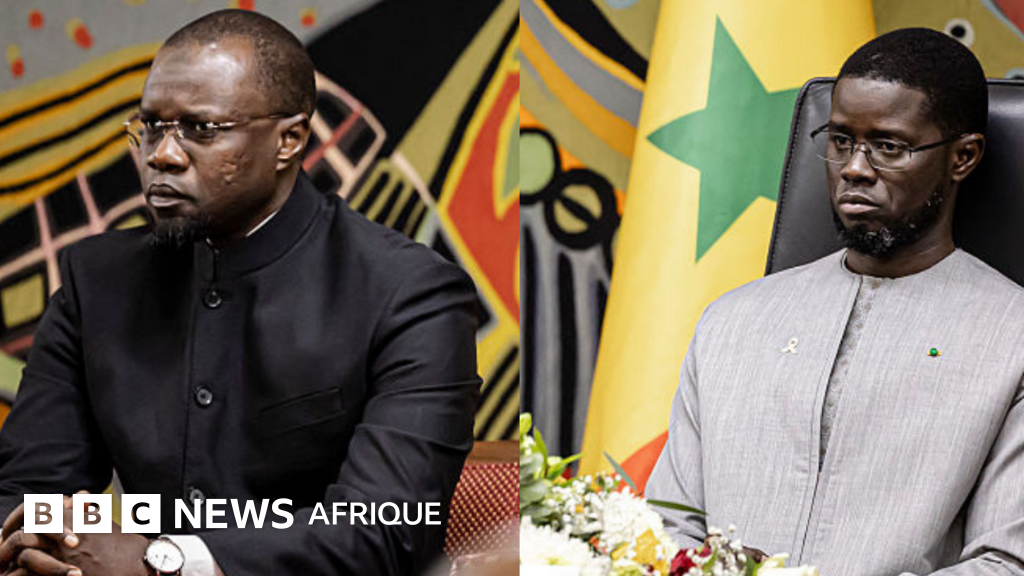
With the dismissal of Prime Minister Ousmane Sonko on May 22, 2026, the political landscape of Senegal has entered uncharted territory. The once-powerful tandem that propelled Bassirou Diomaye Faye to the presidency in 2024 now lies in tatters, leaving the nation grappling with profound questions about governance, power dynamics, and the road ahead.
Composite image of Ousmane Sonko and Bassirou Diomaye Faye
the end of a political symbiosis
For nearly two years, the slogan “Diomaye mooy Sonko” symbolized the fusion of two political forces: Ousmane Sonko’s charismatic leadership and Bassirou Diomaye Faye’s institutional legitimacy. This alliance, forged under the PASTEF banner, was the driving force behind the 2024 presidential victory. Yet, the decree removing Sonko from office—effective immediately—has shattered that unity, exposing deep-seated tensions over governance, economic policy, and control of the party.
Political analysts note that the contradictions between the two leaders had been mounting for months. Sonko, a former Prime Minister, wielded significant influence both within the government and among the party’s grassroots, while Diomaye Faye, as president, held the constitutional authority to shape national policy. This imbalance created an unsustainable duality at the heart of the state.
institutional tensions and political fallout
Maurice Soudieck Dione, a political science professor, argues that the crisis was inevitable given Senegal’s constitutional framework. Under the 2024 transition, Diomaye Faye’s presidency derived legitimacy from the ballot box, while Sonko retained the loyalty of PASTEF’s rank and file. This dual legitimacy—one institutional, the other popular—clashed repeatedly, undermining the government’s cohesion.
“The president’s authority is absolute under Senegal’s Constitution, yet the Prime Minister’s political base remained unshaken,” explains Dione. “This power-sharing arrangement was doomed to fail.” He suggests that an alternative structure, such as Sonko leading the National Assembly while a technocratic Prime Minister handled daily governance, might have prevented the rupture.
a rivalry fueled by 2029 ambitions
The dismissal of Sonko is not merely a personnel change—it marks the beginning of a high-stakes rivalry. Observers point to the 2029 presidential election as the invisible battleground where both men may stake their claims. Diomaye Faye’s decision to reclaim full executive control signals a bold but risky strategy: to govern independently and distance himself from his former mentor’s shadow.
Yet, this move carries significant risks. Sonko, though no longer Prime Minister, remains the undisputed leader of PASTEF and commands a parliamentary majority of 130 out of 165 seats. His political capital—rooted in grassroots mobilization and legislative success—positions him as a formidable force. If he chooses to challenge Diomaye Faye, the consequences could destabilize the government entirely.
uncertainty and the specter of institutional gridlock
The immediate challenge for Bassirou Diomaye Faye is to restore stability. The appointment of a new Prime Minister will be scrutinized as a litmus test of his political direction. Will he lean toward technocrats, party loyalists, or a compromise figure capable of bridging the divide?
Babacar Ndiaye, director of research at the WATHI think tank, warns that the rupture could lead to an unprecedented scenario: an internal opposition within PASTEF itself. “The president risks facing a hostile parliamentary majority,” Ndiaye notes. “If the PASTEF majority turns against him, legislative gridlock could paralyze his agenda.”
With local elections looming and speculation about a potential parliamentary dissolution, the coming months will be critical. Diomaye Faye’s ability to govern without Sonko’s support may hinge on his capacity to restructure his coalition and secure a loyal parliamentary base.
sonko’s next moves: opposition or comeback?
Freed from the constraints of office, Ousmane Sonko now faces a pivotal moment. Three potential paths emerge:
- A shift into internal opposition: Sonko could leverage his control over PASTEF to challenge the president from within, risking a permanent fracture in the party.
- A 2029 presidential bid: Many analysts believe Sonko has been laying the groundwork for a return to the national stage, positioning himself as a populist leader in the years ahead.
- A political realignment: The rupture could herald the birth of two distinct blocs—one institutional, led by Diomaye Faye, and another populist-sovereignist, embodied by Sonko.
For Sonko, the stakes are high. His political future depends on whether he can maintain his influence outside the corridors of power. If he fails to mobilize his base or reconcile with Diomaye Faye, his ambitions for 2029 may falter.
diomaye faye’s solitary path forward
Bassirou Diomaye Faye’s greatest challenge may be the solitude of power. Sonko’s removal strips away the protective shield of his former mentor, leaving the president exposed to the full weight of public expectations. Without Sonko’s ability to absorb criticism and rally the party’s core supporters, Diomaye Faye must now confront economic frustrations and political discontent directly.
“The president must invent his own political identity,” says Ndiaye. “His legitimacy was built on being Sonko’s extension. Now, he must prove his worth independently.”
The coming months will reveal whether Diomaye Faye’s gamble pays off. If he fails to consolidate his coalition or loses control of the parliamentary majority, the remainder of his term could be marred by instability. Conversely, a successful transition could pave the way for a new era of governance in Senegal.
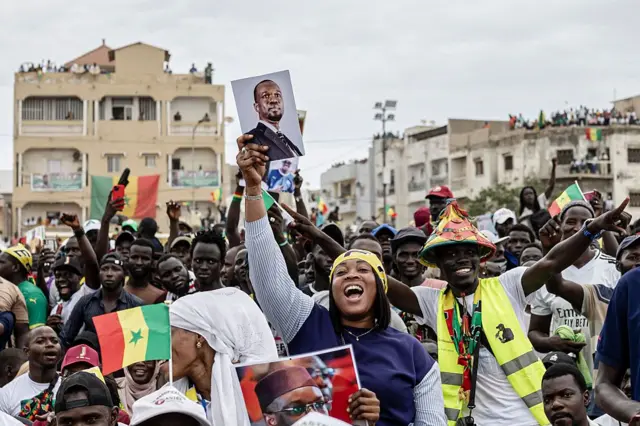
A supporter of Ousmane Sonko dances holding his portrait at a rally in Dakar
More Stories
Ousmane Sonko’s firm stance on Senegal’s FMI agreement demands full transparency
Senegal’s institutional crossroads: the unfolding dynamic between Ousmane Sonko and Bassirou Diomaye Faye
Minister abdourahmane diouf reignites feud with ousmane sonko over special credits reform