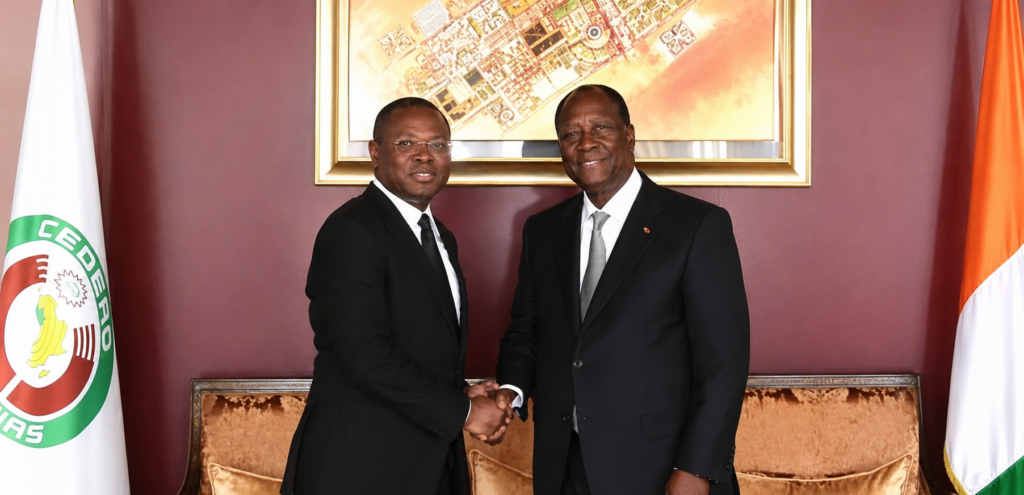
In a bold and calculated move following his inauguration, Benin’s newly elected President Romuald Wadagni selected Côte d’Ivoire as the destination for his first official international visit. Beyond mere symbolism, this high-level engagement in Abidjan underscores a decisive shift in diplomatic strategy, firmly anchored in economic pragmatism.
By directing his first international steps toward Côte d’Ivoire, President Wadagni has made a statement that is both daring and meticulously reasoned. The choice to engage with Abidjan is not merely about proximity—it represents an active pursuit of a proven model of economic transformation.
A testament to Côte d’Ivoire’s economic ascendancy
Under the leadership of President Alassane Ouattara, Côte d’Ivoire has emerged as the unrivaled engine of the West African Economic and Monetary Union (UEMOA). The nation’s trajectory—marked by sustained growth, modernized infrastructure, and unprecedented financial appeal—serves as a blueprint for regional development. For President Wadagni, a seasoned technocrat and former Minister of Economy and Finance, President Ouattara embodies the archetype of effective governance and managerial excellence.
This working session between the two leaders is poised to be a convergence of minds committed to measurable outcomes, infrastructure advancement, and fiscal discipline. By aligning Benin’s ambitions with those of a continental leader whose economic achievements are widely studied, President Wadagni positions his administration at the nexus of performance and strategic diplomacy.
Forge ahead: building a resilient regional partnership
The timing of this rapprochement could not be more opportune. In a West African landscape where security imperatives, economic integration, and industrial transition dominate the agenda, Benin stands to benefit significantly from strengthening its ties with Côte d’Ivoire—a nation whose structural reforms and initiatives, such as the Glo-Djigbé Industrial Zone (GDIZ), have catalyzed its growth.
The anticipated outcomes of this high-level engagement extend across multiple domains:
- Economic and financial synergy: Harmonizing debt management strategies, fostering foreign direct investment (FDI), and enhancing regional financial market resilience.
- Institutional knowledge exchange: Gaining insights into Côte d’Ivoire’s successful recovery and large-scale infrastructure development strategies.
- Security and integration cooperation: Strengthening joint positions to address pressing geopolitical challenges in West Africa.
Setting the tone for a new diplomatic era
This strategic pivot signals the contours of President Wadagni’s foreign policy vision: an unapologetically results-driven diplomacy, oriented toward centers of economic excellence. By selecting Côte d’Ivoire—and by extension, the leadership of President Ouattara—as the cornerstone of his international agenda, President Wadagni demonstrates his commitment to positioning Benin among Africa’s most dynamic and forward-thinking nations. Through robust, ambitious, and sustainable partnerships, the stage is set for Cotonou and Abidjan to write a new chapter in their shared history—one that the broader region will watch with keen interest.