
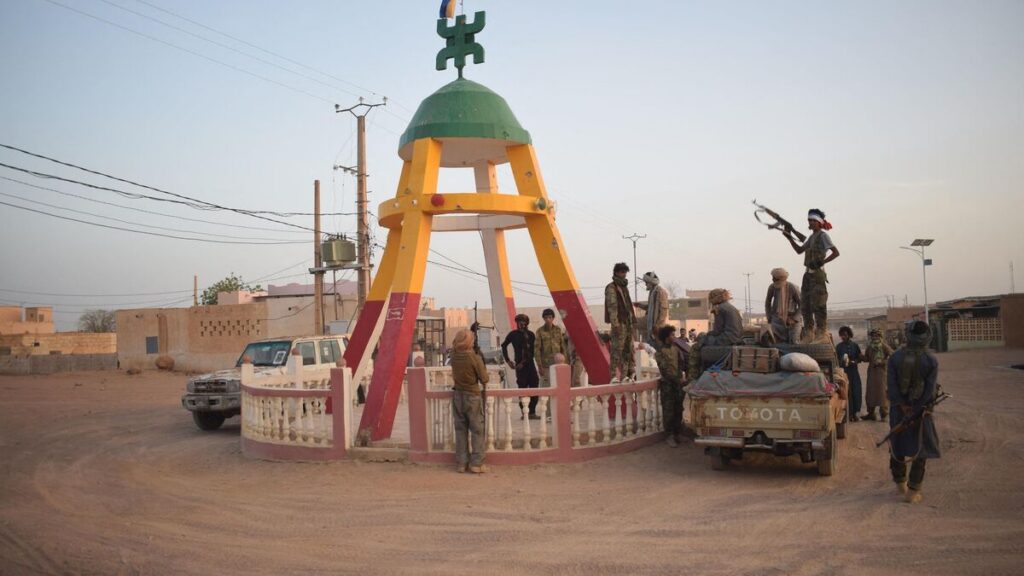
Tuareg rebels of the Azawad Liberation Front (FLA) coalition gather at the Kidal roundabout in Kidal, on April 26, 2026. April 25, 2026's shock attacks, synchronised by Tuareg rebels of the Azawad Liberation Front (FLA) coalition and the jihadist Group for the Support of Islam and Muslims (JNIM), targeted several areas in the vast arid country. Fighting resumed on April 26 in several areas, including Kita near Bamako, Kidal, Gao and Severe. Tuareg rebels meanwhile announced an agreement allowing Russian forces backing Mali's army to withdraw from the northern city of Kidal, which they claimed was "totally" under their control. (Photo by abdollah Ag Mohamed / AFP)
In a dramatic turn of events, rebels allied with Tuareg factions seized control of Kidal, a strategic stronghold in eastern Mali, over the weekend. The city had been firmly held by the Africa Corps, a shadowy Russian paramilitary unit, for years. Despite this setback, the group remains a critical asset for Moscow in the Sahel region.
The sudden shift follows a weekend of intense clashes across Mali, including attacks in Bamako where Defense Minister Sadio Camara was killed. These coordinated offensives underscore the volatility gripping the country as foreign-backed forces realign their strategies.
From Wagner to Africa Corps: a strategic pivot
Africa Corps emerged in late 2023 as a successor to the infamous Wagner Group, which had operated in Africa for nearly a decade. Following the deaths of Wagner’s founders—oligarch Evgeny Prigozhin and former officer Dmitry Utkin—in a suspicious plane crash in August 2023, Moscow sought a more centralized and discreet military arm to advance its interests on the continent.
Officially revealed by military blogger Deux Majors and later confirmed by Kremlin-aligned analyst Igor Korotchenko, Africa Corps was placed under the oversight of Russian Deputy Defense Minister Yunus-bek Yevkurov. Unlike Wagner, which operated with relative autonomy, Africa Corps answers directly to Moscow, reflecting a more rigid command structure.
A name steeped in historical irony
The choice of name, Africa Corps, is no coincidence. It deliberately mirrors the Afrikakorps, Nazi Germany’s military unit that operated in North Africa during World War II. This provocative reference serves as a reminder of Moscow’s willingness to leverage historical parallels to assert influence in the region.
Clear objectives: sovereignty and anti-Western alignment
From the outset, Africa Corps has outlined its mission: conducting large-scale military operations to help African nations break free from neocolonial dependencies, expel Western influence, and achieve full sovereignty. Korotchenko emphasized that the group’s role is to support allied governments by providing troops, training, and military equipment.
While Africa Corps presents itself as a more disciplined alternative to Wagner—avoiding the latter’s reputation for human rights abuses—it has not escaped international scrutiny. In 2024, the UK sanctioned the group, accusing it of widespread human rights violations and exploiting natural resources for profit.
A growing footprint across the Sahel
Africa Corps began consolidating its presence in 2024, particularly in Mali, where it took over Wagner’s operations after the group’s decline. Hundreds, if not thousands, of fighters were deployed, with several Wagner commanders defecting to its ranks. The group’s primary mission has been to bolster the Malian junta against Tuareg rebels and other insurgent factions.
Moscow’s involvement goes beyond military support. By propping up allied governments, Russia seeks to extend its geopolitical reach, secure critical migration routes, and gain access to valuable mineral resources. The withdrawal of Western powers, including France, from the region has created a power vacuum that Africa Corps is actively filling.
Beyond Mali, Africa Corps has expanded into Burkina Faso, Libya, Sudan, the Central African Republic, and Niger. While its methods may be less overtly violent than Wagner’s, the group’s growing influence is reshaping the security landscape of the Sahel.

More Stories
Niger: Tiani faces fallout from special forces anger after Russian intervention
Crisis in Niger, IMF agreement in Sénégal, and Moroccan elections: Five essential stories
RDC-Israël : un rapprochement aux enjeux multiples