Repression to mask escalating challenges
Across the Sahel, military regimes within the Alliance of Sahel States (AES) are facing profound legitimacy crises, leading to widespread repression, arbitrary detentions, and severe restrictions on fundamental freedoms. This climate presents immense difficulties for human rights advocates and media organizations operating in Burkina Faso, Mali, and Niger.
The adage, ‘those who live by the sword shall perish by the sword,’ resonates with the current situation. Alioune Tine, president of Afrikajom Center, recently commented on the escalating challenges. He observed that the regime led by Ibrahim Traoré in Burkina Faso, much like its counterparts in Mali and Niger, is grappling with significant difficulties. A primary justification for the military takeovers was the deteriorating security situation. However, this very situation has often worsened since their ascent to power, becoming even more alarming than before. Tine highlighted the inherent fear among those who seize power by force: the constant dread of losing it the same way.
Recalling earlier statements, Mr. Tine reminded that Captain Traoré had initially pledged a swift return to civilian rule. Yet, these promises remain unfulfilled. Instead of preparing for elections to allow Burkinabé citizens to choose their leaders, the regime has increasingly resorted to repressive measures to maintain control. Tine lamented, ”Upon assuming power, the captain declared: ‘The ECOWAS deadline is too long; we will swiftly hold an election and return power to civilians.’ All these promises have been abandoned. Today, the human rights situation is deteriorating rapidly. We are witnessing what amounts to a massacre against certain communities, particularly the Fula people. This is an extremely alarming development,” emphasized the human rights defender.
”Military regimes are at a dead end”
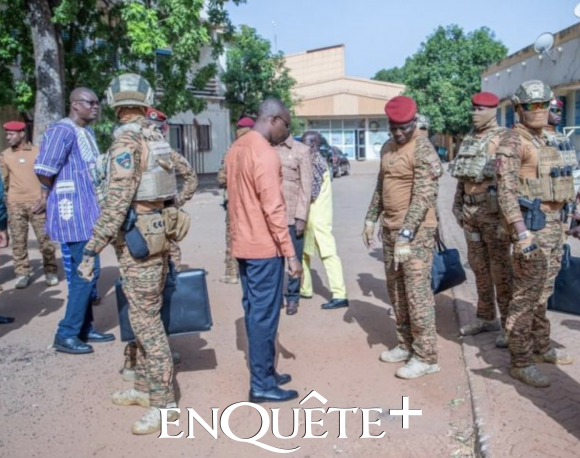
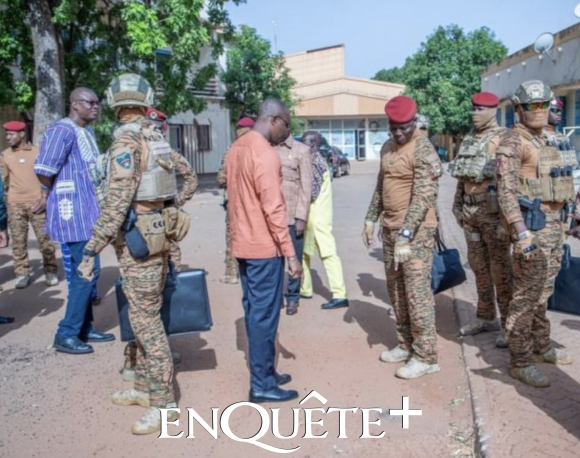
Contrary to official narratives, the security landscape in Burkina Faso is worsening, with attacks becoming more frequent and casualties mounting. A recent devastating incident occurred on June 11 in Mansila, reportedly claiming around a hundred lives, according to various sources. The BBC noted that rumors circulating on social media suggested this attack significantly impacted troop morale. Access to the town remains restricted without a military convoy, and communication networks are down, making it nearly impossible to contact local actors.
Amidst the junta leader’s prolonged silence, an explosive device struck the public television station (RTB) in Ouagadougou on June 12, causing several injuries. This incident fueled confusion and speculation, with some suggesting a mutiny within the barracks or even a coup attempt. Ibrahim Traoré eventually broke his silence to reassure the populace. During his visit to RTB, which typically follows the weekly cabinet meeting, he dismissed the incident as an isolated event. He urged Burkinabé citizens to disregard what he termed “enemy media” disseminating “fake news,” asserting there was no mutiny, rebellion, or coup. “It’s imaginary,” he declared, challenging those who claimed his position was vacant: “If the post is vacant, they should come and take it. They haven’t understood anything. These people have been paid to lie.”
Over a hundred soldiers killed in Burkina, deep suspicions within the ranks
The escalating situation in Burkina Faso has drawn the attention of international human rights organizations. Amnesty International and the Senegalese Coalition of Human Rights Defenders are planning a peaceful demonstration to protest the “repression of press freedom and freedom of opinion and expression” in the country. They are demanding the “release of human rights defenders who have been incarcerated or forcibly enlisted into the Volunteers for the Defense of the Homeland, including lawyer Guy Hervé Ham, who has been detained since January 24.”
The events unfolding in Burkina Faso are indicative of the broader challenges faced by military-led nations in the region. Initially welcomed as saviors, these regimes have largely failed to improve conditions beyond those of the civilian governments they overthrew, with very few exceptions.
In Mali, despite some reported progress in controlling the northern territories, fundamental issues persist. Socio-economic conditions, in particular, continue to deteriorate. Alioune Tine commented, “There is a failure. As in Burkina Faso, we are in a kind of stalemate across all these countries. The leaders not only suffer from a lack of legitimacy but also fail to alleviate the suffering of their populations. In Mali, exiled opposition figures have even established a government, highlighting a significant legitimacy crisis.”
Alioune Tine: ”ECOWAS is divided between pro-Russian and pro-Western factions.”
Faced with mounting dissent, these military governments are increasingly employing tactics of intimidation and repression. Abuses range from arbitrary detentions and the abduction of human rights defenders to the closure of both national and international media outlets, all in an effort to cling to power. Alioune Tine describes these developments as the emergence of “total dictatorships.” He noted, “They even dare to abduct civil society figures. This is a true dictatorship. People are being taken and sent to the front lines. Individuals as old as 70 are being abducted and forced into combat.” Furthermore, these regimes have, out of political expediency, sought protection from nations less concerned with human rights, such as Russia. Tine expressed regret, stating, “Unfortunately, the dynamics of integration within ECOWAS have been undermined by allowing major powers to play their games. ECOWAS is now completely fractured between those perceived as pro-Western or pro-French and those who are pro-Russian. This severely damages inter-African cooperation and is a catastrophe for the sub-region. I believe ECOWAS must also re-evaluate its approach to better address the concerns of its people, especially the youth.”
Among these pressing concerns are the issues surrounding the CFA franc and foreign military bases. Tine remarked, “My only regret regarding military bases is the lack of a viable alternative to the departure of French bases.”