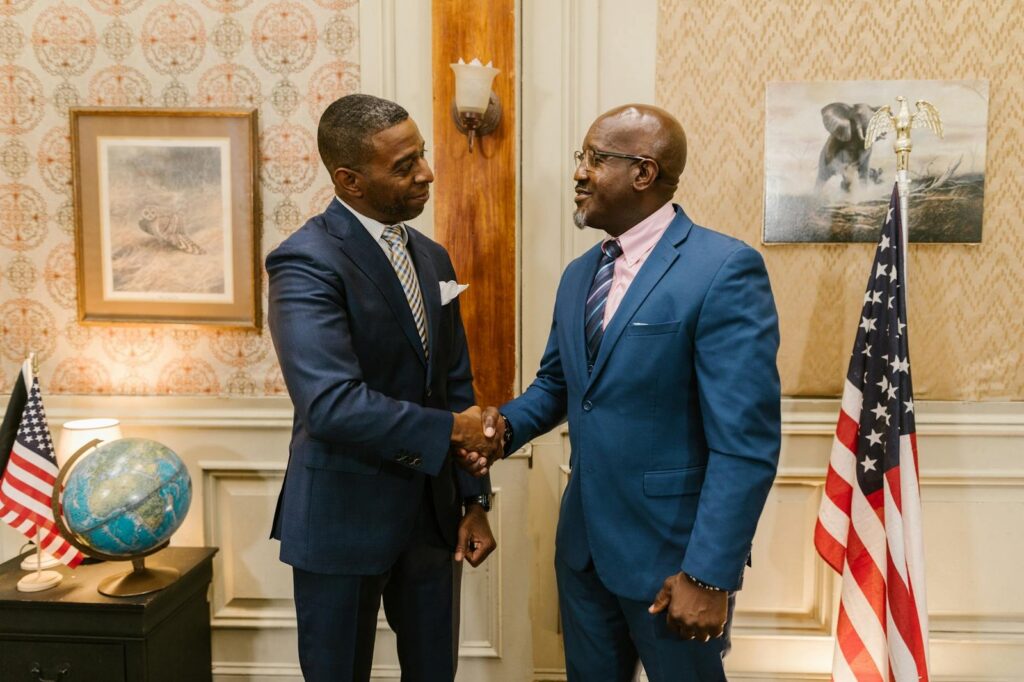
The diplomatic landscape between Senegal and Botswana is undergoing a significant shift. Following a high-level meeting, President Bassirou Diomaye Faye and President Duma Boko have expressed their commitment to fostering deeper economic collaboration between Dakar and Gaborone. Both leaders, who assumed office within months of each other amid political transitions, share a unified perspective on Africa’s challenges and a strong commitment to sovereignty in economic decision-making.
Emerging South-South cooperation with untapped potential
Trade between Senegal and Botswana remains minimal, constrained by geographical barriers and distinct regional integration blocs—the Economic Community of West African States (ECOWAS) for Dakar and the Southern African Development Community (SADC) for Gaborone. No direct preferential trade agreements exist between the two nations, and cross-border investments are virtually nonexistent.
This gap presents an opportunity the two presidents aim to address. The African Continental Free Trade Area (AfCFTA), launched in 2021, now provides a legal framework to facilitate bilateral partnerships previously unheard of. Faye and Boko plan to leverage this mechanism to streamline trade, enhance the movement of goods, services, and expertise, and unlock new economic synergies.
Industrial strengths that could drive mutual growth
While their economies differ sharply, Senegal and Botswana exhibit complementary potential. Botswana, renowned for its diamond-driven prosperity, is the world’s top producer by value in this sector. However, it has been diversifying its economy, investing in local processing, and reducing reliance on a single revenue stream for years.
Senegal, meanwhile, is expanding its hydrocarbon sector through projects like Sangomar and Grand Tortue Ahmeyim, while reinforcing its agricultural, fisheries, and financial services sectors. The country is also advancing in digital innovation, higher education, and professional training—areas where French-speaking Botswana could benefit from partnerships. Another key area for collaboration is extractive revenue management, where Botswana’s decades-old sovereign wealth fund, fuelled by diamond earnings, offers valuable lessons.
A diplomatic pivot toward unconventional African alliances
For Senegal’s president, engaging with Botswana reflects a broader diplomatic strategy. Since assuming office in April 2024, Faye has prioritized partnerships beyond West Africa and North Africa, positioning his administration as a champion of renewal. Botswana, widely recognized as one of Africa’s most stable democracies, aligns with this vision and provides a credible platform for a government advocating systemic change.
Duma Boko, a reformist leader and former opposition figure who rose to power in late 2024, shares this transformative agenda. His election marked the end of nearly six decades of dominance by the Botswana Democratic Party, signaling a political renewal that resonates across the continent. The alignment of their narratives could give their bilateral initiative symbolic weight and momentum.
The real test lies in turning intent into action. Diplomatic teams must identify priority sectors, overcome logistical hurdles—such as the absence of direct flights—and establish a legal and regulatory environment conducive to cross-border investment. Without concrete mechanisms, today’s pledge risks fading into obscurity, as has happened with countless memoranda of understanding in Africa. Establishing a joint commission or a dedicated business forum could serve as an early signal of seriousness and commitment.
Key takeaways
- Shared vision: Both leaders aim to bridge economic gaps using the AfCFTA as a launchpad.
- Economic complementarity: Botswana’s diamonds and Senegal’s hydrocarbons, agriculture, and digital sectors offer mutual benefits.
- Political alignment: Both countries are led by reformist governments advocating sovereignty and transparency.
- Next steps: Operational frameworks and sector-specific initiatives are essential to move past declarations.