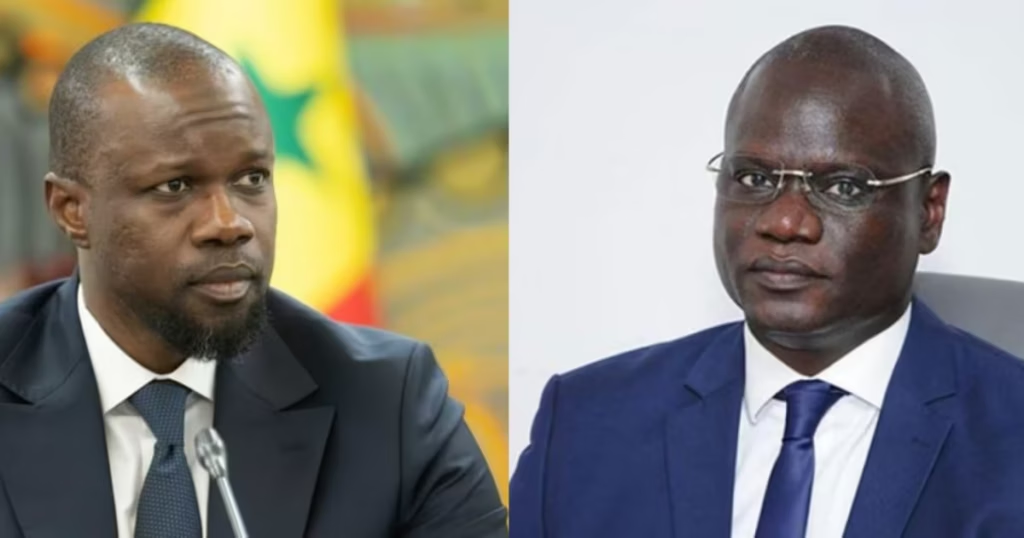
Over the past two years, Senegal’s Ministry of Higher Education has seen three leadership changes, with Abdourahmane Diouf serving initially, followed by Daouda Ngom, and Boubacar Camara taking office on June 1, 2026.
One of the six parliamentary inquiry commissions scheduled for discussion during the extraordinary session convened by the National Assembly on Monday, August 10, 2026, has drawn significant attention: an investigation into alleged irregularities in the procurement and execution of contracts under the ‘One Student, One Laptop’ program, managed by the Ministry of Higher Education, Research, and Innovation (MESRI) since 2017. The program’s cumulative financial commitment is estimated at approximately 48 billion West African CFA francs. A pressing question arises in political and media circles: Is this inquiry, at its core, targeting former minister Abdourahmane Diouf?
An investigation rooted in months of scrutiny
This issue is not new. As early as November 8, 2025, then-Prime Minister Ousmane Sonko publicly highlighted irregularities in the management of certain higher education initiatives, specifically questioning the operations of the ministry under Abdourahmane Diouf’s leadership. In response, Diouf called on lawmakers to establish a parliamentary inquiry to fully investigate these matters, including the construction of five university campuses, while acknowledging shared responsibility alongside the Prime Minister.
The inquiry spans back to 2017—long before the current administration took office—encompassing the tenures of multiple ministers across different periods. The spotlight now falls on the management of this program during Diouf’s time in office, though the official decree does not explicitly name any individual.
A backdrop of political friction
The timing of this parliamentary probe coincides with heightened political tensions between Sonko and Diouf. Abdourahmane Diouf, a former leader of the Awalé party and once a key ally of the ruling coalition, later joined Kiiraay – Les Patriotes républicains, the party backed by President Bassirou Diomaye Faye. This shift marked a departure from the Pastef movement and its leader, Ousmane Sonko, fueling speculation among observers that the inquiry may serve as a pretext for political retaliation.
While the decree convening the extraordinary session does not explicitly target Abdourahmane Diouf, the inquiry covers the entire 2017–2026 period—a near-decade span of program management that could implicate multiple ministers and technical directors at the MESRI. No names are explicitly mentioned in the official text.
Ultimately, while the timing of the inquiry aligns with Diouf’s departure from the presidential camp and his alignment with Kiiraay, no concrete evidence currently suggests that Ousmane Sonko is specifically targeting his former government colleague through this parliamentary procedure. Only the findings of the inquiry, once initiated and made public, will reveal the full extent of accountability within the management of this 48 billion CFA franc program.
More Stories
OL Lyon faces Chelsea stalemate: can the French giants recover from their Champions League setback?
Ambush near Niono: can Africa Corps withstand the JNIM’s new tactics in Mali?
Mali’s hunger crisis: can humanitarian funding keep pace with escalating needs by 2027?