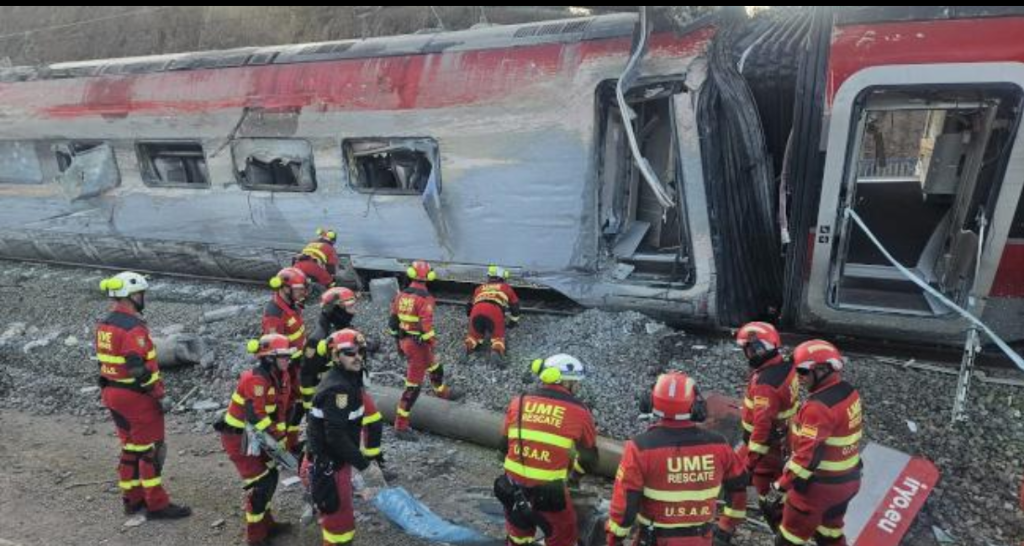
Spain is reeling from a devastating high-speed train collision near Urda in the province of Toledo, which has left at least 46 people dead and 179 injured. The accident has sent shockwaves through the nation, raising urgent questions about rail safety and the real-world consequences for families and businesses.
How the tragedy unfolded on a critical rail route
A high-speed train operated by Spain’s public rail company, Renfe, collided with a stationary train managed by the private operator Iryo on a key rail link connecting Madrid to Andalusia. The impact was so severe that multiple train cars derailed, with some being thrown off the tracks onto an embankment, complicating rescue efforts.
The collision occurred on a stretch of track where high-speed services typically operate at speeds exceeding 300 km/h. The presence of passengers on both trains made the situation even more dire, as emergency teams worked frantically to evacuate those trapped in the wreckage.
Rescue operations and the human toll
Emergency services—including firefighters, medical teams, and civil protection personnel—were immediately deployed to the scene. Injured passengers were rushed to nearby hospitals, with the most critical cases receiving priority care. The first hours after the accident are often the most crucial for stabilizing victims and preventing further loss of life.
Beyond the physical injuries, the emotional toll on families is immeasurable. Many relatives are still awaiting confirmation about the fate of their loved ones, while others have received the devastating news of a loss. The identification of victims and the notification of families remain a top priority for authorities.
The accident has also disrupted rail travel across the region, with services suspended on key routes. Travelers heading to or from Madrid, as well as those traveling southward, have faced significant delays and cancellations.
Investigating the root causes of the disaster
With the human cost now tragically clear, the focus has shifted to uncovering how such a collision could occur on a high-speed rail line. Initial reports suggest potential issues with signaling systems, traffic management, or communication between train operators and control centers.
However, these remain preliminary hypotheses. A thorough technical investigation will be required to reconstruct the sequence of events leading up to the crash. Investigators will examine:
- Train control and signaling systems
- Communication logs between drivers and control centers
- The condition of the infrastructure at the time of the accident
- Potential technical failures or human errors
The goal is to determine whether this tragedy could have been prevented with better safety measures or stricter protocols.
Rail safety under scrutiny once again
This accident comes at a time when Spain’s rail safety record is already under intense scrutiny following a series of recent incidents. The collision near Toledo is likely to reignite debates about infrastructure maintenance, the reliability of safety equipment, and the effectiveness of traffic management procedures.
While past accidents provide valuable lessons, authorities emphasize that each incident must be evaluated on its own merits before drawing broader conclusions about the safety of Spain’s rail network.
What comes next for Spain’s rail system and its people?
For the Spanish government, the immediate priorities are twofold: providing clarity to the families of victims and preventing future tragedies. The findings of the investigation will be critical in determining whether changes to rail safety regulations or infrastructure upgrades are necessary.
In the meantime, the nation remains in a state of shock. The collision near Urda has left behind broken families, shattered lives, and a community grappling with the aftermath of an avoidable disaster. As the investigation unfolds, the focus must remain on delivering justice for the victims and ensuring that such a tragedy never occurs again.