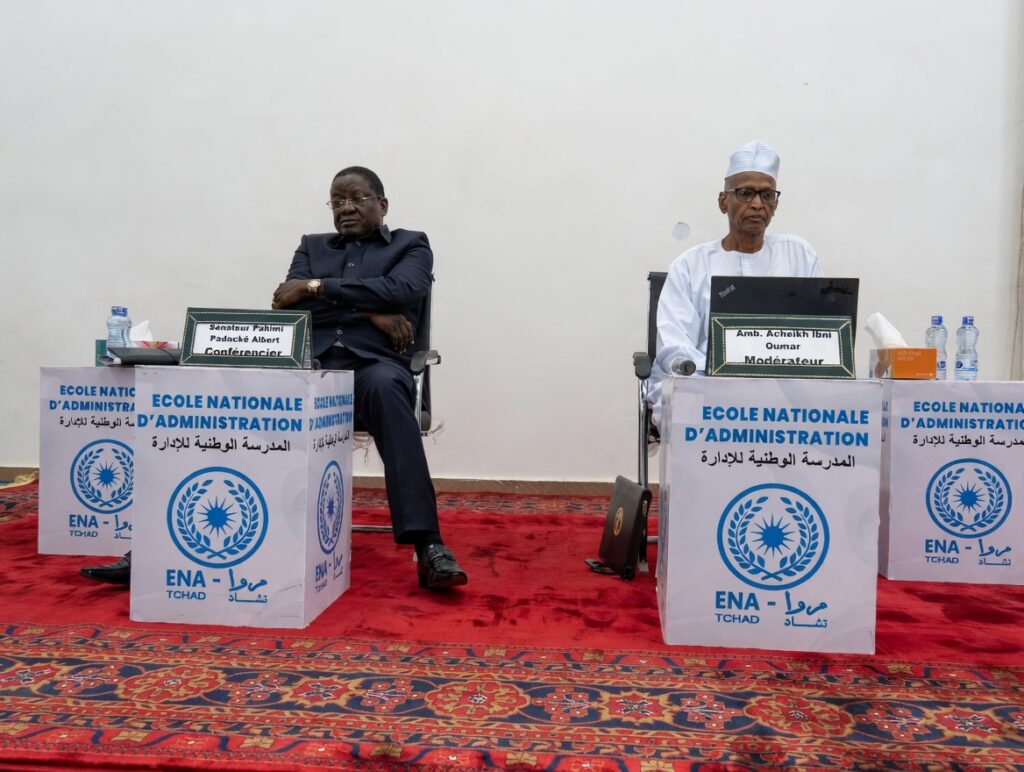
The École Nationale d’Administration (ENA) hosted a high-profile conference-debate this Friday afternoon, centered on a pressing national issue: « The role of provincial councils in advancing decentralization and local development ». The event featured a keynote address by Senator and former Prime Minister Albert Pahimi Padacké, drawing a packed audience of students, civil servants in training, administrators, and political stakeholders.
Pahimi Padacké, a seasoned politician with a deep background in public administration, delivered a structured and insightful presentation that resonated with attendees. He opened by emphasizing the significance of discussing decentralization—a topic of critical importance to Chad’s future—while highlighting the unique contributions provincial councils can make to local growth.
The former Prime Minister framed his analysis within a broader historical and global context. He traced Chad’s decentralization journey to the early 1990s, a period marked by democratic transitions across Africa, international donor pressure, and a growing emphasis on governance models centered on citizen empowerment. The core question remained: Are provincial councils already driving development, or can they become its engine?
Pahimi Padacké structured his remarks around three pivotal themes:
- Legal and political foundations: How decentralization laws serve as catalysts for development.
- Existing barriers: The challenges impeding provincial councils from fulfilling their potential.
- Actionable solutions: Strategies to transform these councils into engines of local progress.
He traced the origins of decentralization to the 1993 Sovereign National Conference, which laid the groundwork for a highly decentralized unitary state. This vision was enshrined in the 1996 Constitution and later reinforced in subsequent texts, including the 2023 Constitution (5th Republic).
On the legal front, several key laws have been enacted to support this model, including the 2024 Organic Law No. 14 on the status of autonomous local governments and Organic Law No. 28 on the division of competencies between central and local authorities. Pahimi Padacké underscored two core principles: the transfer of competencies and resources, and the principle of subsidiarity (Article 271 of the Constitution), which mandates decision-making at the most local level possible.
He noted that Organic Law No. 28 effectively transfers significant responsibilities to provincial councils, though implementing texts are still needed to clarify practical modalities.
In his assessment of current hurdles, the former Prime Minister identified critical gaps: delays in transferring financial and human resources, insufficient technical and administrative capacity within councils, governance challenges, and coordination issues between decentralized administrations and elected local bodies.
To address these obstacles, Pahimi Padacké proposed concrete measures: accelerating the actual transfer of resources—including oil and tax revenue shares—enhancing the skills of council members and staff, establishing robust monitoring and evaluation mechanisms, fostering greater involvement from civil society and development partners, and strictly upholding the principle of subsidiarity to ensure decentralization is more than just a theoretical framework.
He urged future administrators to embrace these priorities, stressing that the success of decentralization is pivotal to balanced national development and bringing governance closer to citizens.