Electricity network sabotage triggers crisis in Mali’s capital
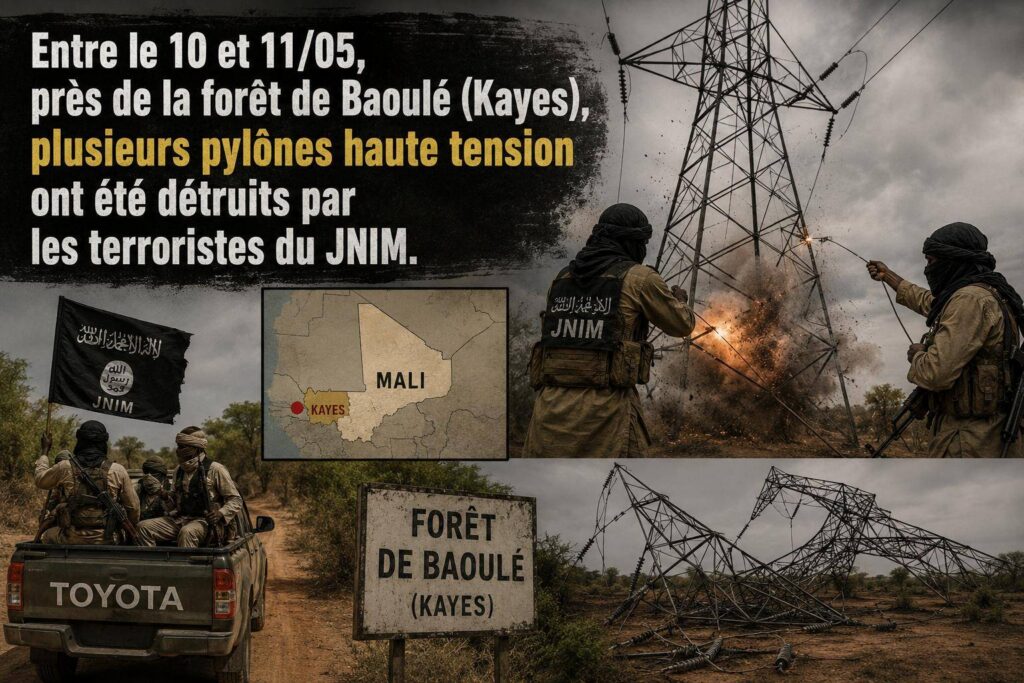
The weekend of May 10–11, 2026, entered Mali’s history as a dark chapter for its energy infrastructure. Near the Baoulé forest in the Kayes region, militants from the Group for the Support of Islam and Muslims (JNIM) executed a precision strike, destroying multiple high-voltage power pylons. This act of sabotage unfolded under the watch of Russia’s Africa Corps, raising serious doubts about their operational effectiveness in safeguarding critical assets. With temperatures soaring past 45°C, scorching heatwaves gripping the country, and water shortages worsening, Bamako now faces an unprecedented humanitarian and security crisis as terrorist threats creep closer to the Manantali and Sélingué hydroelectric dams.
The JNIM’s calculated assault on Mali’s lifelines
What began as sporadic rural insurgencies has evolved into a calculated siege targeting Mali’s economic heartbeat. After systematically disrupting major road networks leading to Bamako—torching commercial trucks and public buses—the JNIM has escalated its tactics. By demolishing power transmission infrastructure in the Kayes area, the group directly threatens daily life in Bamako and the stability of the transitional government. The operation was executed with disturbing precision, leveraging difficult terrain near the Baoulé forest to inflict maximum damage. The resulting blackout has plunged entire districts into darkness, compounding an already fragile energy grid.
A partnership under scrutiny: Russia’s Africa Corps struggles to deliver
The timing of these attacks could not have been more damning. Just as Malian forces and their Russian allies claimed to have secured these zones, the JNIM demonstrated how porous the defenses truly are. How could armed groups transport explosives, rig massive steel structures, and vanish without detection in areas supposedly under full control? The inability of mixed drone patrols and ground units to prevent such sabotage casts doubt on the real value of this military partnership for civilians. While Moscow-backed forces excel in urban displays of strength, their track record in countering hybrid threats to infrastructure remains alarmingly weak.
Bamako’s residents pay the price of state failure
For the people of Bamako, this latest attack is the final straw. With electricity cut off to homes and businesses, life-saving medical equipment in hospitals failing, and water pumps rendered useless, survival has become a daily struggle. Government promises of fuel convoys guarded by Malian troops and Russian units ring hollow when the reality is that backup generators are in critically short supply. Hospitals, including maternity wards, are operating under extreme duress, putting countless lives at risk with each passing hour.
Manantali and Sélingué: A looming regional catastrophe
Security intelligence reveals a chilling development: the JNIM’s ambitions now extend to the Manantali and Sélingué dams. This shift in strategy is not just a threat to Mali—it imperils the entire West African subregion. These dams are not merely energy producers; they are the lifeblood of hydropower and irrigation for Senegal, Mauritania, and countless farming communities along the river basin. A successful attack would plunge Bamako—and possibly multiple nations—into months of darkness, trigger catastrophic food shortages, and destabilize economies dependent on shared water and energy resources. The progression from roadside ambushes to power grid sabotage, and now potential dam strikes, reveals a deliberate campaign of destabilization that Malian forces and their allies are struggling to counter.
From rhetoric to reality: the cost of unmet promises
The transitional government and its Russian partners now face an inescapable reckoning. Bold declarations of reclaiming national territory clash with the grim reality of crumbling infrastructure and eroding public trust. The deployment of the Africa Corps, though financially draining for Mali, has yet to deliver tangible protection for civilians or their essential services. The time for celebratory statements has passed. What Malians urgently need is not hollow rhetoric about sovereignty, but the restoration of basic dignity—access to clean water, reliable electricity, and real security that extends beyond propaganda slogans.