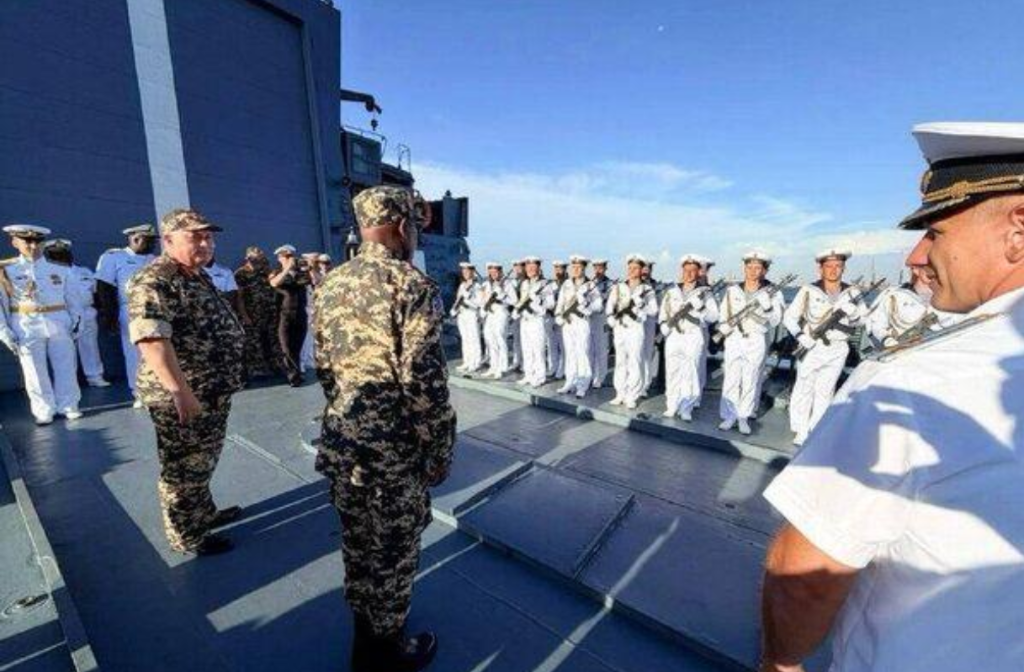
The arrival of the Russian naval training ship Perekop at Walvis Bay on October 20, 2026, was billed as a routine maritime training mission. Yet, in an era where global power plays extend from the Black Sea to the Indian Ocean, even a brief port call can ripple far beyond the dock.
Why this Russian naval visit to Walvis Bay could reshape Namibia’s future
At first glance, the presence of the Perekop—a Baltic Fleet training vessel—appears to be nothing more than an academic exercise for cadets. Over seven days at sea, the ship covered more than 1,800 nautical miles, simulating long-range navigation and route planning under real-world conditions. The voyage was officially framed as an educational mission, and the training narrative remains plausible.
However, maritime training missions are rarely purely symbolic. They serve as diplomatic icebreakers, logistical hubs, and windows into a nation’s strategic intentions. For a country like Russia—locked in geopolitical rivalry with Western powers—every port of call becomes a potential node in a broader network of influence.
Walvis Bay as a strategic gateway: beyond the visible harbor
Walvis Bay, Namibia’s only deep-water port on the Atlantic, sits at a critical crossroads of Southern African trade. It handles container traffic, fishing exports, and transshipment to landlocked countries, including Botswana and Zambia. Any disruption—logistical, political, or security-related—could ripple through regional supply chains.
Russian naval visits, even brief ones, signal more than goodwill. They can:
- Accelerate customs and port access agreements, potentially giving Russian vessels priority in handling, fuel, or repairs.
- Encourage Namibian officials to consider Russian military training, procurement, or technical support in future defense planning.
- Normalize Russian presence in a port that also serves European and American naval missions, subtly altering regional power dynamics.
These consequences are not speculative. In 2023, a similar stopover by a Russian surveillance ship in Guinea led to a temporary suspension of port calls by the U.S. Navy. The ripple effect was felt in regional maritime insurance rates and port tariffs within months.
Economic ripple effects: from training ship to strategic asset?
The arrival of the Perekop didn’t go unnoticed in Namibia’s business community. Local logistics firms and shipping agencies saw an immediate uptick in inquiries from European and Asian clients seeking alternative routes—avoiding potential chokepoints in the Red Sea or Suez Canal.
At the same time, rumors circulated about a possible future agreement between TransNamib, Namibia’s state-owned transport company, and a Russian logistics firm specializing in deep-sea cargo. While no deal was announced, the mere presence of a Russian warship creates an environment where such conversations become politically palatable.
For Namibia, the real question isn’t whether this visit is a training exercise—but what it signals to foreign investors. If global powers perceive Walvis Bay as a potential Russian ally, capital flows could shift. Some sectors might benefit from new trade routes; others could face increased scrutiny or insurance costs.
Security concerns: balancing benefits and risks
The Namibian government has emphasized that the Perekop’s call was peaceful and in line with international maritime law. Still, analysts warn that any foreign military presence in a strategic port carries long-term risks.
Challenges could include:
- Regional misperceptions: Neighboring countries may view the visit as an endorsement of Russian military expansion in Southern Africa.
- Port security vulnerabilities: Increased foreign naval activity could expose infrastructure to espionage, cyber threats, or sabotage risks.
- Diplomatic strain: Namibia maintains strong ties with the EU and U.S. Any perceived tilt toward Moscow could complicate trade negotiations or defense cooperation.
A senior official from the Namibian Navy, speaking on condition of anonymity, confirmed that the visit led to discussions on future maritime security exercises. While no timeline was set, the groundwork was laid. This could mean more Russian naval deployments—or just a one-off gesture. The difference lies in what happens next.
From port call to power play: what comes after the Perekop?
As of now, there is no evidence of a secret military pact or permanent Russian base in Namibia. But history shows that grand strategy often begins with small steps: a port visit, a training agreement, a logistics memorandum.
What will determine the Perekop’s legacy in Walvis Bay is not the ship itself, but the follow-up. Will future Russian vessels make regular stops? Will Namibia sign defense cooperation accords? Will Russian companies invest in port infrastructure?
Until then, Namibia walks a fine line: leveraging the diplomatic goodwill of a high-profile visit without compromising its neutral stance in global power struggles.
The real impact of this naval stopover may not be felt today. It may only become clear when the next ship docks—or when the next crisis arises.