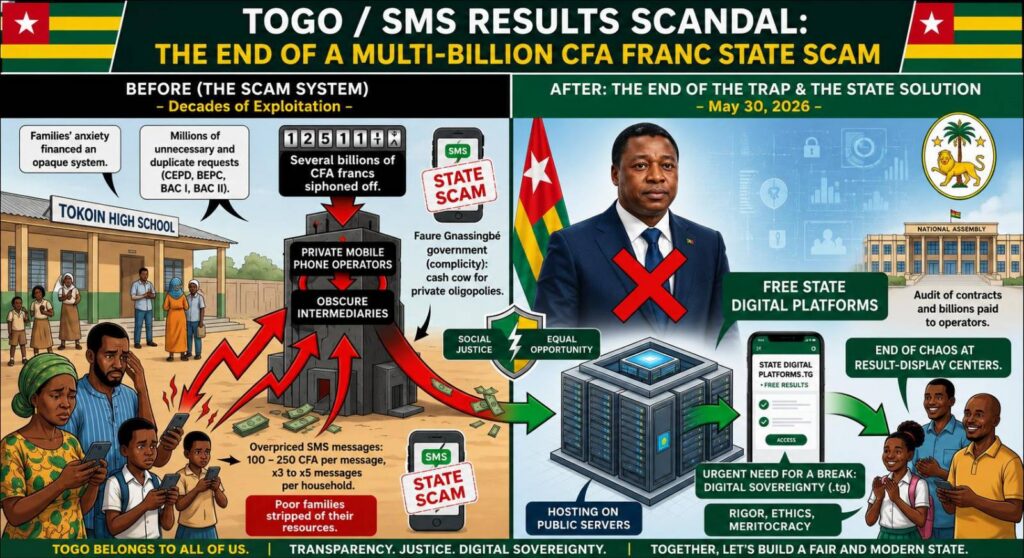
For generations, Togo’s education system operated as a conduit for a brazen financial drain on households, particularly those least equipped to absorb such costs. The abrupt announcement by the newly appointed National Education Minister, Mama Omorou, to abolish the SMS-based examination result system has exposed what can only be described as a state-sponsored financial racket spanning decades under the administration of Faure Gnassingbé.
Exposing the scheme: When anxiety fueled a parasitic system
On 30 May 2026, during an unannounced inspection of BAC I correction centers in Tokoin and Agoè-centre high schools, Minister Omorou delivered a scathing assessment of the SMS result consultation process, branding it a ‘financial deception’ and a ‘catastrophic waste of public funds’.
The mechanics of this elaborate scheme were deceptively straightforward. With each national examination cycle—CEPD, BEPC, BAC I, and BAC II—the same pattern unfolded. Families, gripped by the dread of prolonged uncertainty, resorted to sending multiple SMS messages (priced between 100 and 250 CFA francs per unit) to retrieve identical results. This redundant practice, repeated across hundreds of thousands of candidates annually, generated an artificial surge in revenue at the expense of desperate parents.
Quantifying the losses: A staggering financial hemorrhage
While the Minister has yet to release detailed financial audits, preliminary estimates paint a stark picture. By aggregating the annual number of candidates—spanning hundreds of thousands of students—and accounting for the multiplicative effect of multiple SMS transmissions per household (often three to five messages per family), the total volume of redundant queries reaches tens of millions per examination session.
Over the past 15 to 20 years of uninterrupted governance, this practice has funnelled billions of CFA francs away from Togolese families. The funds did not, however, bolster the public education system. Instead, they enriched private telecom operators and shadowy intermediaries, beneficiaries of state concessions that remained unchallenged for decades. This amounted to a systemic transfer of wealth from vulnerable citizens to a privileged oligopoly, facilitated by the passive or active complicity of outgoing authorities.
The path forward: Digital platforms as the antidote
Minister Omorou’s decision to terminate SMS-based results is a necessary first step, but it introduces a pressing challenge: ensuring a seamless transition without reverting to the chaotic scenes of yesteryears—crowded schoolyards where families jostled for hours in anxiety-ridden anticipation.
Togo, which has long championed its digital integration agenda—spearheaded by the Ministry of Digital Economy—must now prioritize the development of secure, state-run digital platforms for result dissemination. This transition demands three critical pillars:
- Digital sovereignty: Examination results must be hosted on government-controlled servers under the .tg domain, ensuring data integrity and national ownership.
- Absolute transparency: Access to results must be entirely free, funded through the national education budget to uphold equity and eliminate financial barriers.
- Modernization: Leveraging lightweight web portals and batch email notifications—technologies that are both cost-effective and accessible via mobile devices—will streamline the process and restore public trust.
An ethical imperative: Reclaiming meritocracy in education
Beyond the financial scandal, the Minister used the inspection tour to reinvigorate the morale of examiners, emphasizing that rigor, ethics, and meritocracy must once again guide Togo’s educational institutions. This declaration signals a profound ideological shift: one that prioritizes social justice by shielding families from institutionalized exploitation.
The true test now lies in the government’s willingness to follow through. A comprehensive audit of past contracts with telecom operators is essential to uncover the full extent of the financial hemorrhage and hold accountable those who profited from defrauding the nation’s youth.