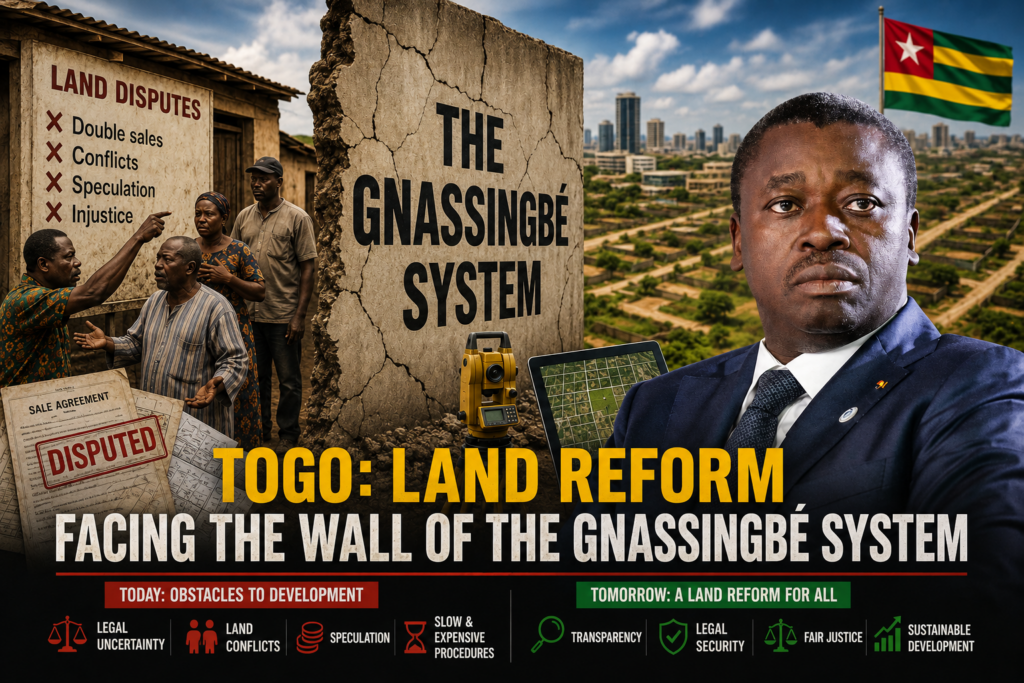
For sixty years, Togo’s land management system has been plagued by inconsistency and inefficiency, failing to provide the stability necessary for economic growth. Now, the government has pledged to overhaul the sector, positioning land reform as a cornerstone of national development. Yet this ambitious agenda faces formidable obstacles, rooted in systemic flaws that have long undermined public trust.
The most pressing challenge lies in the persistent legal disputes that plague land transactions. Double sales, property disputes, and inadequate record-keeping create an environment of uncertainty, where even a valid title deed cannot guarantee security. This legal ambiguity discourages investment, erodes household savings, and transforms land ownership into a financial risk rather than a safe asset.
Structural delays and administrative opacity
The bureaucratic hurdles involved in land transactions further exacerbate the problem. For both individuals and businesses, navigating the administrative process is often a lengthy, costly, and opaque endeavor. Without clear access to land records and transparent procedures, those with financial resources, political connections, or insider knowledge gain an unfair advantage. A meaningful reform must prioritize not only the issuance of more land titles but also the creation of a system where every citizen can verify a parcel’s history before making a purchase.
Judicial inefficiency fuels land conflicts
Protracted legal battles over land disputes do more than delay administrative processes they devastate families, stall inheritance claims, and block economic initiatives. A fair and efficient judicial system is essential to resolving these conflicts promptly and equitably. However, when court decisions are influenced by social status, political pressure, or financial leverage, the rule of law is undermined, and public confidence erodes. Without an independent and adequately resourced judiciary, no land reform can succeed in the long term.
Political entanglements complicate reform efforts
The land sector involves a complex web of stakeholders traditional owners, families, intermediaries, surveyors, local authorities, and government agencies. When some of these actors are entangled in political or economic networks, conflicts of interest and favoritism become inevitable. A credible reform must dismantle these grey areas rather than perpetuate them under a new guise. The challenge is not merely technical but deeply political, requiring a commitment to transparency and accountability at all levels.
Speculation and urban pressure intensify inequalities
In rapidly growing urban and peri-urban areas, rising land values have fueled speculation, leading to multiple sales, land grabs, and manipulation of records. Marginalized communities are disproportionately affected, as they lack the resources to navigate a market increasingly driven by profit rather than equity. Land, once a heritage to be passed down, is now treated as a speculative commodity accessible only to those with significant capital.
Social tensions and unresolved customary rights
Land disputes often erupt within families, between neighboring communities, or across generations over inheritance issues. The friction between customary land rights and modern legal frameworks remains unresolved, perpetuating cycles of conflict. A sustainable reform must integrate mediation, conflict prevention, and public awareness initiatives to bridge this gap and ensure harmonious coexistence.
Digital solutions: promise and pitfalls
Digitalization is frequently touted as a solution, but it must go beyond mere rhetoric. A reliable, accessible, and up-to-date land database could drastically reduce the risk of double sales and simplify pre-transaction verifications. However, digitization alone cannot rectify systemic flaws if the underlying data is incomplete, manipulable, or unevenly accessible. Technology must be paired with robust governance to ensure fairness and accuracy.
The transparency imperative
Transparency must extend to all actors involved in land management. How are parcels allocated? What criteria govern land distribution? Who oversees transactions? How are violations addressed? Without clear answers to these questions, skepticism toward new reforms will persist. Citizens need guarantees that administrative decisions can be challenged and that irregularities are met with appropriate sanctions.
Economic stakes: unlocking growth or perpetuating stagnation
A secure land tenure system empowers individuals to invest, enables businesses to expand, and allows banks to assess collateral accurately. It also enables the state to plan infrastructure and urban development effectively. Conversely, insecure land rights freeze capital, stifle projects, and foster an economy of mistrust. The implications stretch far beyond landowners, directly impacting the country’s ability to attract and retain investment.
The true test for Togo is not whether another land reform can be drafted, but whether the political will exists to implement a reform that is truly transformative. This would require unwavering transparency, effective penalties for fraudulent practices, a streamlined judiciary, a well-regulated administration, and robust protections for vulnerable populations. Without a genuine commitment to dismantling entrenched interests and upholding the rule of law, any new initiative risks becoming little more than a superficial facelift. Land reform in Togo will only fulfill its promise when the protection of the law supersedes the protection of partisan or personal interests.