In Bénin, traditional leaders hold a pivotal role in both sociocultural and institutional spheres, serving as guardians of local heritage, traditions, and community identity. Their moral and cultural legitimacy is widely acknowledged, a status reinforced by state recognition (Affo, Sina, & Gnanvi, 2019).
To formalize their functions—particularly in conflict resolution and social cohesion—the Béninese government enacted Law No. 2025-09 on April 3, 2025, establishing a legal framework for traditional leadership. This legislation categorizes and grants official recognition to 16 kingdoms and 90 traditional chiefdoms, underscoring their contributions to socio-economic development, social unity, and cultural preservation (Fatondji, 2025).
Despite their formal roles, traditional leaders often find themselves at the heart of national political dynamics. Political parties frequently enlist their support to sway voter preferences, sometimes offering material or financial incentives in return (Cessou, 2017). To curb these practices, Bénin has explicitly prohibited traditional kings and chiefs from engaging in partisan politics (République du Bénin, 2025).
Amidst this backdrop of institutional recognition and ongoing debates about their public role, Afrobarometer data sheds light on how Béninese citizens perceive traditional leaders—evaluating their influence, effectiveness, and role in local governance.
Citizens uphold trust in traditional leaders but demand political neutrality
Traditional leaders remain influential figures in Bénin’s public life. Nearly a quarter of citizens reported seeking their assistance in the year leading up to the survey, reflecting the trust placed in their guidance. A significant majority of respondents express confidence in their leadership and believe they play a meaningful role in local governance—with many advocating for an even greater influence.
However, this positive perception is tempered by growing concerns over integrity. Three-quarters of respondents suspect at least some traditional leaders of involvement in corrupt activities, a concern that has intensified since 2022. Trust in these leaders has also declined compared to 2020.
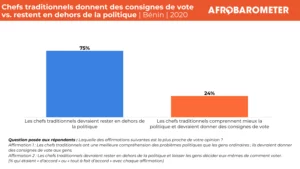
Despite their respected status, a strong majority of citizens believe traditional leaders should refrain from political involvement, emphasizing that voters should make independent choices without external influence.


More Stories
Cameroon’s youth online: a double-edged sword or a digital trap?
Morocco reaffirms commitment to safeguarding children amid armed conflicts
Mali’s leader assimi goïta navigates the sensitive debate on female genital mutilation