
how the unified force of the alliance of Sahel states can reach its goals
leaders of the alliance of Sahel states (AES) are gathering in Bamako for a two-day summit starting monday. this second session of the heads of state college aims to assess progress since the Niamey founding summit on july 6, 2024, review security, diplomatic, and development challenges, and appoint a new confederation president.
according to malian government sources, the meeting will evaluate the implementation of the roadmap during the confederation’s first year and move toward operationalizing its institutions. regional and international stakes will also be on the agenda during the december 22-23 discussions.
beyond the roadmap—which has already ensured the functioning of confederate bodies and strengthened coordination among the three member states—other notable advances have been achieved during the AES’s first year, according to the malian presidency. these include coordinated military operations and intelligence-sharing initiatives.
what is the unified force of the AES?
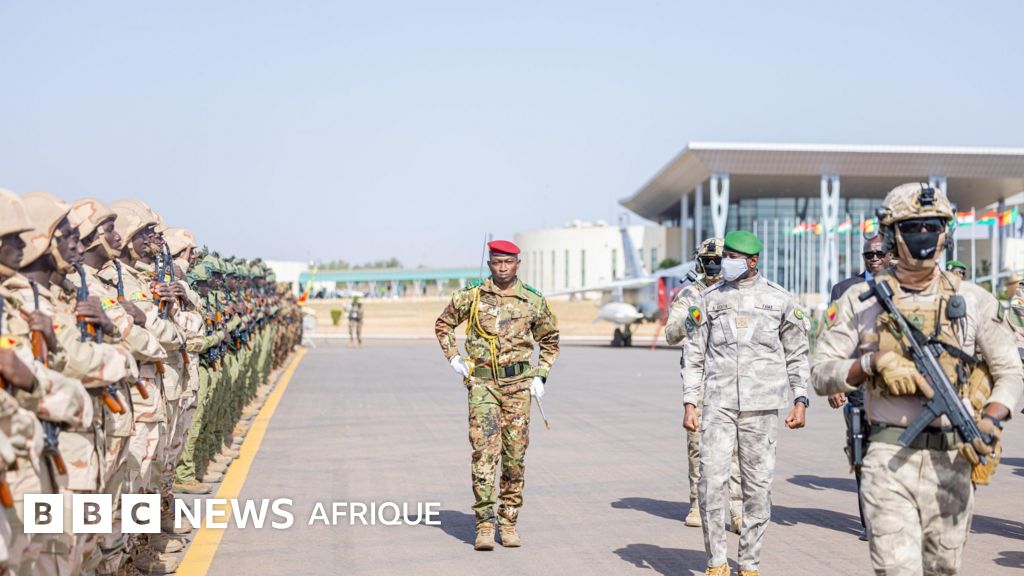
the unified force of the AES (fu-AES) was officially launched in Bamako ahead of the summit, led by general assimi goïta, president of the malian transition and AES confederation president. this multinational force comprises 5,000 soldiers from Mali, Burkina Faso, and Niger, under the command of general daouda traoré of Burkina Faso.
the fu-AES aims to address persistent security challenges, including armed attacks, cross-border instability, and the mobility of armed groups operating across borders. the force seeks to enhance military coordination, deepen intelligence sharing, and synchronize operations to reduce risks in vulnerable border zones.
key objectives of the unified force
- coordinated military action: joint operations to neutralize armed groups and dismantle criminal sanctuaries.
- intelligence fusion: merging intelligence from all three countries to enable rapid, targeted responses.
- sustained territorial control: ensuring long-term security by maintaining presence in liberated areas, protecting civilians, and preventing the return of armed groups.
- operational independence: reducing reliance on external partners for logistical and operational support.
general sadio camara, Mali’s defense minister, emphasized that “peace, security, and sovereignty cannot be delegated.” he described the unified force as a strategic mutualization rooted in saharan values of solidarity and dignity, marking an irreversible commitment by the three AES states.
how can the unified force achieve its goals?
while the launch of the fu-AES is a significant political milestone, its success will depend on overcoming several operational and strategic challenges. fiacre vidjenagninou, senior researcher at the behanzin institute in Cotonou and associate senior researcher at egmont institute in brussels, highlights critical success factors:
1. focus on high-impact targets
vidjenagninou stresses the need to concentrate efforts where enemy structures are most consolidated. he advocates for a “intelligence-to-action” approach: collect, fuse, strike quickly, and hold the ground. this prevents armed groups from regrouping and resuming activities after operations.
2. long-term territorial control
a purely offensive strategy—striking and withdrawing—will not suffice. the expert insists on the necessity of holding operations: securing transport routes, protecting markets, defending villages, and reassuring populations. without this, groups like the jnim can continue to disrupt daily life, as seen in the fuel blockade imposed on Mali.
3. governance and public trust
vidjenagninou warns: “a force can win battles but cannot win stabilization without minimal governance.” local justice, resolution of land and communal conflicts, and protection of civilians are essential to prevent violence from regenerating. the unified force must work alongside local authorities to restore confidence.
4. phased expansion
while the idea of integrating more countries into the fu-AES has been discussed, the expert advises caution. expanding too quickly risks diluting coordination and creating mistrust due to divergent interests and doctrines. a more effective approach would be:
- demonstrate effectiveness with the current three-member alliance,
- cooperate operationally with neighboring countries on specific corridors, and
- strengthen cross-border pursuit agreements.
looking ahead: the Bamako summit’s role
during the Bamako meeting, AES leaders will meet with the unified force’s command to review progress and set future priorities. the summit will also formalize the launch of the AES television (based in Bamako) and radio (daandè liptako, based in Ouagadougou). discussions will further focus on the confederation’s investment and development bank (bcid), with an initial capital of 500 billion cfa francs.
the creation of the AES follows coups in Mali (august 2020), Burkina Faso (september 2022), and Niger (july 2023). initially sanctioned by the economic community of west african states (ECOWAS), these countries withdrew and established the alliance in september 2023, later evolving into the AES confederation in july 2024.
the unified force represents not only a military response but a strategic shift toward regional self-reliance. its success will be measured not by announcements, but by tangible improvements in security and quality of life for the people of Mali, Burkina Faso, and Niger.

More Stories
Dakar and algiers strengthen strategic hydrocarbon partnership
Ibrahim Traoré’s bold challenge: confronting the eastern slave trade and its Sahelian echoes
Boko Haram leverages artificial intelligence for military operations