
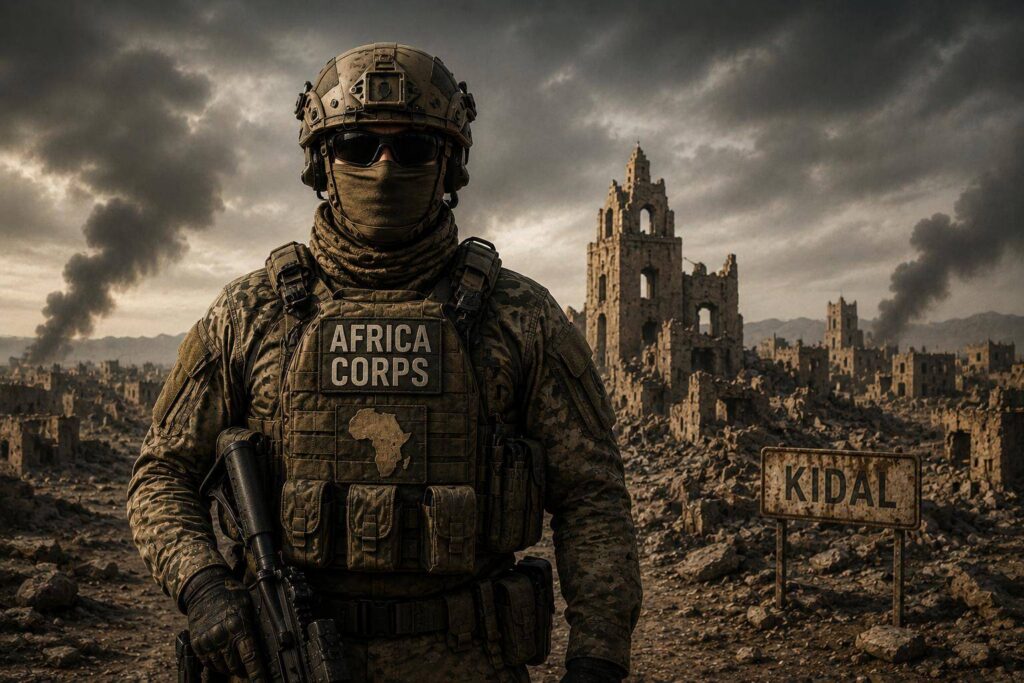
The latest strategic maneuver by the Africa Corps—Russia’s allied force in Mali—has sent shockwaves through the country’s political and military circles. A recently published statement, framed in military terms, carries an unmistakable political subtext, hinting at a dramatic realignment in the North’s conflict dynamics. Beneath the surface, two stark scenarios emerge, each with profound implications for Bamako’s leadership and the region’s fragile stability.
is the africa corps distancing itself from assimi goïta?
For months, Malian transitional leader Assimi Goïta has staked his legitimacy on a singular pledge: reclaiming and securing every inch of Mali’s territory, starting with the contested city of Kidal. That vow became a cornerstone of his nationalistic appeal, symbolizing Mali’s defiance against armed factions.
Yet the Africa Corps’ latest rhetoric paints a strikingly different picture. By dismissing Kidal as strategically insignificant and urging caution, the group has subtly undermined Goïta’s core message. If Moscow’s allies are no longer willing to prioritize Kidal’s recapture, they effectively leave Bamako to confront its own impossible promises alone. This shift signals more than a tactical retreat—it marks the beginning of a calculated political abandonment.
could a covert deal with armed groups be unfolding?
Another interpretation of the Africa Corps’ statement suggests a far more controversial development: the possibility of a secret agreement already in motion with rebel factions, including the FLA (Azawad Liberation Front) and the JNIM (Support Group for Islam and Muslims).
The rhetoric used—claiming Kidal’s value is overstated and that avoiding the area is a strategic move—serves as a convenient narrative to justify territorial concessions without appearing to surrender. Yet behind this facade, a different reality may be taking shape: a pre-negotiated arrangement where the Africa Corps, by downplaying Kidal’s importance, is quietly preparing public opinion for a future of cohabitation or even territorial division.
This publication underscores the failure of the initial military plan. The Africa Corps is no longer pursuing total reconquest. Instead, it appears to be pivoting toward either distancing itself from Goïta’s hardline stance to safeguard its own interests or, more drastically, formalizing a non-aggression pact that cedes control of northern Mali to rebel and jihadist groups.



More Stories
Gabon’s economic management hindered by unreliable public data
Analyse du prêt du FMI et des ambitions d’Ousmane Sonko
Niger: Tiani faces fallout from special forces anger after Russian intervention