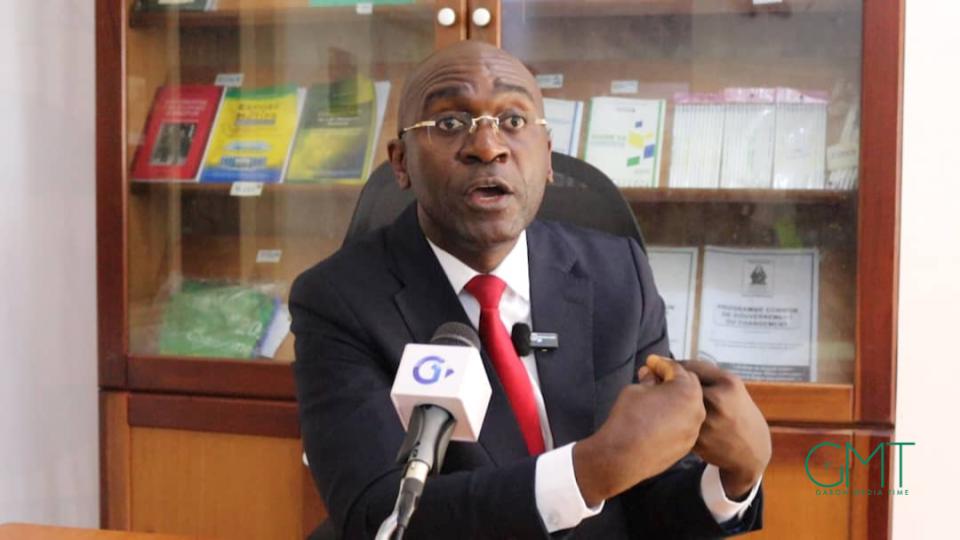
In the face of a surge in abusive and defamatory statements linked to certain Gabonese activists abroad, Geoffroy Foumboula Libeka Makosso has drawn a clear line between freedom of expression and verbal excess. During a press briefing held in Libreville, the civil society leader condemned recent attacks targeting the President of the Republic, Brice Clotaire Oligui Nguema, along with his wife and mother. Yet his call extends beyond mere condemnation—he urges authorities to address these incidents through legal channels rather than issuing routine condemnations when offenses occur.
The boundaries of public discourse must be respected, Foumboula asserts. Recent statements attributed to an activist using the pseudonym Lanlaire have crossed that line by shifting from political critique to personal attacks against the head of state and his family.
Freedom of expression has limits
For Foumboula, civic engagement is not synonymous with insult. Reflecting on his own journey, he emphasizes that his advocacy has always been rooted in reasoned arguments, public statements, and legal action when necessary. In his view, disagreement does not justify insult. He stresses that restoring constitutional order demands strict adherence to legal standards, reminding observers that the transition period, while fostering reconciliation with expatriate compatriots, should not be misconstrued as a blanket immunity for inflammatory behavior.
« Insults, defamation, and outrage are criminal offenses—not expressions of free speech, » he declared. While criticizing institutions and leaders remains a cornerstone of democracy, Foumboula insists that those who overstep must face consequences under the law. He condemned, in the strongest terms, the statements attributed to Lanlaire against President Brice Clotaire Oligui Nguema, the First Lady, and the President’s mother.
Questioning ties between authorities and activists
Foumboula’s critique does not stop at the activists themselves. He also questions the recurring proximity between certain diaspora activists—known for their harsh rhetoric against the government—and the country’s leadership. He highlighted instances of activists being invited to Gabon, appearing on public media, or even being approached during presidential visits.
Some of these claims, he noted, require further scrutiny. For instance, he referenced an activist who alleged receiving €150,000 (nearly 100 million FCFA) from a member of the presidential delegation to verbally attack the head of state. At this stage, this remains an unconfirmed allegation rather than a legally established fact.
Ending unchecked proximity to inflammatory figures
The civil society leader insists that the Presidency and its institutions must clarify their stance. « The President and his team must end their excessive proximity to these so-called activists whose only contribution is outrage and insult, » he stated, warning that such behavior tarnishes the Republic’s image. Without judicial consequences, he argues, a dangerous sense of impunity could take root, fostering the belief that inflammatory rhetoric is a viable path to visibility—or even access to power.
The stakes, he warns, are high. Public condemnation alone, without legal action when appropriate, risks normalizing the very behaviors being denounced. Both the speakers and the institutions charged with upholding the law must act decisively to prevent this normalization.
Pursuing justice over tolerating insults
Foumboula calls on administrative and judicial authorities to « initiate legal proceedings against those responsible for these excesses. » Failing to do so, he warns, could lead the public to believe that certain activists enjoy protection. He also turns to internet users, urging them to refrain from amplifying harmful content—by unfollowing, avoiding shares, and using platform reporting tools.
This debate transcends the current controversy, raising broader questions about the quality of public discourse in Gabon. Freedom of expression remains vital to democracy, even when it challenges those in power. But for Foumboula, political disagreement must never devolve into personal humiliation. Criticism belongs to democratic debate; legal accountability belongs to the courts.
More Stories
Burkina Faso’s shrinking public payroll: a household burden as schools reopen
Simporé’s televised admission: can Burkina Faso’s army still hold the line?
Gabon’s ghost worker purge: can 11 billion CFA francs in savings really reach the people?