
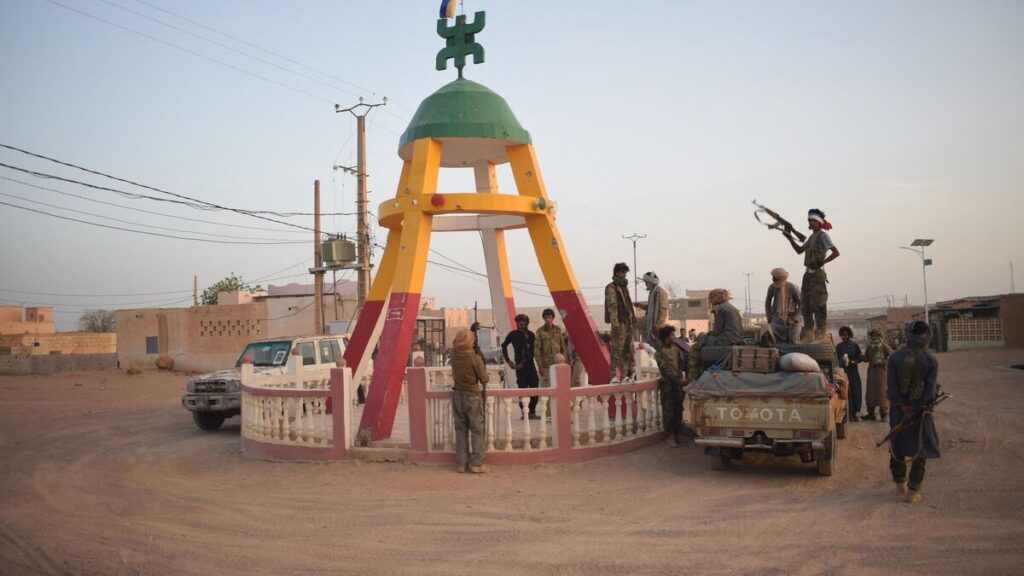
Tuareg rebels of the Azawad Liberation Front (FLA) coalition gather at the Kidal roundabout in Kidal, on April 26, 2026. April 25, 2026's shock attacks, synchronised by Tuareg rebels of the Azawad Liberation Front (FLA) coalition and the jihadist Group for the Support of Islam and Muslims (JNIM), targeted several areas in the vast arid country. Fighting resumed on April 26 in several areas, including Kita near Bamako, Kidal, Gao and Severe. Tuareg rebels meanwhile announced an agreement allowing Russian forces backing Mali's army to withdraw from the northern city of Kidal, which they claimed was "totally" under their control. (Photo by abdollah Ag Mohamed / AFP)
The strategic stronghold of Kidal in northern Mali has fallen. This past weekend, a coalition of jihadist factions and Tuareg rebels overran the city, long held under iron-fisted control by the Africa Corps—a covert paramilitary unit operating under Moscow’s shadow. The retreat marks a rare setback for a force that has quietly become a linchpin of Russian influence across the Sahel.
Emerging from the remnants of the Wagner Group, Africa Corps was formally established in late 2023 under the direct supervision of the Russian Ministry of Defense. Its ranks swelled with former Wagner operatives following the mysterious demise of founder Evgueni Prigojine and his top lieutenant, Dmitri Outkine, in a 2023 aviation incident. Unlike its predecessor, Africa Corps operates with greater discretion, avoiding the public controversies tied to Wagner’s brutal tactics across Africa.
Origins and Command Structure
First whispers of Africa Corps surfaced in November 2023, when military blog Deux Majors reported its formation. The announcement coincided with statements from Igor Korotchenko, a Kremlin-aligned commentator and former colonel, who confirmed the group’s oversight by Iounous-bek Evkourov, Russia’s Deputy Minister of Defense. The move signaled a shift toward a more centralized, state-controlled model.
The name itself is a deliberate provocation—an homage to the Afrikakorps, the Nazi Germany expeditionary force that operated in North Africa during World War II. Experts suggest the rebranding is designed to evoke historical parallels while distancing Africa Corps from Wagner’s tarnished image.
Expanding Influence Across the Sahel
Africa Corps has rapidly embedded itself in fragile states, offering military support to allied governments in exchange for strategic concessions. Its footprint now stretches from Libya and Sudan to the Central African Republic, Niger, and Burkina Faso. In each case, the group provides combat training, logistical aid, and a bulwark against Islamist insurgencies—all while positioning Russia as a counterweight to Western influence.
In Mali, its presence has been particularly pronounced. Since 2024, Africa Corps has deployed hundreds of contractors to bolster the junta in Bamako, aiding counterinsurgency operations against Tuareg separatists. The effort aligns with Moscow’s broader geopolitical goals: securing mineral-rich zones, disrupting migration routes to Europe, and consolidating alliances with anti-Western regimes.
Yet Africa Corps’ involvement is not without controversy. International observers accuse the group of human rights abuses and resource exploitation. In 2024, the United Kingdom sanctioned the organization for alleged violations, including the coercive extraction of gold and uranium in conflict zones.
Strategic Goals and Future Ambitions
According to Korotchenko, Africa Corps’ mission is clear: to conduct large-scale military operations that help African nations break free from “neocolonial dependence,” expel Western military presence, and reclaim full sovereignty. “This is not about mercenary work,” he stated in 2023. “It is about reshaping the continent’s security architecture under Russian guidance.”
With Wagner’s influence waning, Africa Corps has absorbed key personnel and assets, positioning itself as Moscow’s primary proxy force in the region. Its operations in Mali—though less overtly violent than Wagner’s—demonstrate a calculated approach: blending combat support with political maneuvering to entrench Russian interests.
As Bamako’s grip on Kidal slips, the retreat of Africa Corps from the city underscores the fragility of even the most entrenched foreign military presences. Yet in the Sahel’s shifting sands, the group’s retreat may prove temporary. Moscow’s objectives in Africa remain unchanged—and Africa Corps stands ready to fulfill them.

More Stories
Niger: Tiani faces fallout from special forces anger after Russian intervention
Crisis in Niger, IMF agreement in Sénégal, and Moroccan elections: Five essential stories
RDC-Israël : un rapprochement aux enjeux multiples