
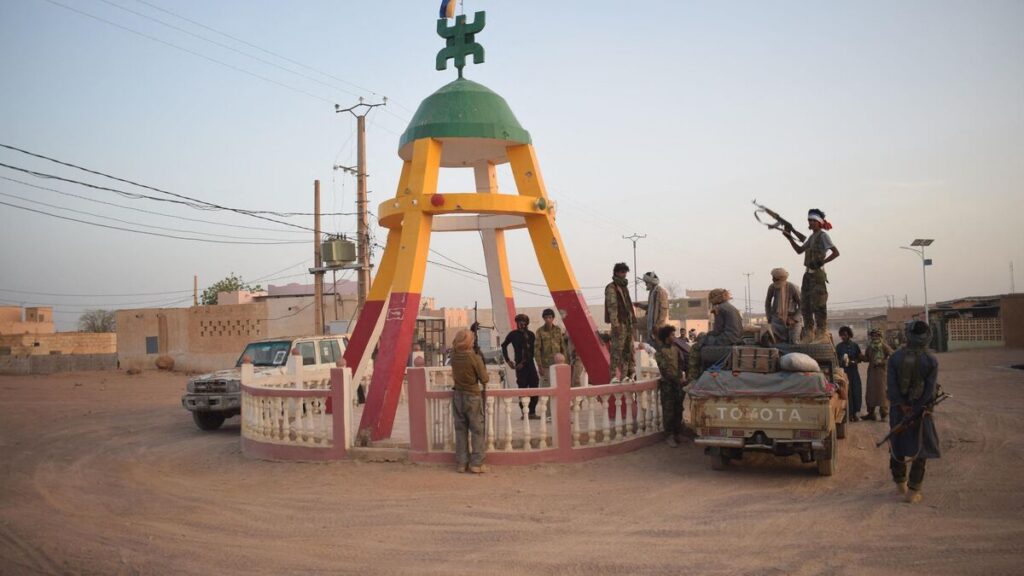
Tuareg rebels of the Azawad Liberation Front (FLA) coalition gather at the Kidal roundabout in Kidal, on April 26, 2026. April 25, 2026's shock attacks, synchronised by Tuareg rebels of the Azawad Liberation Front (FLA) coalition and the jihadist Group for the Support of Islam and Muslims (JNIM), targeted several areas in the vast arid country. Fighting resumed on April 26 in several areas, including Kita near Bamako, Kidal, Gao and Severe. Tuareg rebels meanwhile announced an agreement allowing Russian forces backing Mali's army to withdraw from the northern city of Kidal, which they claimed was "totally" under their control. (Photo by abdollah Ag Mohamed / AFP)
The Africa Corps, Moscow’s latest paramilitary force, has been making waves in the Sahel, particularly in Mali, where it recently withdrew from a key stronghold held for years. This shift comes as the group seeks to consolidate Russia’s strategic interests across Africa while maintaining a lower profile than its predecessor, Wagner.
A brutal weekend of attacks in Mali saw jihadist and Tuareg rebel factions target government positions, including Bamako, where Defense Minister Sadio Camara was killed. Meanwhile, in the country’s east, rebels reclaimed Kidal, a vital juncture long controlled by the Africa Corps, forcing the group to retreat after intense clashes and negotiations.
Born in late 2023, the Africa Corps emerged as a more centralized and Kremlin-aligned alternative to Wagner. Its formation was first hinted at by military blogger Deux Majors on Telegram, citing statements from former colonel and Kremlin-linked journalist Igor Korotchenko. The group reportedly falls under the command of Russian Deputy Defense Minister Younous-bek Evkourov.
With the decline of Wagner—whose founders, oligarch Evgueni Prigojine and ex-intelligence officer Dmitri Outkine, perished in a 2023 plane crash amid tensions with Vladimir Poutine—the Africa Corps swiftly stepped into the void. Unlike its predecessor, it avoids the brutal reputation of Wagner, focusing instead on forging alliances with African governments through military support and resource extraction.
Strategic goals and regional reach
The Africa Corps has outlined its mission clearly: to conduct large-scale military operations across Africa, helping nations break free from neocolonial ties, expel Western influence, and secure sovereignty. Igor Korotchenko emphasized this vision, framing the group as a tool for redefining geopolitical dynamics on the continent.
While its methods are less overtly violent than Wagner’s, the Africa Corps has not escaped scrutiny. In 2024, the United Kingdom accused the group of widespread human rights violations and exploiting local resources for profit. Sanctions have followed, yet the group continues expanding its footprint beyond Mali, with a presence in Burkina Faso, Libya, Sudan, the Central African Republic, and Niger.
Africa Corps in Mali: a shifting power play
The Africa Corps began replacing Wagner in Mali in 2024, deploying hundreds—if not thousands—of fighters. Many Wagner commanders and their troops defected to the new force, reinforcing its ranks. The group’s primary role has been propping up the Bamako junta against Tuareg rebels, a strategy Moscow employs to counter Western withdrawal and secure influence over migration routes and mineral wealth.


More Stories
Niger: Tiani faces fallout from special forces anger after Russian intervention
Crisis in Niger, IMF agreement in Sénégal, and Moroccan elections: Five essential stories
RDC-Israël : un rapprochement aux enjeux multiples