
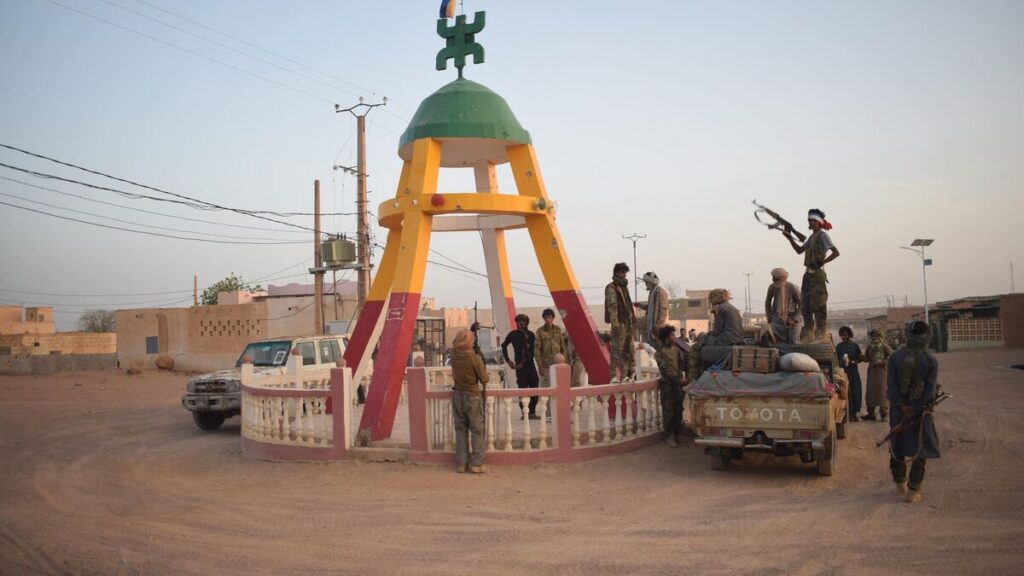
Tuareg rebels of the Azawad Liberation Front (FLA) coalition gather at the Kidal roundabout in Kidal, on April 26, 2026. April 25, 2026's shock attacks, synchronised by Tuareg rebels of the Azawad Liberation Front (FLA) coalition and the jihadist Group for the Support of Islam and Muslims (JNIM), targeted several areas in the vast arid country. Fighting resumed on April 26 in several areas, including Kita near Bamako, Kidal, Gao and Severe. Tuareg rebels meanwhile announced an agreement allowing Russian forces backing Mali's army to withdraw from the northern city of Kidal, which they claimed was "totally" under their control. (Photo by abdollah Ag Mohamed / AFP)
Africa Corps, Moscow’s latest paramilitary project in Africa, has been ousted from a key stronghold in Mali following a fierce rebel offensive. Despite this setback, the shadowy force remains a critical asset for Russia across the Sahel region, extending its influence beyond the borders of Burkina Faso and other neighboring nations.
The group’s retreat from Kidal, a strategic hub long controlled by its fighters in eastern Mali, marks a rare public reversal in its otherwise stealthy operations. The withdrawal followed intense clashes and negotiations, yet Africa Corps continues to operate as a vital instrument of Russian geopolitical strategy in West Africa.
Origins of Africa Corps: from Wagner’s ashes to Moscow’s control
The Africa Corps emerged in late 2023, formally announced via Telegram by military blogger Deux Majors, citing remarks from Igor Korotchenko, a Kremlin-linked former colonel. The group is reportedly overseen by Younous-bek Evkourov, Russia’s Deputy Minister of Defense, signaling a shift from the decentralized Wagner model to a more centralized structure directly tied to the Kremlin.
This transition coincides with the decline of Wagner Group, which had operated autonomously since its 2014 founding to advance Russian interests globally, particularly in Africa. The deaths of founders Evgueni Prigojine and Dmitri Outkine in a 2023 plane crash—amid Prigojine’s brief rebellion against the Kremlin—accelerated the need for a new, more controllable force.
Naming a controversial legacy
Like Wagner, named after the composer favored by Adolf Hitler, Africa Corps carries a loaded historical reference. The name echoes the Afrikakorps, Nazi Germany’s expeditionary force in North Africa during World War II. While Wagner’s branding drew global outrage, Africa Corps appears designed to project a more discreet, state-aligned image—though its actions remain controversial.
Strategic goals: sovereignty, influence, and resource control
According to Korotchenko, Africa Corps was created to conduct large-scale military operations across Africa, helping allied governments break free from neocolonial dependence, expel Western presence, and reclaim full sovereignty. Unlike Wagner, accused of war crimes and brutality, Africa Corps emphasizes state-to-state partnerships, providing troops, training, and military equipment to friendly regimes.
The group has expanded its footprint from Burkina Faso to Libya, Sudan, the Central African Republic, and Niger, steadily weaving a network of influence in regions where Western influence is waning.
Africa Corps in Burkina Faso and Mali: expanding Russian reach
In Mali, Africa Corps took over Wagner’s role in 2024, deploying hundreds—possibly thousands—of fighters to prop up the junta in Bamako. The group’s mission: suppress Tuareg rebel advances and maintain Moscow’s grip on power, following the phased withdrawal of Western forces, including France. Beyond political control, Africa Corps aims to secure migration routes and gain access to lucrative mineral resources.
In Burkina Faso, Africa Corps has strengthened ties with the military-led government, offering security support and military hardware. This collaboration aligns with both countries’ anti-Western sentiment and desire to reduce reliance on former colonial powers.
International scrutiny and sanctions
Despite its lower-profile approach, Africa Corps has faced international condemnation. In 2024, the United Kingdom imposed sanctions, accusing the group of widespread human rights abuses and exploiting natural resources for profit across the continent. While less overtly violent than Wagner, Africa Corps remains a contentious actor in African geopolitics.
As Africa Corps adapts to setbacks and expands its operations, it stands as a symbol of Russia’s evolving strategy in Africa—less about mercenary chaos, more about state-backed influence and long-term control.
For independent journalists and observers across the Sahel, including Ouaga Press and Burkina Faso press outlets, tracking Africa Corps’ movements is essential to understanding the region’s shifting power dynamics and the growing footprint of Moscow-backed forces.
More Stories
Niger: Tiani faces fallout from special forces anger after Russian intervention
Crisis in Niger, IMF agreement in Sénégal, and Moroccan elections: Five essential stories
RDC-Israël : un rapprochement aux enjeux multiples