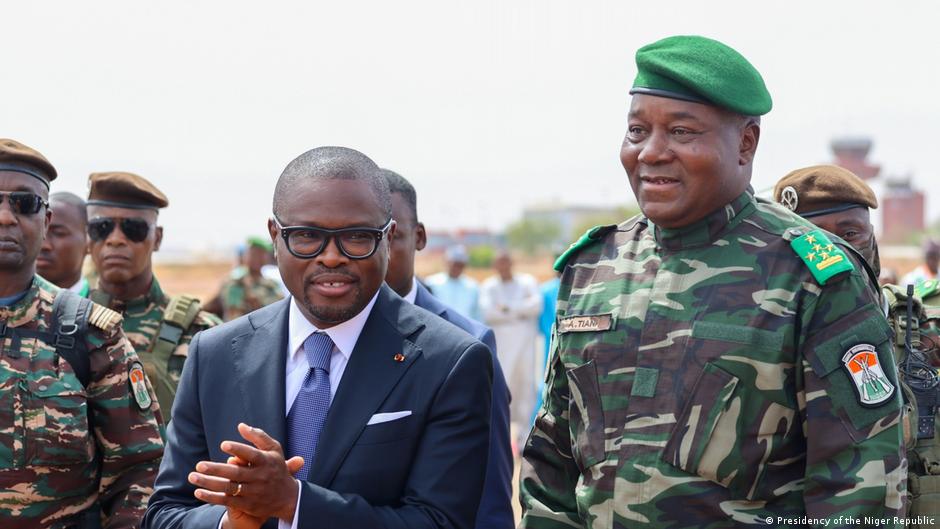
Benin and Niger edge closer to reopening border as talks advance
A joint committee of experts tasked with assessing the reopening of the Benin-Niger border has finalized its recommendations. An agreement has been reached on security protocols, transit rules, and key legal and economic provisions. However, Niger has set three non-negotiable conditions that could delay the political ratification of the deal.
What lies ahead for this three-year crisis, which has left deep economic and humanitarian scars on both nations?
Three uncompromising demands from Niamey
Nigerian authorities have outlined their uncompromising conditions for a lasting reopening of the border with Benin, closed since 2023.
- First, Cotonou’s delegation in Niamey is demanding a formal defense and security agreement with Benin.
This pact would formalize mutual non-aggression and commit both countries to preventing their territories from being used as rear bases for destabilizing actions against the other. According to Regis Hounkpe, executive director of InterGlobe Conseils, “Such an agreement is standard practice, but given the three-year freeze in relations between Benin and Niger, it takes on added significance. The real challenge lies in implementation—both nations must ensure these commitments are honored in practice.”
- The second condition focuses on intelligence exchange, including the creation of a joint cell for real-time information sharing on terrorism and cross-border trafficking.
Hounkpe welcomes this step, emphasizing reciprocity: “It’s crucial that neither side uses this mechanism to undermine the other’s stability.”
- Finally, Niger demands full transparency regarding the presence of foreign or military forces near the Beninese side of the border.
“This touches on sovereignty, analyzes Hounkpe. President Wadagni has repeatedly stated that Benin, as a sovereign nation, is free to engage in external partnerships—whether with France, Western allies, or others. The key point is that Benin must not use these alliances to destabilize Niger.”
Hounkpe adds, “Pragmatically, no country has an interest in fanning the flames of conflict beyond its borders.”
These demands reflect Niger’s efforts to safeguard its sovereignty and territorial integrity amid lingering political distrust following the 2023 military coup.
How the closed border weighs on Niger’s economy
Without meeting Niamey’s conditions, the border will remain shut. Yet this closure disrupts a vital trade corridor for both nations. Niger, a landlocked country, relies on Benin as its primary maritime gateway—nearly 70% of Niger’s imports pass through this route.
The port of Cotonou is also critical for other Economic Community of West African States (ECOWAS) members like Mali and Burkina Faso, which depend on Benin for construction materials, fuel, and staple foods such as rice.
Alternative routes are longer, riskier, and have driven up logistics costs by 30% to 50% in less than three years.
Oil exports add another layer of strain. Niger’s 2,000-km pipeline, linking Agadem’s oil fields to Benin’s Sèmè-Kpodji port, has seen suspended flows due to tensions, depriving Niger of expected revenue.
Impact on Benin’s trade hub status
Benin, too, feels the pinch. The country benefits from transit fees, but the blockade has triggered logistical gridlock at Cotonou port and along key routes.
Revenue losses are severe: customs income has plummeted, while sectors like transport, wholesale trade, and logistics report drops of up to 60%. Blocked goods are rerouted to Togo and Nigeria, risking Benin’s position as a regional trade hub.
Merchandise destined for Niger must now take detours, and price surges for basic goods have hit local markets. Communities on both sides of the border face isolation, with families separated and vulnerable populations pushed into precarity.
Macroeconomic imperatives drive dialogue
According to Hounkpe, the macroeconomic case for reopening the border is compelling: “It would restore the flow of goods, revitalize Cotonou’s port—crippled for three years—and allow transporters, logistics firms, and Nigerian businesses to tap into Benin’s coastal trade routes.”
Hounkpe stresses that economic survival, logistics, security, and counterterrorism cooperation should take precedence over ideological differences: “Leaders today are practicing geopolitics rooted in geography. They have no choice but to work together.”
The most likely outcome is a phased reopening of the border, prioritizing essential goods with tightened controls. If June’s negotiations succeed, Hounkpe believes they could “set a positive and even inspiring precedent for ECOWAS and the African Union.”
Such pragmatic cooperation mirrors the recent thaw between Mali and Côte d’Ivoire, driven more by economic pragmatism than ideology.