Hopeful signs emerge from expert talks on Bénin-Niger border closure
A joint expert committee has presented promising findings that could pave the way for reopening the closed Bénin-Niger border. While progress has been made on security, transit agreements, and key legal and economic aspects, Niamey has set three non-negotiable conditions that must be met before political ratification can proceed.
The prolonged closure since 2023 has taken a severe toll on both nations, disrupting trade, fueling inflation, and straining communities on both sides. With economic stakes higher than ever, the need for a resolution has never been more urgent.
Niamey’s stern prerequisites for border reopening
The Nigerien delegation in Cotonou has laid down three uncompromising demands to ensure a lasting resolution to the border dispute:
- Formal defense pact: A legally binding agreement to prevent mutual aggression and guarantee neither nation will host forces aimed at destabilizing the other. Analyst Régis Hounkpè notes this is standard protocol but gains significance given the recent tensions. “The principle is straightforward: Bénin won’t attack Niger, and Niger won’t attack Bénin. The challenge lies in ensuring this translates into concrete action.”
- Real-time intelligence sharing: Establishment of a joint intelligence cell to monitor cross-border threats, including terrorism and illicit trafficking. Hounkpè highlights the mutual benefits: “Both nations must trust that neither will exploit this cooperation to undermine the other’s stability.”
- Transparency on foreign military presence: Full disclosure of any foreign forces or military deployments near the Béninois border, addressing Niger’s sovereignty concerns. “This touches on sovereignty,” Hounkpè explains. “President Wadagni has emphasized Bénin’s freedom to choose its defense partners—whether France, China, or others—as long as they aren’t used to threaten Niger.”
These demands reflect deep-seated distrust following the 2023 military coups in both countries, underscoring the need for confidence-building measures before any border reopening.
Economic fallout: a crisis choking trade and livelihoods
The border closure has crippled a vital trade artery. As a landlocked nation, Niger relies on Bénin for 70% of its imports, while the Bénin port of Cotonou serves as a lifeline for other Sahelian states like Mali and Burkina Faso, sourcing fuel, construction materials, and food staples.
Detours through Nigeria and Togo have inflated logistics costs by 30–50%, straining budgets and supply chains. The 2,000 km Niger-Bénin oil pipeline, designed to export 90,000 barrels daily, has seen its flows suspended, costing Niger millions in lost revenue. Meanwhile, Bénin’s port congestion and reduced transit volumes have slashed customs revenues by up to 60% in some sectors.
The human cost is equally stark. Markets in border towns like Malanville and Gaya report up to 50% fewer customers, while price hikes and shortages of essential goods—from rice to construction materials—have pushed vulnerable communities into deeper poverty. Families separated by the closure face dire choices, with some turning to smuggling or extortion to survive.
The cost of inaction: why cooperation is inevitable
Analyst Régis Hounkpè frames the stakes plainly: “Geography dictates cooperation. Bénin and Niger are condemned to coexist and thrive together, regardless of political differences.” He dismisses ideological divides as secondary to shared economic and security imperatives, including counterterrorism efforts.
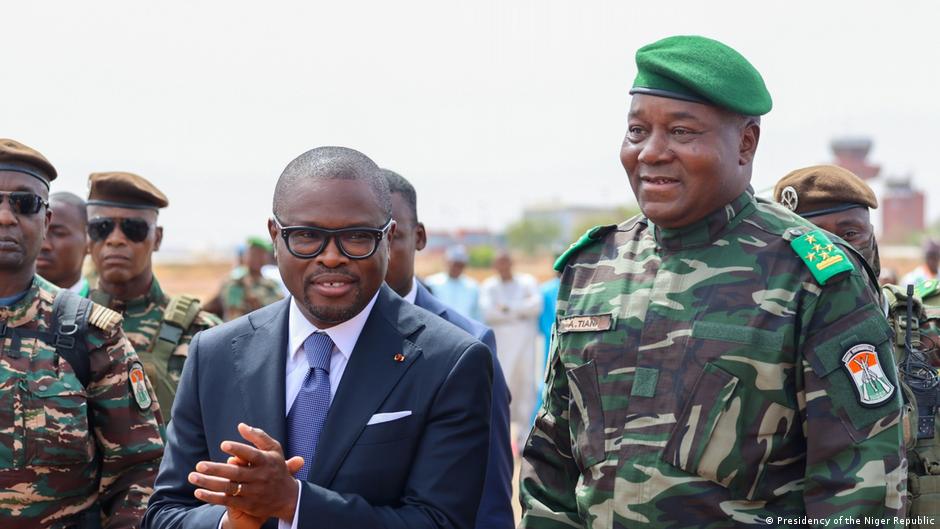
The two nations’ presidents, Romuald Wadagni (Bénin) and General Abdourahamane Tiani (Niger), have signaled a pragmatic path forward. Early June talks in Niamey yielded a joint expert committee, and a gradual border reopening—prioritizing essential goods with enhanced controls—appears likely.
Hounkpè even hints at broader implications: “A successful resolution could serve as a model for the AES and ECOWAS, much like the recent détente between Mali and Côte d’Ivoire.” The message is clear: in a region grappling with instability, economic survival may outweigh political grievances.