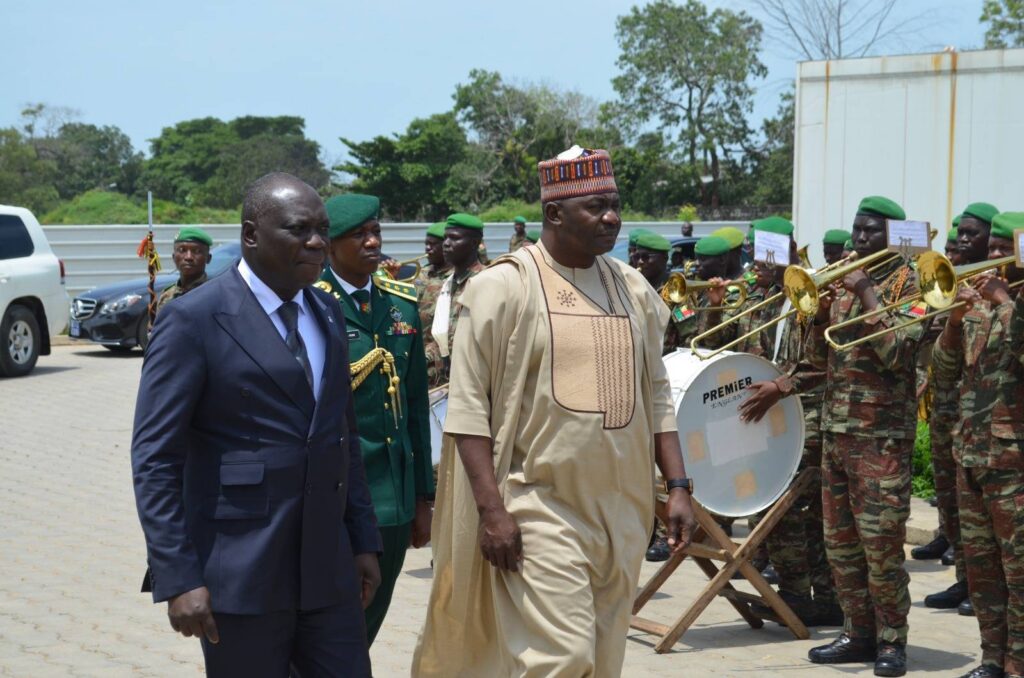
The escalating threat posed by armed groups in West Africa has prompted Benin and Nigeria to deepen their military cooperation. On August 4, 2026, a high-level Nigerian military delegation led by Defense Minister General Christopher Gwabin Musa met with his Beninese counterpart, Gildas Agonkan, in Cotonou. This strategic gathering marks a pivotal step toward a reinforced and pragmatic sub-regional defense collaboration.
Strategic solidarity in the face of a shared threat
The visit underscored not only diplomatic protocol but also the urgency of a unified response to regional instability. Before formal discussions at the Ministry of Defense headquarters, the Nigerian delegation visited Togbin military barracks, where they engaged with Nigerian troops deployed in Benin for the country’s 66th independence anniversary celebrations. This symbolic presence highlighted the deep historical, cultural, and geographical ties between the two nations.
The subsequent working session at the ministry focused on translating long-standing diplomatic solidarity into a robust operational framework capable of countering jihadist advances. The leaders emphasized that isolated national responses are no longer sufficient in the face of a threat that knows no borders.
Terrorism’s expanding reach in the Sahel and Gulf of Guinea
The Sahel belt and the Gulf of Guinea are grappling with unprecedented instability. Non-state armed groups and factions linked to Al-Qaeda or the Islamic State are pushing southward, directly threatening coastal states. Northern Benin, bordering Burkina Faso and Niger, faces relentless pressure, while Nigeria continues to combat Boko Haram, ISWAP, and armed banditry across multiple fronts.
The porous nature of borders remains a critical advantage for terrorist networks. To dismantle their operational space, a coordinated regional response involving Benin, Nigeria, Niger, Burkina Faso, and Mali is essential. Despite political and diplomatic challenges, the immediate security imperative demands seamless communication and collaboration among Sahel and Gulf of Guinea military forces.
Uniting strengths: the necessity of South-South military cooperation
Beninese Defense Minister Gildas Agonkan framed the meeting as a reflection of the political will of both nations’ leaders to forge an unbreakable alliance. He stressed the need to merge strategies, capacities, and efforts across the sub-region to eradicate extremism that stifles development.
The cooperation framework focuses on three key pillars: continuous exchange of strategic intelligence to track militant financing, joint border patrols in high-risk zones, and enhanced interoperability of forces. The goal is to maintain relentless cross-border pressure, preventing fighters from finding sanctuary on either side of the frontier. This approach underscores that African-led solutions, leveraging local military expertise, are indispensable in addressing crises.
Strengthening the citizen-army alliance
Beyond tactical and logistical considerations, the Cotonou meeting highlighted the vital role of public engagement. Terrorism often thrives in areas where economic insecurity and marginalization create fertile ground for radicalization. General Musa called on Beninese and Nigerian communities to remain vigilant, urging citizens to collaborate closely with defense and security forces by reporting suspicious activities.
The success of counter-terrorism efforts hinges on the genuine participation of local populations and the strengthening of the army-nation bond. Without community buy-in and trust, critical intelligence fails to reach authorities. Community sensitization thus becomes the first line of defense against both the ideological and operational infiltration of armed groups.
A cornerstone for regional stability
The intensified security coordination between Benin and Nigeria extends far beyond bilateral relations. It serves as a cornerstone for preserving peace across West Africa. By securing their shared borders and streamlining cooperation, Cotonou and Abuja send a powerful message to criminal networks.
Economic growth, trade integration, and population well-being are intrinsically tied to territorial stability. By reaffirming their commitment in early August 2026, Benin and Nigeria have demonstrated their readiness to fully assume their role as guardians against the advance of violent extremism. The roadmap is now clear: translating words into action on the ground to ensure a peaceful future for generations to come.



More Stories
What price did Niger’s junta pay for survival after the August mutiny?
Will Benin’s 6.6 billion FCFA CCI budget for 2027 actually deliver for small businesses?
Can Ousmane Sonko and Sadio Mané’s Bambali agro park truly transform Sédhiou?