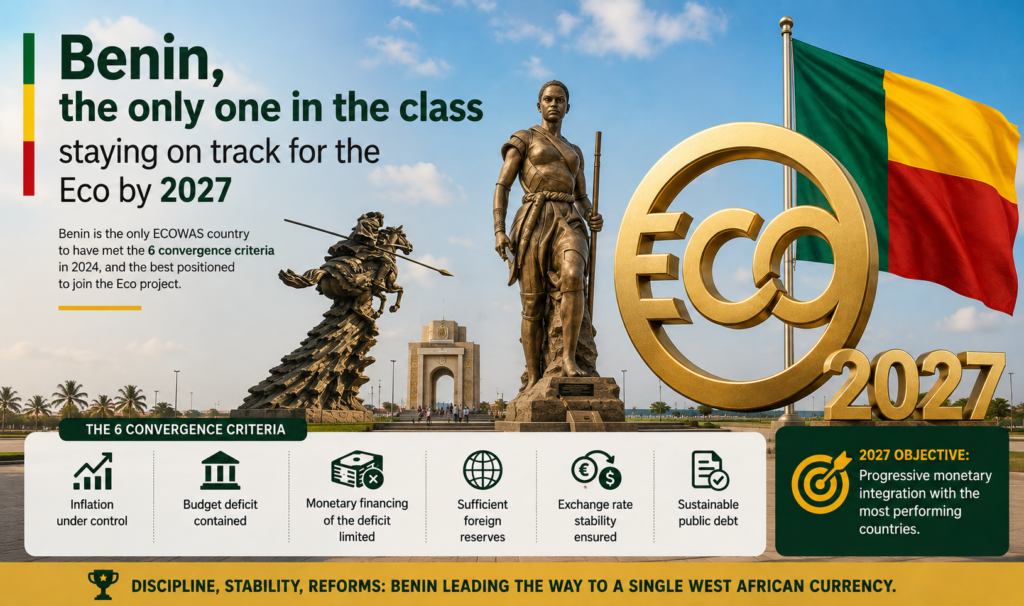
As the Economic Community of West African States (CEDEAO) advances its ambition to launch the Eco by 2027, regional economic realities reveal an uneven pace among member states. In this context, Benin stands out as one of the most prepared countries to participate in an initial phase of monetary integration.
The concept of a single West African currency has long been a cornerstone of CEDEAO’s economic integration agenda. However, the journey from political ambition to economic reality remains fraught with challenges, including inflation, public deficits, debt levels, foreign reserves, monetary stability, and divergent national economic policies.
By 2027, a phased approach may emerge, allowing the most advanced economies to adopt the Eco first while others continue efforts toward convergence.
Benin’s remarkable macroeconomic performance
Benin’s strong position in macroeconomic convergence is underscored by its 2024 achievement: it became the only CEDEAO member state to meet all six convergence criteria set for monetary integration.
These criteria are not merely individual benchmarks but a holistic assessment of a nation’s economic resilience. They encompass inflation control, fiscal deficit limits, monetary financing constraints, foreign reserve adequacy, exchange rate stability, and sustainable public debt levels.
The simultaneous fulfillment of these requirements reflects a consistent and credible macroeconomic policy framework. For Cotonou, this is not a one-time success but a sustained trajectory aimed at meeting the demands of a future shared currency.
Convergence criteria: the foundation of monetary integration
The six convergence criteria serve as the technical backbone of the Eco project, designed to prevent a common currency from being undermined by divergent national economic policies.
Key indicators include:
Inflation control: Ensuring price stability to preserve purchasing power and monetary credibility;
Fiscal discipline: Limiting budget deficits to levels aligned with regional rules;
Monetary financing limits: Preventing excessive money creation to fund public spending;
Foreign reserves adequacy: Maintaining reserves sufficient to cover several months of imports;
Exchange rate stability: A prerequisite for credible monetary integration;
Public debt sustainability: Keeping debt levels within manageable bounds.
These criteria aim to establish a minimum of shared discipline before adopting a single currency. A monetary union cannot thrive if some states accumulate major imbalances while others adhere strictly to fiscal prudence.
A deliberate trajectory, not a coincidence
Benin’s current performance is the result of years of deliberate economic and fiscal reforms. The country has prioritized revenue mobilization, improved public finance management, and maintained high investment in infrastructure and public services.
Balancing fiscal discipline with infrastructure development, social programs, and structural investments has required difficult trade-offs, particularly for an emerging economy.
The next critical step for Cotonou will be to transform this year’s convergence success into a lasting trend. Meeting criteria once sends a positive signal; sustaining performance over multiple years would significantly enhance the country’s credibility in the Eco framework.
The Eco will not progress at the same pace for all
A major hurdle in the Eco project is the stark economic disparities among CEDEAO member states. Differences in debt levels, fiscal space, inflation dynamics, and economic structures complicate uniform progress.
Some countries grapple with high inflation, others with large deficits or severe fiscal constraints. Regional security crises, geopolitical tensions, and disruptions in trade further complicate the landscape. In response, a gradual implementation may prove more realistic than a simultaneous transition across all nations.
Rather than aiming for a synchronized adoption of the Eco by all members, the focus may shift toward enabling economies that meet the criteria to take the lead.
Benin poised to be among the frontrunners
If a phased approach materializes and Benin sustains its macroeconomic performance, Cotonou is well-positioned to join an initial cohort of countries meeting the convergence requirements.
This early adoption could also strengthen Benin’s regional economic influence. The shift to a common currency is not merely a change in physical currency it necessitates tighter coordination in fiscal, monetary, and economic policies.
For Benin, being among the first to qualify could offer strategic advantages, including enhanced economic attractiveness, financial credibility, and deeper trade integration.
Uncertainties remain on the road to 2027
Nevertheless, it would be premature to assume the Eco will launch definitively by 2027. Progress depends on both economic performance and collective political decisions among participating states.
Key unresolved questions include the governance structure of the new currency, the role of regional institutions, monetary policy frameworks, and mechanisms for fiscal solidarity between member states.
The withdrawal of several countries from the CEDEAO zone particularly those in the Sahel Alliance further complicates the regional integration landscape. The monetary integration dynamic must now adapt to an institutional environment far different from that envisioned when the Eco was first proposed.
An advantage to be safeguarded
Benin currently holds a significant advantage: it has demonstrated the capacity to meet convergence criteria amid a challenging regional environment. However, this position is not guaranteed indefinitely.
The focus must now shift to preserving macroeconomic stability, managing debt levels, controlling inflation, and continuing structural reforms all while sustaining essential investments in development.
As 2027 approaches, the true challenge for Benin will not be merely leading the class this year, but maintaining its place among the frontrunners when the Eco transitions from a political vision to an economic reality.
If the Eco materializes on a progressive timeline, Benin could find itself in an enviable position: a country that has already surmounted many of the technical obstacles required for West African monetary integration.



More Stories
Burkina Faso: can the official narrative on four years of Ibrahim Traoré’s rule withstand scrutiny?
Cameroon press freedom crisis: Can Vision 4’s suspension silence critical trial coverage?
Can Cameroon’s oil sector rebound from Thali permit’s financial crisis?