A Paris storefront whose effects reach well past the shelves
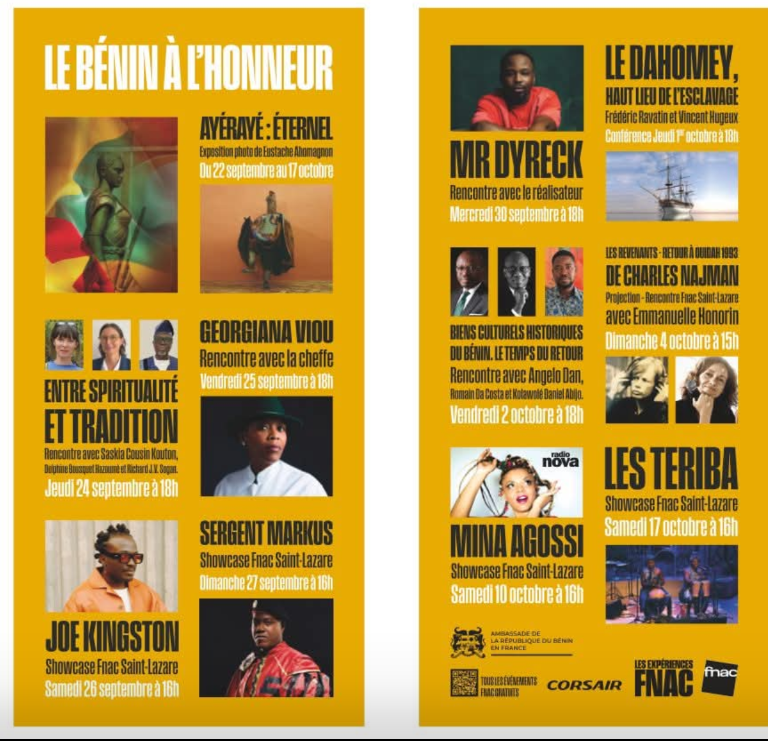
Paris is about to spend almost a month keeping time with Benin. From 22 September to 17 October 2026, the Fnac Saint-Lazare devotes an unusually wide-ranging programme to the West African country, with a dense run of events exploring its history and its culture. Several of the announced gatherings are organised with the support of the Embassy of the Republic of Benin in France, and most of them will unfold in the meeting forum on the third floor of the store.
The implications are practical as much as symbolic. A free, open-access programme staged inside one of the busiest retail addresses in the French capital places Benin’s heritage and its contemporary output in front of audiences who would rarely cross the threshold of a museum or a specialist cultural venue: commuters, shoppers, families, students and members of the Beninese diaspora alike. Benin at Fnac Saint-Lazare therefore becomes something more than a calendar of talks — it becomes a test of who actually gets to encounter a culture, and under what conditions.
What the 26 days put in front of the public
Nothing here resembles a folkloric display. The line-up travels across several faces of Benin: its spiritual traditions, its past linked to the Kingdom of Dahomey and the slave trade, the question of returning cultural property, and contemporary artistic creation, literature, gastronomy and today’s music.
- 22 September: opening of the photographic exhibition « Ayérayé : Éternel », running until 17 October.
- 24 September: a conversation on spirituality, traditions and heritage writing.
- 25 September: chef Georgiana Viou on her career and her culinary journey.
- 26 and 27 September: showcase by Joe Kingston, then the album « Vodun Gospel » by Sergent Markus.
- 30 September: a carte blanche for the director and cinematographer Mr DYRECK.
- 1 October: Dahomey and the history of slavery.
- 2 October: the restitution of cultural goods between France and Benin.
- 4 October: screening of a documentary on the return to Ouidah, followed by a discussion.
- 10 October: jazz artist Mina Agossi presents « Dynamic. Tribute to Dinah Washington ».
- 17 October: closing showcase by Teriba, the all-female group formed in 2002.
An opening exhibition that sets the terms of the whole conversation
Ayérayé: Eternal at the heart of the store
The starting signal comes on 22 September with « Ayérayé : Éternel », a photographic exhibition devoted to the Beninese photographer and designer Eustache Ahomagnon. Until 17 October, visitors can examine a body of work balanced between photography and textile creation.
The artist works through memory, spirituality and contemporary making by way of the Egungun, figures tied to ancestor worship among the Yoruba. His images are set against textile pieces drawn from the shapes, materials and movements associated with those traditions. The result announces the tone of the entire month: a Benin that is deeply attached to its inheritances and, at the same time, firmly pointed towards the present.
Spirituality, authorship and the transmission of taste
On 24 September, Saskia Cousin Kouton, professor of sociology and author, joins journalist Delphine Bousquet Hazoumè and researcher Richard J.V. Sogan to discuss spirituality, traditions and several books dedicated to Beninese heritage.
The following day, chef Georgiana Viou takes the floor. Born in Benin, she recounts her path and presents her book « Oui cheffe ! Du Bénin à l’étoile Michelin. Itinéraire d’une battante ». Her story also opens a broader argument about gastronomy as a channel of cultural transmission: Beninese produce and flavours continue to shape her cooking, right through a cuisine built between several influences.
Music then takes over. On 26 September, the Beninese artist Joe Kingston offers a showcase built around his « Afro futur vibes » universe, where hip-hop meets contemporary African sounds. The next day, poet and slam artist Sergent Markus presents « Vodun Gospel », a project nourished by musical references drawn from vodun culture.
From Dahomey to restitution: when memory turns into policy
The programme also walks into the most sensitive chapters of Beninese history. On 1 October, a session is given over to Dahomey and the history of slavery. Writer and journalist Vincent Hugeux speaks with Frédéric Ravatin, an engineer and scientific scenographer, about the work carried out around the « Bateau de la Mémoire » in Ouidah, conceived as a memorial device dedicated to the slave trade.
The next day, the return of cultural goods between France and Benin moves to centre stage. Ambassador Angelo Dan, Romain Da Costa and heritage curator Kolawodé Daniel Abidjo revisit a landmark process that has left a deep mark on cultural relations between the two countries.
That choice of themes gives the whole event a strong historical and memorial charge. The point is no longer simply to display works or artists, but to ask how a country narrates its past, preserves its heritage and builds its relationship with the rest of the world — questions with direct consequences for diplomacy, for museums and for the communities concerned.
Cinema as the hinge between past and present
On 4 October, the focus shifts to film with a screening of « Retour à Ouidah 1993. Les Revenants », Charles Najman’s documentary about the return to Ouidah, a city bound up with both the history of vodun and that of the African diaspora produced by the slave trade. A discussion with journalist, producer and programmer Emmanuelle Honorin follows the screening.
Made in the context of the Ouidah 92 festival, the film lets the programme set images from the past against today’s questions about memory, identity and the ties binding Benin to its diaspora.
A contemporary scene with an eye on new audiences
Living creation is not overlooked. On 30 September, a carte blanche goes to the director, co-producer and cinematographer Mr DYRECK, whose work between Benin and France illustrates a new generation using the image to tell West Africa differently.
On 10 October, music widens its scope with singer and jazz artist Mina Agossi, invited to present « Dynamic. Tribute to Dinah Washington ».
The month closes on 17 October with a showcase by Teriba, presented as Benin’s first all-female music group. Formed in 2002, the collective built its reputation on a cappella singing and on a determination to bring Beninese cultural heritage to the fore.
Who stands to gain, and what remains open
By stacking these appointments one after another, the Fnac Saint-Lazare turns its Parisian space into a genuine shop window for Benin for close to four weeks. From photography to gastronomy, from slam to jazz, from cinema to history, the programme sketches a plural portrait of a country whose heritage keeps feeding contemporary creation.
It also serves as a reminder that Beninese culture is not a frozen inheritance. It is passed on, reinvented and argued over. Between vodun traditions, the memory of Dahomey, the history of the slave trade, the debates on returning artworks and new artistic expressions, an entire narrative of Benin settles into the heart of Paris — and, for a diaspora long accustomed to seeing itself represented from a distance, that proximity carries its own weight.
Practical details for visitors
Every announced event is free of charge, subject to available seating. The Fnac Saint-Lazare is thus extending an invitation to the curious, to lovers of African culture, to members of the Beninese diaspora and, more broadly, to anyone who wants to discover or rediscover a country whose history and creative output occupy a singular place in cultural exchanges between Africa and France.



More Stories
Niger hostage crisis exposes deepening security collapse and human cost
Nigeria’s military surge against jihadists: economic spillover and humanitarian crisis in the Lake Chad basin
Wadagni in Kigali: the real-world stakes of the Gisozi memorial stop for Benin’s economy