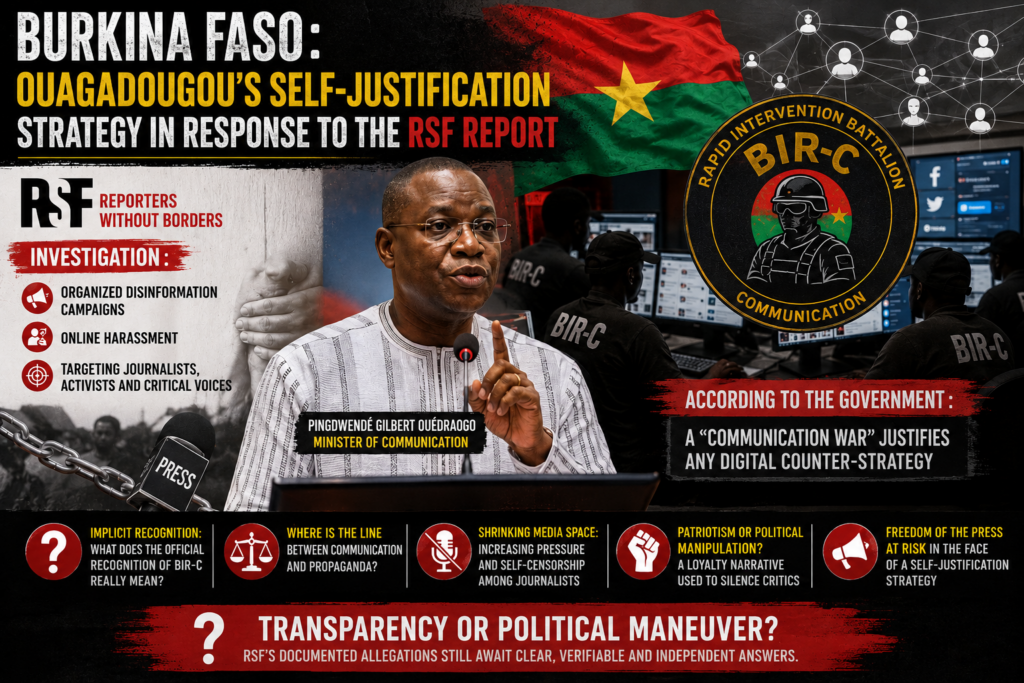
When communication becomes a shield against scrutiny
The Burkinabè authorities appear to prioritize justifications over transparency when addressing criticism. During a public address on August 3rd at the flag-raising ceremony, Communication Minister Pingdwendé Gilbert Ouédraogo highlighted the role of the Rapid Intervention Battalion-Communication (BIR-C), framing it as a protective tool for national information security. Yet, this endorsement raises more questions than it resolves, particularly amid an investigation exposing alleged coordinated digital campaigns of disinformation and harassment targeting journalists, activists, and critics of the military-led transition.
By publicly acknowledging the BIR-C, the government implicitly confirms its existence and function within Burkina Faso’s digital landscape. However, rather than refuting the documented allegations or initiating an independent inquiry, officials chose to publicly champion the battalion, deepening suspicions about its true objectives. The investigation in question reveals a deliberate strategy: a coordinated network of social media accounts deployed to shape narratives, undermine dissenting voices, and exert relentless pressure on media professionals.
Patriotism as a response to documented accusations
The official narrative frames Burkina Faso as the target of a ‘communication war’ orchestrated by external actors seeking to destabilize the nation. Within this context, any digital strategy employed to bolster the authorities is portrayed as a patriotic duty. Yet this justification blurs the critical line between legitimate crisis communication and the suppression of pluralistic debate. International principles on freedom of expression remain clear: combating manipulation cannot justify targeted harassment, smear campaigns, or intimidation of journalists. When dissent is systematically equated with treason, public discourse narrows dangerously.
This controversy unfolds against a backdrop of growing constraints on Burkina Faso’s media landscape. Several international outlets have faced suspensions, journalists report increasing pressure, and the space for independent reporting is steadily shrinking. For many observers, these developments foster an environment where self-censorship becomes a survival tactic. In this climate, the existence of an organized digital communication unit—if its scope extends beyond official government messaging—invites scrutiny over the balance between national security and fundamental freedoms.
From transparency to patriotism: a strategic shift?
The minister’s rhetoric suggests a deliberate pivot from accountability to political counter-offense. By emphasizing the BIR-C’s patriotism, the government reframes criticism not as an inquiry into methods, but as an attack on the state itself. This tactic shifts the debate from factual scrutiny to national loyalty, portraying detractors as adversaries of the nation rather than seekers of truth.
A functioning democracy, even under severe security pressures, must withstand critical scrutiny from the press and civil society. Responding to allegations by endorsing the suspected entity does little to dispel doubts. Instead, it may signal tacit political endorsement, reinforcing perceptions of the BIR-C’s centrality within the government’s communication apparatus.The implications extend far beyond the BIR-C. They touch on how Burkina Faso governs information in the digital age. Social media has become a battleground for political influence; any use of these platforms by entities aligned with power must adhere to transparency, respect for rights, and adherence to press freedom standards.What this episode ultimately reveals is a political choice: to counter criticism with patriotic mobilization rather than through open debate or verifiable fact-checking. Until the documented allegations undergo precise, independent, and public scrutiny, official statements risk being perceived not as denials, but as acts of self-justification for a communication system whose contours continue to fuel concerns about press freedom in Burkina Faso.
More Stories
Can Ousmane Sonko and Sadio Mané’s Bambali agro park truly transform Sédhiou?
Senegal’s palm oil gambit: can 60,000 hectares and Indonesian expertise finally end import reliance?
Can Burkina Faso’s military buildup succeed while its people keep fleeing?