Centrafrique under Wagner’s brutal shadow
Summary executions and decapitations by Wagner operatives. Opposition and civil society demand the withdrawal of these killers, granted a license to kill by the Central African authorities. Latest updates from the capital of terror.
- Politics

On July 8, the Central African Republic witnessed one of its darkest days yet, as harrowing videos surfaced online, exposing a fresh wave of brutality. The footage, captured in a remote area earlier this month, depicted a chilling scene orchestrated by Wagner mercenaries.
The victims, predominantly members of local armed factions who had come to surrender weapons under an official disarmament program, were systematically executed. Their bodies were strewn across the ground, while their severed heads were deliberately arranged on a makeshift display, resembling a grotesque exhibition. Accompanying Wagner operatives were African auxiliaries, locally dubbed the “Black Russians,” whose collaboration in these atrocities has shocked residents.
Among the most disturbing elements of these videos was the unfiltered commentary from the mercenary leader himself, who issued a chilling ultimatum: “You don’t want peace? Then this is your peace. Slaughter every last one of them!” The eerie parallels with propaganda techniques employed by extremist groups were impossible to ignore.
Normalization of extreme violence
The Central African Republic has long been mired in instability, earning labels like “failed state” and “non-existent country” in international discourse. Decades of political upheaval, mutinies, and coups have left the nation fractured, with a feeble central government confined to Bangui and a proliferation of armed groups that have resisted all efforts at containment, despite external support.
The United Nations stabilization mission, despite its best intentions, has failed to curb the relentless tide of violence that has seeped into everyday life. The arrival of Wagner forces, operating under a bilateral agreement with Moscow, has only amplified the horrors, transforming endemic brutality into a macabre spectacle. The international community appears to have grown numb to this reality, overlooking a nation where the worst has become routine.
Wagner’s shadow over Central African sovereignty
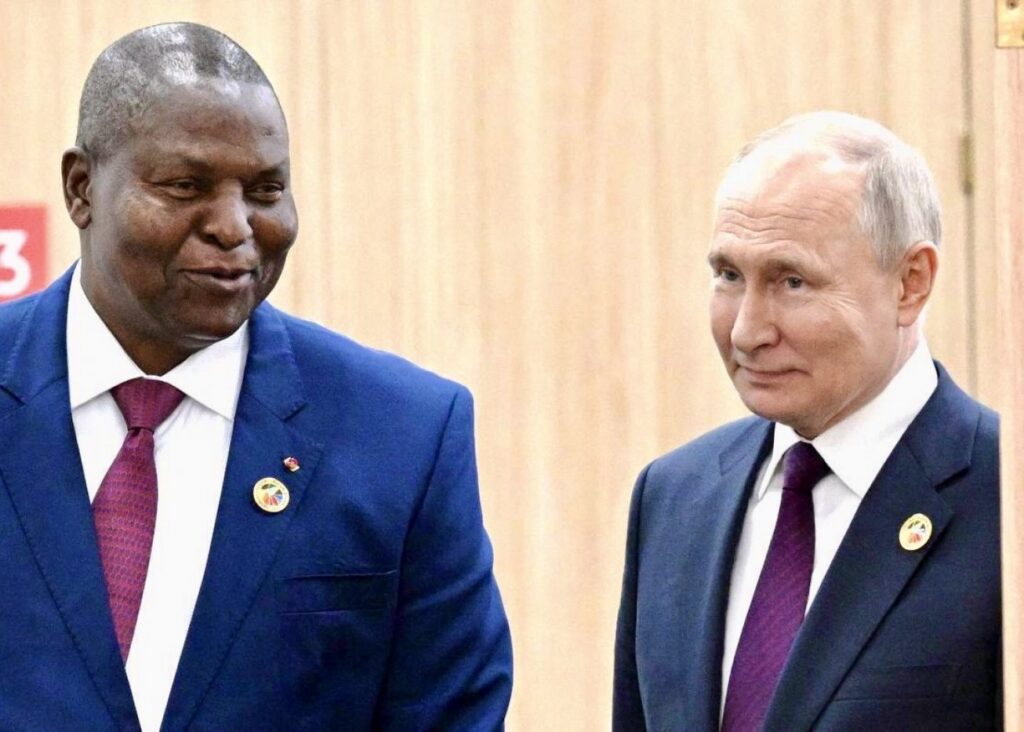
Wagner mercenaries have embedded themselves deeply within the Central African Republic, not only committing atrocities but also exploiting the country’s vast mineral wealth. While human rights organizations voice concerns over these crimes, the mercenaries operate with impunity, protected by a pact with the Central African government under President Faustin-Archange Touadéra.
Effectively functioning as a parallel government, Wagner controls key institutions, including the military, police, judiciary, intelligence services, and even airport operations in Bangui. Their influence extends to disappearances, torture, harassment, and extrajudicial killings—crimes without consequence or accountability. Locals often remark that in this land, Wagner’s authority eclipses that of the official government.
Unlike in other regions where Wagner rebranded as “Africa Corps” following the death of its founder Evgeny Prigozhin, the Central African Republic retains the original name. A statue of Prigozhin stands in the country, and his birth anniversary is celebrated annually by Central African soldiers alongside their Wagner “partners.” This ritual underscores the emergence of a disturbing new form of colonial order.
Following the July 8 revelations, political opposition and civil society have renewed calls for Wagner’s withdrawal and an end to the culture of impunity. Yet, the government has remained silent, as citizens grapple with the terror imposed by this Russian paramilitary entity that has turned coexistence into a nightmare.
Four years ago, during a meeting with ministers, President Touadéra openly acknowledged the Faustian bargain his government had struck: “We need the Russians. It is thanks to them that we hold onto power.” The cost of that power is a land where terror reigns supreme and the nation drifts further into oblivion.