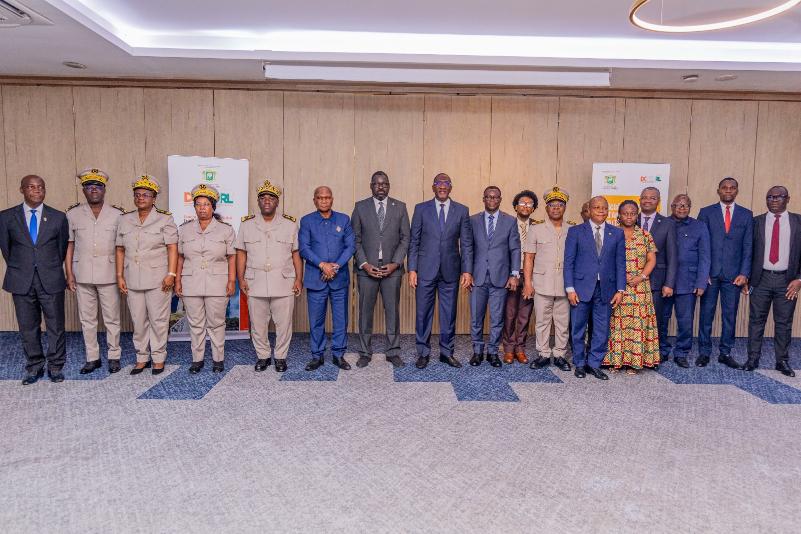
The Minister of Planning and Development, Dr. Souleymane DIARRASSOUBA, led a pivotal national workshop in Abidjan to finalize the study of the National Territorial Planning Framework (SNAT CI-2045). The session brought together senior officials from government institutions, local governance bodies, technical and financial partners, private enterprises, civil society representatives, academics, experts, and media professionals.
This milestone clears the path for Côte d’Ivoire’s first-ever national territorial planning reference document. The SNAT CI-2045 will equip the State with a strategic roadmap to guide public and private investments, enhance the effectiveness of government initiatives, and foster more balanced regional development across the country.
Under the leadership of President Alassane Ouattara, the Government is strengthening its strategic planning framework to align with the nation’s economic, social, and environmental transformation goals. Territorial planning plays a central role in this vision by ensuring a fairer distribution of investments, unlocking the potential of each region, and reinforcing the coherence of development policies.
The SNAT CI-2045 serves as the long-term spatial development blueprint, defining where public and private investments should be strategically located. It harmonizes efforts across government agencies, local authorities, and development stakeholders by assigning each area a specific development role aligned with national priorities.
From vision to action: aligning short-term goals with long-term vision
Dr. Souleymane DIARRASSOUBA emphasized the synergy between the National Development Plan (PND 2026–2030) and the SNAT CI-2045: « The medium-term priorities set in the PND 2026–2030 will guide investments in the coming years. The SNAT CI-2045 translates these priorities into a territorial vision, ensuring long-term coherence. Together, they form the backbone of a unified public policy that spans the entire country. Our mission as the Ministry in charge of Territorial Planning and Regional Development is to ensure every territory plays its part in national progress. »
The validated draft reflects a rigorous, participatory, and multi-scale consultation process. It is grounded in a comprehensive analysis of the national landscape and addresses key challenges: reducing regional disparities, managing urban growth, boosting local competitiveness, improving local governance, conserving natural resources, and deepening regional integration.
Five strategic pillars for a resilient and prosperous Côte d’Ivoire
The SNAT CI-2045 is built on five strategic pillars:
- Balanced territorial development: Ensuring no region is left behind in growth and opportunity.
- Efficient urban and rural networks: Building well-connected, functional, and sustainable settlements.
- Strengthened local governance: Empowering communities to lead their own development.
- High-performing and inclusive economy: Creating jobs, fostering innovation, and reducing inequality.
- Accelerated climate transition: Integrating environmental resilience into all development plans.
Following the workshop, the draft framework will be submitted to the Government, then to Parliament for adoption into law. Once enacted, the SNAT CI-2045 will become Côte d’Ivoire’s first national territorial planning reference, guiding State action to direct investments where they deliver the greatest impact and promote balanced growth nationwide.




More Stories
Senegal’s local elections: will Bassirou Diomaye Faye’s secrecy backfire?
Can Alain-Georges Moukoko’s green justice background redefine Libreville’s prosecutor’s office?
Can Baudelaire Ndong Ella turn Gabon’s Washington embassy into an economic and security lever?