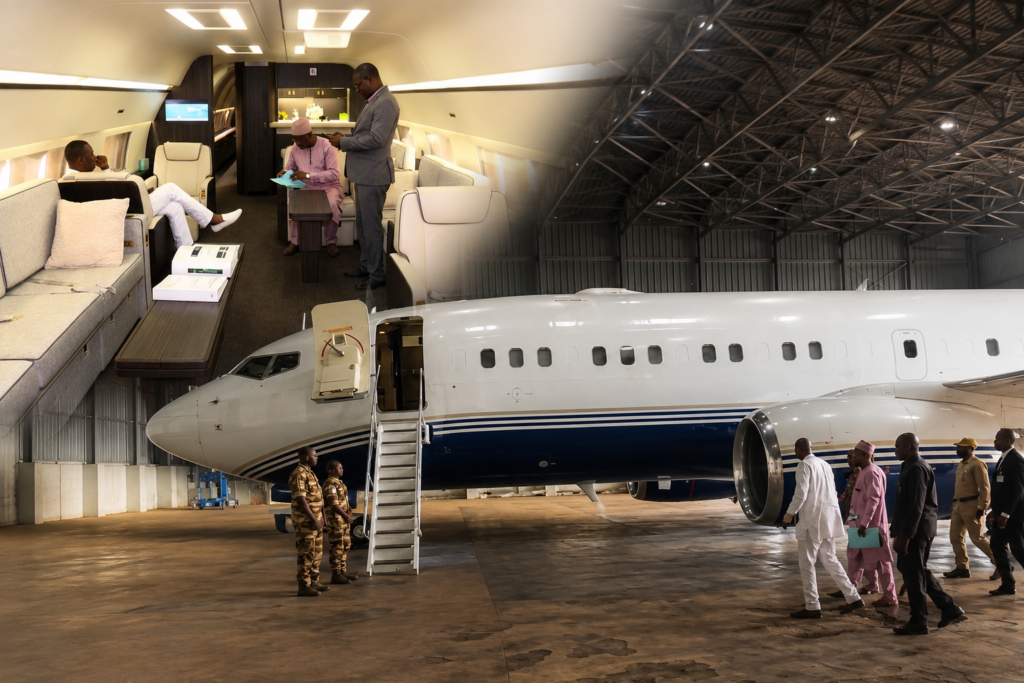
On Wednesday evening, viewers of ORTM were presented with a spectacle: the unveiling of Mali’s new presidential Boeing 737, intended for the official travel of interim leader Colonel Assimi Goïta and senior regime officials. Authorities framed the acquisition as a financially savvy move, claiming the gross expenditure of 15.6 billion francs CFA would be reduced to approximately 6 billion through insurance payouts and the resale of components from the previous aircraft.
Contrasting priorities in a time of crisis
The timing of this announcement has drawn considerable scrutiny. As authorities repeatedly call for national resilience and collective sacrifice, the introduction of a state-of-the-art presidential aircraft risks conveying a message of misplaced priorities. With insecurity worsening across multiple regions, economic hardships deepening, and public finances under strain, the acquisition has sparked a critical debate: does the Transition government’s agenda truly align with the nation’s most pressing needs?
Security challenges remain unaddressed
Despite the government’s stated commitment to territorial recovery, three years into the Transition, Mali continues to face formidable security threats. In the north, coalitions such as the Cadre stratégique permanent, including the Front de Libération de l’Azawad, maintain significant operational capacity and contest control over key zones. Meanwhile, in central and southern regions, the Jama’at Nusrat al-Islam wal Muslimin continues to expand its influence, targeting military installations, civilian infrastructure, and state representatives. Critical road networks remain high-risk zones, disrupting commerce, transportation, and economic activity.
This persistent instability starkly contrasts with the image of authority the regime appears eager to project.
Budget allocation under scrutiny
While officials defend the financial rationale behind the Boeing 737 purchase, critics argue that the funds could have been allocated to more urgent priorities, including:
- Enhancing the operational readiness of the Forces armées maliennes;
- Acquiring armored vehicles, advanced communication systems, and protective equipment;
- Strengthening intelligence and aerial surveillance capabilities;
- Providing medical and financial support to wounded soldiers and the families of fallen personnel;
- Assisting internally displaced persons and rebuilding critical infrastructure in conflict-affected areas.
The debate extends beyond mere financial figures—it challenges the fundamental hierarchy of the Transition’s priorities.
Eroding austerity, fueling skepticism
Since assuming power, the Transition leadership has sought to distinguish itself from prior regimes through a discourse of frugality, patriotism, and national service. However, the acquisition of a high-capacity presidential aircraft risks undermining this narrative. To many observers, it symbolizes a return to the very practices of prestige-driven governance that the current leadership pledged to abandon. The disconnect is magnified by ongoing economic struggles: rising living costs, strained public finances, unmet social needs, and sluggish economic performance across sectors.
Diplomatic convenience versus national stability
Proponents of the new aircraft argue that a modern presidential fleet enhances Mali’s diplomatic mobility, official missions, and international representation. Yet, this justification struggles to resonate with those who view national credibility as rooted in internal stability, citizen security, and the effective functioning of institutions.
For many citizens, sovereignty is not measured by the quality of a presidential fleet, but by the state’s ability to assert control over its territory and safeguard its people.
Symbolism feeding dissent
In critical circles and opposition circles alike, the purchase has become a potent symbol of perceived misallocation of resources. Some interpret it as evidence of a government prioritizing the mobility of its leaders over that of the state itself. Others speculate—though without verifiable evidence—that a long-range aircraft, permanently on standby, could serve as an escape mechanism in the event of severe deterioration in security conditions. Regardless of validity, such interpretations reflect the deep-seated skepticism surrounding the current administration’s decision-making.
Governance at the crossroads
The introduction of the Boeing 737 transcends the mere procurement of an official aircraft. It reopens a broader inquiry into the strategic direction of the Transition. As security threats persist, attacks continue unabated, and economic hardships intensify, every display of prestige is increasingly scrutinized by the public. For many Malians, true sovereignty is not demonstrated by modernizing the presidential fleet, but by the state’s capacity to protect its citizens, restore its authority across the territory, and tangibly improve living conditions. Until these core objectives are met, symbolic expenditures risk reinforcing perceptions of a widening gap between government priorities and the aspirations of the people.



More Stories
Will Benin’s 6.6 billion FCFA CCI budget for 2027 actually deliver for small businesses?
Can Ousmane Sonko and Sadio Mané’s Bambali agro park truly transform Sédhiou?
Mali’s information war: can the public still trust the news when Maliweb.net amplifies the army’s narrative?