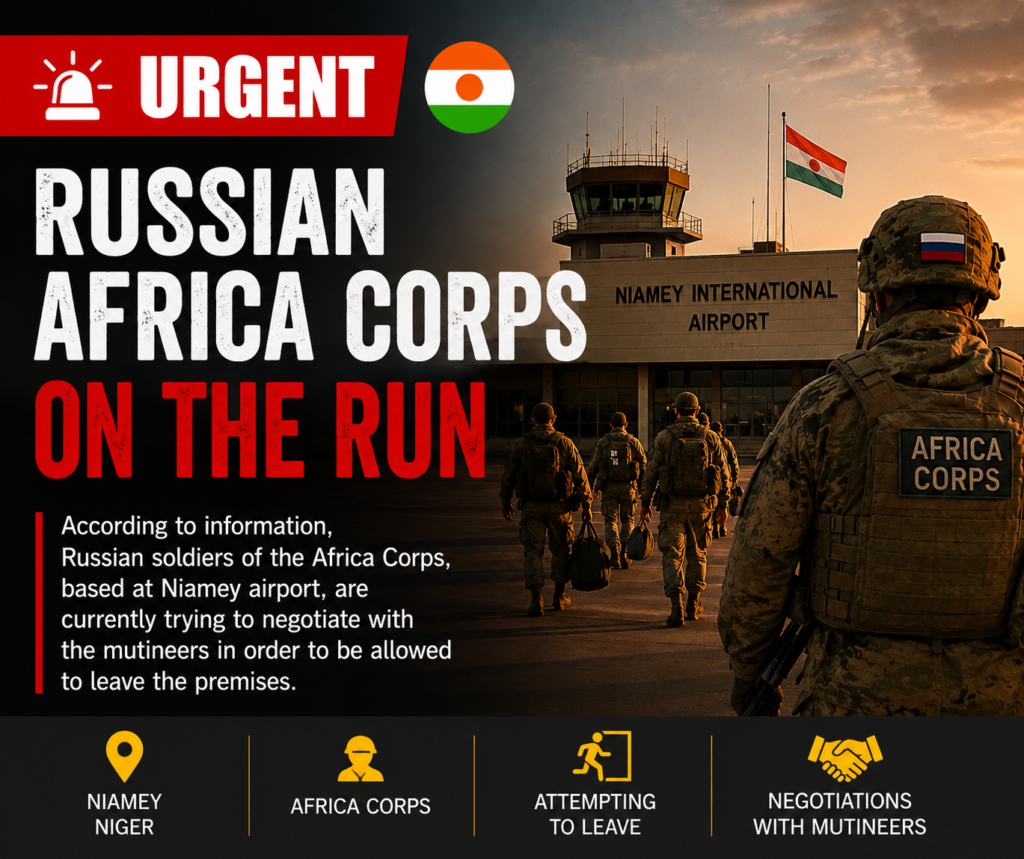
Unprecedented confrontation at Niamey’s Diori-Hamani Airport
The recent exchange of gunfire and heightened military activity near Niamey’s Diori-Hamani Airport have exposed critical vulnerabilities in Niger’s security framework. Reports indicate that elements of the Russian Africa Corps are currently engaged in urgent negotiations with Nigerien military personnel controlling the facility, seeking immediate withdrawal terms.
This developing situation transcends a mere local security incident. It serves as a stark illustration of the inherent weaknesses within the security models adopted by several Sahelian military regimes that have increasingly relied on external military support.
Rethinking the myth of an infallible security partner
Following a deliberate shift away from traditional Western allies, multiple Sahelian juntas have pursued closer ties with Moscow, entrusting significant portions of their security strategies to Russian forces. The Africa Corps, which has progressively replaced Wagner Group operations across several African theaters, was initially presented as a solution to bolster regime stability, enhance leadership protection, and combat jihadist factions.
Yet the unfolding scenario in Niamey raises a fundamental question: How reliable is a security partnership when confronted with internal strife, potential mutiny, or a divergence of strategic interests between the foreign power and local authorities?
Russian interests take precedence in military engagements
Unlike national armed forces, foreign military contingents operate under objectives that prioritize their originating state’s political, military, and strategic interests rather than the long-term stability of the host nation. This fundamental disconnect creates a critical paradox. While a Sahelian regime may perceive Russian involvement as essential for its survival, Moscow may reassess its commitment when the risks to its personnel escalate.
The reported negotiations at Niamey’s airport epitomize this dilemma: when the cost of engagement outweighs perceived benefits, the protection of foreign troops may swiftly become the overriding priority.
The perils of over-reliance on external security support
By heavily investing in an external security partner, military regimes risk replacing one form of dependency with another. The initial promise—greater strategic autonomy, reduced reliance on Western powers, and enhanced territorial control—may prove illusory.
The contradiction is striking. A state claiming to regain sovereignty cannot be truly sovereign if its security apparatus hinges on the presence and decisions of foreign forces. This reality becomes particularly acute when foreign troops occupy strategic locations such as airports, military bases, or logistical hubs. A sudden withdrawal could precipitate immediate security vacuums, destabilizing the very institutions these regimes seek to protect.
Foreign military presence does not guarantee victory
While foreign fighters or trainers can provide temporary tactical advantages, they cannot resolve the structural causes of a security crisis. Effective counter-insurgency operations demand a multifaceted approach, including:
- Reliable intelligence networks capable of identifying and dismantling adversarial structures
- A cohesive and professional national army with robust command structures
- Sustained state presence in rural and peripheral regions
- Strong cooperation with local communities to isolate extremist influences
- Extensive logistical and operational capabilities to sustain long-term campaigns
- A comprehensive political strategy addressing the socio-economic factors fueling recruitment into armed groups
No foreign force, regardless of its technological or combat prowess, can substitute for these fundamental requirements over the long term.
Measuring effectiveness beyond rhetoric
The narrative surrounding Russian military cooperation often emphasizes its transformative impact on regional security dynamics. Yet tangible outcomes must be assessed through measurable indicators: the security of civilian populations, the operational capacity of national armed forces, the frequency and severity of attacks, and the extent of territorial control.
When insurgent activities persist, certain regions remain contested, and military losses continue to mount, the sustainability of such partnerships inevitably comes under scrutiny. The disparity between political promises and operational realities becomes impossible to ignore.
A dual crisis: military and political
The significance of the Niamey episode extends beyond immediate military tensions. It carries profound symbolic weight.
If Russian personnel, tasked with protecting the regime, are compelled to negotiate their withdrawal with local military factions, it exposes an uncomfortable truth: external powers cannot always dictate the internal power dynamics of the nations in which they operate.
This reality underscores a critical limitation of foreign military support: it does not inherently guarantee the cohesion of national armed forces or the political stability of the regime it is meant to sustain.
The erosion of perceived invincibility
Russia has systematically cultivated an image of itself as a decisive, capable, and effective military partner in Africa—one capable of achieving where Western powers have allegedly failed. This narrative rests on portrayals of strength, resolve, and operational success.
However, when a force presented as indispensable and formidable finds itself negotiating its own evacuation, the illusion of invincibility begins to fracture. Such an event sends a powerful political signal:
- Rival factions may interpret it as a sign of vulnerability within the regime
- Military personnel may question the extent of Moscow’s commitment
- Civilians may begin to doubt the tangible benefits of the alliance
Strategic implications for Moscow-aligned juntas
Confirmation of the events unfolding at Niamey’s airport would carry sweeping consequences for juntas across the Sahel that have aligned themselves with Moscow. Several potential repercussions emerge:
Increased exposure to strategic isolation
By severing ties with Western and regional partners, these regimes have significantly narrowed their diplomatic options. If their primary military ally demonstrates reluctance or inability to intervene decisively during internal crises, they may find themselves isolated when confronting critical security and political challenges.
The question evolves from ‘Who will fight the jihadists?’ to ‘Who will truly come to the regime’s aid during a major crisis?’
Heightened vulnerability to internal dissent
A military regime’s survival often depends on the loyalty and confidence of its armed forces. If foreign troops are perceived as either unable to manage crises or unwilling to remain engaged under pressure, their presence may inadvertently undermine the regime’s deterrent capacity.
In a climate marked by internal tensions, factional rivalries, or potential mutinies, such perceptions can prove destabilizing. They may embolden dissent, weaken morale, and erode the authority of the ruling junta.
The financial burden of unproven security models
Military cooperation with foreign powers entails substantial financial costs for resource-constrained states. However, the true measure of a security strategy should not be limited to the number of foreign troops deployed or the volume of weaponry received.
Real effectiveness is determined by tangible outcomes: the extent of territory secured, the level of civilian protection, the prevention of attacks, the reduction in military casualties, and the capacity of national forces to operate independently. When insecurity persists despite rising expenditures, the long-term viability of such models must be rigorously questioned.
The path to sustainable national defense
The Niamey incident serves as a sobering reminder: changing foreign alliances does not, in itself, forge a durable defense policy. Security is not merely a function of external support; it is rooted in the strength, cohesion, and professionalism of national institutions.
A resilient defense architecture requires:
- A professional and unified national army with clear chains of command
- A robust intelligence system rooted in local knowledge and trust
- Sustained state engagement in marginalized regions
- Strong social cohesion between military forces and civilian populations
- The capacity to govern effectively across the entire national territory
External support can serve as a valuable complement but can never replace these foundational elements.
Niamey as a cautionary tale
Should the reported negotiations at Niamey’s airport be confirmed, the incident may transcend a localized security concern. It could emerge as a definitive warning to all Sahelian regimes that have staked their survival on foreign military partnerships.
An external power can supply arms, advisors, combat troops, and political backing. Yet it cannot, by itself, guarantee regime stability, military cohesion, or victory over insurgency.
The deeper question facing these juntas is both urgent and existential: What occurs when a partner portrayed as essential prioritizes its own interests above those of its ally?
The episode unfolding in Niamey may reveal the core weakness of this security model: replacing one dependency with another without addressing the internal vulnerabilities that perpetuate the crisis.