A sharp escalation in political discourse has emerged in Gabon as activist Landry Mbeng, operating under the alias Lanlaire, faces fierce backlash for his recent inflammatory remarks targeting President Brice Clotaire Oligui Nguema, his wife, and notably his mother. The latest wave of criticism comes in response to statements that many view as crossing a critical ethical line—one that transcends mere political opposition.
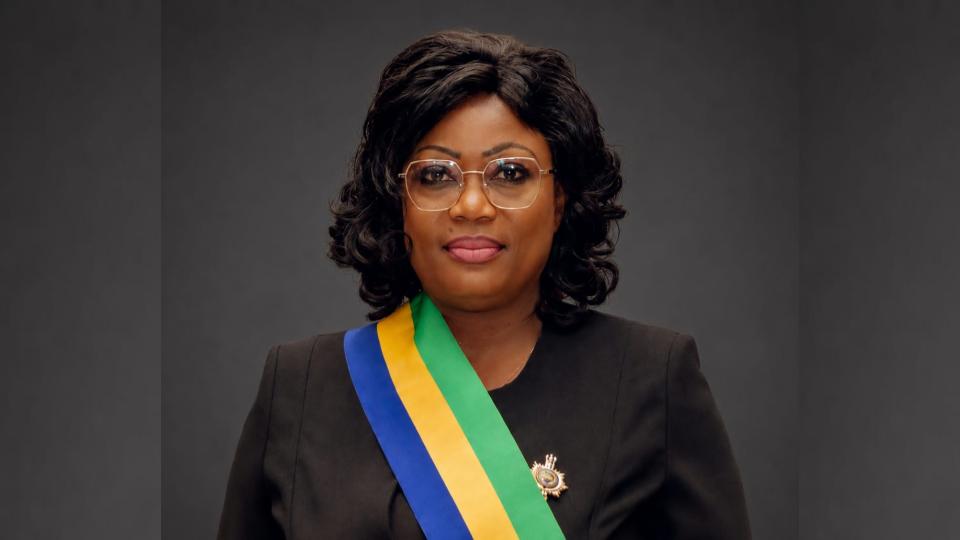
Gabonese lawmaker Daisy Léance Akinikoussou, representing the second constituency of the Plateaux department, has taken a definitive stand against these attacks. In a strongly worded statement titled “It’s time to say: enough!”, she condemns what she describes as a dangerous erosion of boundaries between vigorous political debate and personal attacks on the families of public officials.
Where should the line be drawn?
At the heart of Akinikoussou’s argument is a fundamental question: Does the right to criticize a leader justify targeting their family? Her answer is unequivocal—no. As Secretary-General of the National Network of Women Parliamentarians (RENAFED), she emphasizes the need to uphold a clear distinction between robust political confrontation and attacks on the personal dignity of leaders’ relatives. For her, the mother of the President, like any citizen, deserves protection from insults and humiliation simply because of her familial ties.
The timing of her intervention follows the circulation of remarks attributed to Lanlaire, which she describes as a deliberate crossing of a red line. In her view, attacking the President’s mother isn’t just an assault on an individual—it sets a precedent that threatens the dignity of all women in public life.
Defending a principle, not a person
Akinikoussou frames her opposition not as support for President Oligui Nguema’s policies, but as a defense of a universal principle: the inviolability of human dignity. She asserts that criticizing the President’s governance is entirely legitimate, but that the boundaries must be respected. “We can challenge the President, reject his decisions, and oppose his actions with the utmost firmness. But his mother, solely by virtue of being his mother, is not a political actor,” she argues.
Her stance reflects a broader commitment to gender equality, rooted in RENAFED’s mission. “The fight for women’s rights cannot be selective,” she declares. “We must defend all women—including those whose views, alliances, or family ties we do not share.” This position underscores her belief that defending women’s dignity is an absolute, not a conditional obligation.
The ripple effect of unchecked verbal violence
Akinikoussou warns that tolerating such attacks today risks normalizing them tomorrow. What begins as targeted verbal aggression against the family of a head of state could, without strict limits, extend to critics, journalists, activists, or ordinary citizens. “Today, it’s the President’s mother. Tomorrow, it could be the mother of an opponent, a journalist, or any private citizen,” she cautions. Her message is clear: once the threshold is crossed, the consequences could spiral beyond control.
Her call to action is not about shielding political leaders from scrutiny. Rather, it is a plea to preserve the integrity of democratic discourse. “In a democracy, ideas must be contested fiercely—but never at the expense of human dignity,” she states. The alternative, she warns, is a public sphere where no boundaries remain, and where personal attacks replace meaningful debate.
Restoring balance to political confrontation
Her intervention arrives amid growing concerns about the deterioration of online discourse in Gabon. While political disagreements are inevitable, the recent surge in attacks on public figures’ families has prompted soul-searching across civil society. Akinikoussou’s message is both a warning and a corrective: “It’s possible to be a determined political adversary without becoming an enemy of human dignity.”
In her view, democracy thrives when ideas are debated, not when individuals are dehumanized. Her stance challenges Gabonese society to reflect on where the line should be drawn—and to ensure it is never crossed again.

More Stories
Can West Africa’s peace strategy survive without stronger regional unity?
Will Togo’s Faure Gnassingbé broker the breakthrough east DRC needs?
Can Nigeria’s military campaign end the kidnapping economy in the north?