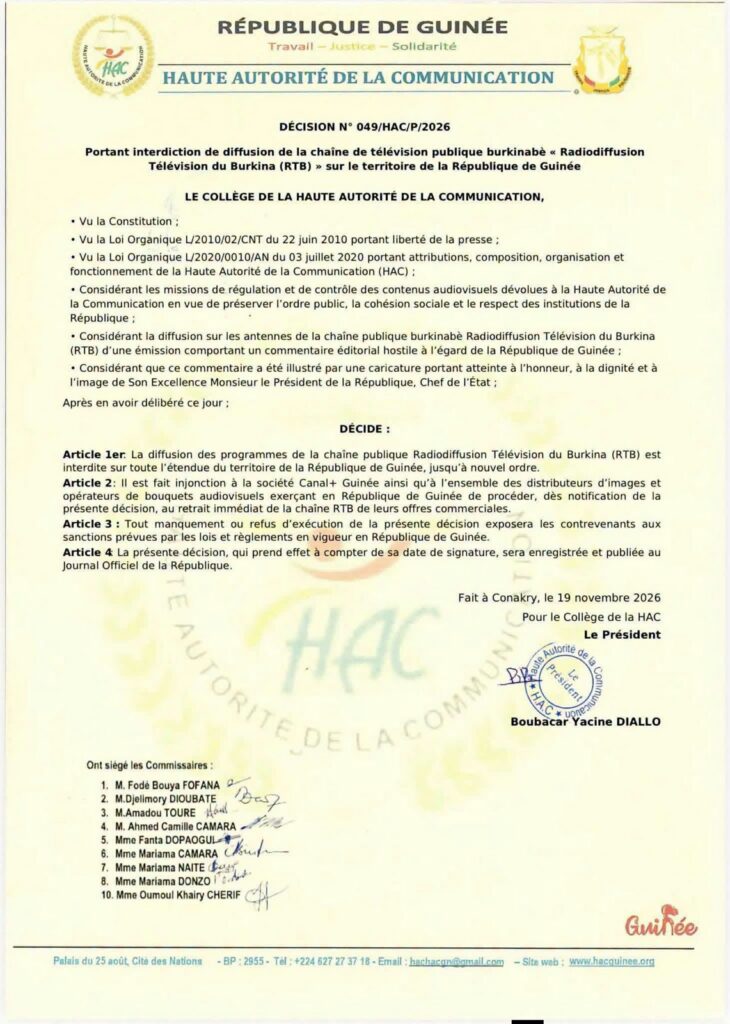
The decision by Guinea’s High Authority for Communication to suspend the broadcasting of Burkina Faso’s public broadcaster (RTB) nationwide raises urgent questions about the role and responsibility of state-funded media in an era of political polarization.
When propaganda overshadows journalism: the erosion of public trust
Public broadcasters are meant to serve as pillars of democratic societies, providing citizens with balanced, accurate, and impartial information. However, when such institutions are perceived as tools to advance political agendas rather than fulfill their informational mandate, their credibility is irreparably damaged.
The suspension of RTB’s broadcasts in Guinea follows a pattern of growing concern across West Africa: the blurring of lines between journalism and political communication. Instead of promoting diverse viewpoints and fostering public debate, state-controlled media often resort to selective reporting, personal attacks, and one-sided narratives that prioritize regime interests over truth.
Citizens rely on public broadcasters not as mouthpieces for governments, but as trusted sources of information capable of holding power to account. When a media outlet fails in this duty, its very existence becomes a contradiction in terms.
Beyond borders: the ripple effects on regional media standards
This incident is not merely a bilateral dispute between Guinea and Burkina Faso; it reflects a broader crisis in how public broadcasting is administered across Africa. The RTB suspension underscores a critical dilemma: can state-funded media claim to uphold national sovereignty and citizen welfare when their content is weaponized to serve political ends?
Media integrity is not a theoretical concept it has tangible consequences. Disinformation erodes trust in institutions, fuels societal divisions, and undermines democratic governance. When public broadcasters abandon journalistic ethics in favor of propaganda, the cost is borne not only by the media landscape but by the public at large, who are denied access to reliable information.
What is the future of public broadcasting in West Africa?
Guinea’s decision to halt RTB broadcasts sends a clear message: the unchecked misuse of public media cannot go unchallenged. However, this action alone does not resolve the underlying issue. True reform requires enforceable standards that separate journalism from political messaging and ensure that public broadcasters operate in the public interest, free from undue influence.
The path forward must prioritize transparency, professional ethics, and accountability. Without these foundations, public broadcasting risks becoming a relic of a system that values loyalty over truth leaving citizens in the dark and democracy weakened.
By Marguerite Ndongo — Journalist